
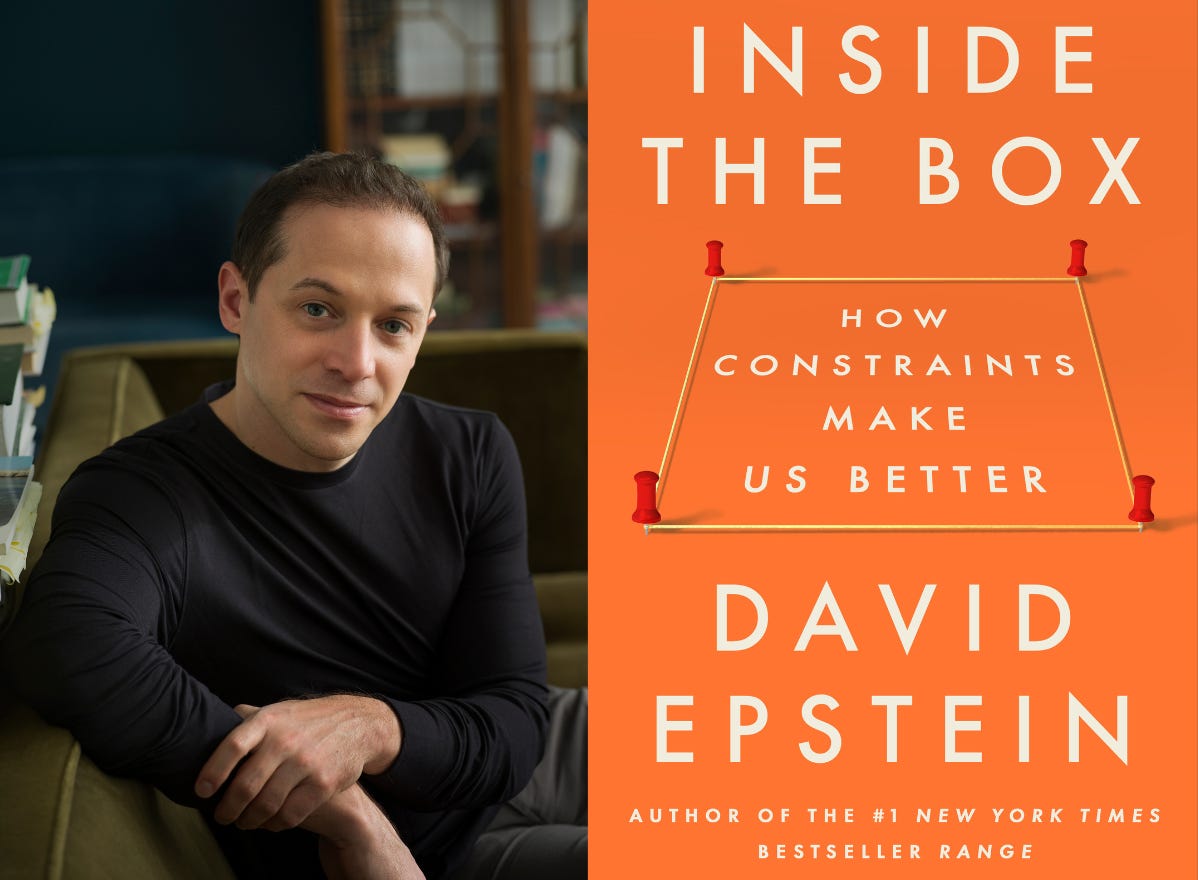
David Epstein doesn’t just study how people learn and grow—he road-tests it. A former ProPublica reporter and Sports Illustrated writer, he’s chased down steroid scandals, Arctic research projects, and big questions about how talent really develops. His first book, The Sports Gene: Inside the Science of Extraordinary Athletic Performance, explored the biology and environment behind elite talent, challenging myths about what makes greatness possible. His follow-up, Range: Why Generalists Triumph in a Specialized World, widened that lens, arguing that curiosity and breadth, not early specialization, are the true engines of mastery.
His forthcoming book, Inside the Box: How Constraints Make Us Better (scheduled for release in May 2026), turns that idea on its head, exploring the paradoxical power of limits and how rules, structure, and friction can actually make us more creative.
In this Author Insider Questionnaire, David talks about architecture versus improvisation, learning from critics, and why a good constraint might be the most liberating creative tool of all.
21 Questions with David Epstein
1. I couldn’t have written my last book without…
A structural plan. With my first two books, I was more of a gardener (throw down a seed and see where it takes you) than an architect. This led to things like writing entire chapters that I then had to cut, because in the end, they didn’t fit a coherent structure. (I had to cut a reporting trip to Arctic Sweden from my first book!)
Being a parent now, wanting to write more efficiently and also wanting to write a more coherent book with more economical storytelling, I spent a long time creating a structural plan this time around before writing, and I stuck to it. It led me to write in order for the first time in my career. Harrowing to have a new process after more than a decade of book writing, but it was incredibly engaging, much more efficient when I got to writing, and I think without question the new book is my best work from a craft standpoint. I would never not do this again.
And, after all, the book is about helpful constraints, so the medium is the message.
2. What’s the thing most people get wrong about being a writer?
To be honest but crude: probably the amount of money that bestselling writers make, at least from book sales alone.
But on a more interesting note, a lot of people approach me and say they want to write a book, and it becomes clear pretty quickly that they view writing as a form of self-expression, and maybe a break from their “real work.” And that’s great! But I think that is very different from what I and most of my peers are doing.
I find my work incredibly engaging and enriching, but I do not view it primarily as self-expression, and I do not view it as a break. It requires a lot of self-discipline. You’re the boss and the employee—all the employees, in a sense. Like Murakami, I find that I need to train my body to get ready for the few-year drive of writing a book.
3. What’s something you wish you’d started doing five years ago?
Being a lot more serious about my circadian rhythm during winter! I actually love to read and write in the wee hours, but if I want to focus intensively and over a long period, I need to get myself on a pattern that includes getting up and active right away in the morning, getting some sunlight, and having a no-screen wind-down routine that often involves reading something I love but have already read so there’s no suspense (John Williams’s Stoner is the pick of the moment). I now go to sleep with some workout clothes on, because then I wake up and I’m like, well, I’m not going to change now so might as well run.
4. Hemingway wrote standing up; Edith Wharton, lying down. What are your quirks?
I don’t really have any fun quirks like that, and can write in many environments. These days I much more often write without music on, based on some things I learned about attention and working memory while researching the new book. I also basically don’t write for about the first year of a book, just research and organize information, so maybe that’s a quirk!
5. Do you read your reviews?
I think I’ve probably read most of my reviews in mainstream outlets. It’s a treat when someone engages seriously and writes a review. As Borges said, good readers—who engage with a work and expand its meaning—may be rarer than good writers.
That said, getting your arms around the mass of internet reviews—I’m not up for that. A fellow author told me about a study on how the first Amazon review has an outsized impact on a product. For my last book, in the US my first review was five stars, and in the UK it was one star. The book sold better in the US!
6. What income streams make up your writing business?
Books and speaking. I think I’m probably quite rare among nonfiction authors in that I’ve made more from books than speaking.
7. Is there a book you wish you’d written?
Ulysses! I mean, seriously, but I think James Joyce was the right guy for the job.
In that vein of the right writer for the job: Alex Hutchinson wrote a book called Endure about the role of the brain in endurance. That’s a book I was thinking of writing, and actually talked with him about the topics quite a bit. But he did a fantastic job, so now I wouldn’t want anyone else to have done it but him. He’s basically the Canadian me but taller. What’s not to like?!
8. Have any tech tools made your job easier?
I used Scite.ai quite a bit while researching the new book. Basically, it allows you to search or upload a paper, and—to simplify—it makes a citation map of papers that cite that paper. It also creates a list of “citation statements”—little excerpts where you can see how other papers cited your paper of interest.
I used to do this by collecting all these papers manually and searching for the mentions to understand the landscape around a particular area of research, and figure out the names and topics that recur. So I’d say this turned what was often a day of research into maybe two hours in some cases.
9. What new tools or distribution channels do you want to try?
In the past, I’ve been video-averse. But now I’ve decided I want to try YouTube. I’ve found myself engaging with really thoughtful content on YouTube, from literary criticism to visualizations of mathematical concepts, to videos that deliver takeaways from research in a similar fashion to what I do in books. So early next year I’m going to start making some videos based on concepts in my books, including the one that isn’t out yet.
10. Where do you find new ideas?
I see ideas everywhere. Most people I talk to and things I read prompt some new thought. When I was at ProPublica, Stephen Engelberg told me that it was clear my problem wasn’t going to be coming up with ideas, but choosing which ones to try to execute. He was right.
11. How do you keep track of new ideas?
I have this thing I call a “master thought list” for each book project. It’s basically a place I dump interesting things: thoughts, quotes, stats, citations, etc. And I start moving similar ones toward each other, and eventually put them under a “tag” that is basically a concept name, and then I seed the document all over with words I think I would search if looking for a particular idea.
It becomes almost like a wiki of my brain with respect to this project. (And yes, I’ve used Roam, but I actually find this doc easier if I do the seeding well.) Eventually, I move related tags toward one another and end up with a bit of a storyboard. For the new book, the master thought list is about 30,000 words longer than the actual book.
12. What’s the best piece of professional advice you’ve ever received?
“I have the luxury of learning from my critics.” Malcolm Gladwell said that to me. He and I first met for a debate, where I was his critic. Then we became running partners, debate partners, friends, and even co-authored an editorial in, of all places, the Journal of Ophthalmology. He was talking about himself, but he set an example for me of how to learn from one’s earnest critics rather than getting defensive.
13. And the worst?
To brand myself as “The Sports Gene” guy after my first book was a surprise bestseller. I’m not saying that would have been bad advice financially or whatever—I just don’t know—but my learning was already plateauing in that area, and I felt like that book was my sports capstone project, addressing my own deepest questions about sports.
I’m a big fan of taking advantage of the early part of the learning curve in many different areas. So right when that book came out, I was already leaving Sports Illustrated for ProPublica. Now, that was a bit abrupt.
Some other bad advice was that I would only need two weeks between those jobs to deal with the book publicity. Whoops!
14. What is the one piece of advice you would give to recent graduates who want to make a living as writers?
Short-term optimization can undermine long-term development. Make career moves that broaden your skills—freelancing early on forced me to write in many different voices, which was fantastic. And I changed jobs a bunch of times (I left my cushy staff writer gig at Sports Illustrated to be an intern at ProPublica for a while because I could learn), and took online fiction writing courses. Build your toolbox for adaptability in the long-term. Never mind landing whatever you think your dream job is right away.
15. What’s on your nightstand right now?
Oh gosh, a ridiculous and perilously balanced series of piles. But on top and closest to my head is The Rise of the Roman Empire by Polybius, and So Long, See You Tomorrow by William Maxwell. Brian Greene’s Until the End of Time is nearby, and fiction and nonfiction collections of Borges never leave the nightstand under any circumstances.
16. Foreign rights, audio rights, film rights: which have been the most valuable to you?
Foreign rights and it’s not close.
17. How did you find your agent?
I’ve had two different agents. The first represented many of my colleagues at Sports Illustrated, so I met him through a colleague. My current agent is actually the only one who ever reached out to me. He read a long feature article I wrote about genetics, and called to say he saw a book there. I was already with another agent, but he was so thoughtful in the discussion that it really stuck in my mind.
Then a few years later I ended up living one floor above novelist Hilary Jordan, in Brooklyn. We became friends, and it turned out the guy who reached out to me (Chris Parris-Lamb) was her agent, and she loved him. That led me to get back in touch.
18. Coffee, tea, or something stronger?
This one hurts. I keep making it my New Year’s resolution to start drinking coffee, and by January 3, I’ve failed. I’m a writer! I should be in coffee shops writing! I should have headaches if I don’t get my coffee in time! But alas—no coffee, no tea. I guess I’m powered by the pure ether of the writing life itself.
19. What’s one marketing tip you’d give a new author?
I think the tip I could have used was to be a little less shy about asking for reasonable favors. I was so sheepish about that early on. It’s still tough, but it’s not like we’re pushing b.s. dietary supplements on people. If you’re polite, your asks are reasonable, and you respect the no’s that people give, it’s okay to ask on behalf of work you believe in. Doesn’t mean it’s easy, at least for many of us.
20. What is your new book about?
It is about how constraints can actually be useful rather than just limiting in bad ways. It ranges from the neuroscience of why the form of a haiku liberates creativity rather than stifles it, to social constraints that gave rise to the modern economy by allowing strangers to trust one another. I think of the three buckets in the book as: creativity, collaboration, and contentment.
21. Any new projects the Author Insider community can help support?
Yes! The new book I just mentioned. I have no clue how the ideas will resonate—that’s for readers to decide. But from a writing craftsmanship standpoint, I’m confident this is my best work. I tried a new structure, and I think it worked well, and I’m proud of it in a way that I was not at this stage with my other two books.
Thanks to David for sharing his reflections on writing, research, and the strange magic of constraints. His answers remind us that limits don’t just box us in—they sharpen our focus, clarify what matters, and sometimes spark the best work of all.
Inside the Box: How Constraints Make Us Better will be published by Riverhead in May 2026. (But you can pre-order it now!)
Want More Insights?
If you enjoyed this 21 Questions feature, you’ll love the rest of Author Insider—real talk, publishing insights, and creative wisdom from bestselling authors and industry pros.
Subscribe free (or paid, if you’d like to support our work) and join the community.
Until next time,
Panio Gianopoulos

Editorial Director, Author Insider & The Next Big Idea Club