

Book launches are hard. They take a huge amount of effort, rarely go as planned, and often leave authors wondering whether all that time and money were worth it. It’s easy to feel like everything depends on launch, and that if the book doesn’t take off during those first few weeks, its chances are over.
To be fair, the whole pre-order system—where all advance copies sold are counted in the week the book is released—logically pushes toward a super-aggressive rollout. And yet, just hear me out, if everyone is doing the same thing, doesn’t that basically cancel out any potential advantage? It’s like when athletes use performance-enhancing drugs; sure, you’re keeping up, but you’re not winning because of the drugs.
Regardless, I’m not arguing to pull back on your launch strategy. By all means, hire a publicist, go on dozens of podcasts, flog the book on your newsletter, do a little dance on TikTok if you’ve got some sweet moves. But you should also have a longer-term strategy in mind, on the off chance that your book, one of the four million published in the US every year, isn’t an immediate triumph.
Recently, I interviewed Michael Bungay Stanier, author of The Coaching Habit, about book launch strategies. Michael’s book has sold millions of copies and is widely regarded as the best-selling book on coaching of the century, continuing to find new readers nearly a decade after its release. He had some intriguing insights and strategies for keeping a launch going (or restarting it), four of which I’m sharing below.
N.B. While Michael’s experience is specifically with books in the business/self-help/leadership categories, many of these strategies apply to other genres, too—they just might need some tweaking.
1. Optimize for recommendation, not attention

Launch strategies tend to aim for maximum visibility. They’re built around getting as many people as possible to notice the book as quickly as possible.
But attention fades very fast. What sustains sales over time is something much quieter and less exciting: the book continuing to solve a real problem for readers. When a book becomes genuinely useful—something people return to, apply, or reference—it stays in circulation long after the launch cycle ends.
Here’s the concept that Michael emphasized: the moment that really matters isn’t when someone buys your book for themselves. It’s when they buy it for someone else. The shift from personal consumption to recommendation signals trust. It means the book has crossed a threshold from “hmm, interesting” to “you have to read this!”
Authors often obsess over early metrics like sales rank or reviews (when my first book was released, I was transfixed by an app that refreshed its Amazon ranking hourly). But if you’re going to obsess over something, it should be whether people are sharing your book with others.
2. Authors without massive platforms often spread themselves too thin

When you don’t have a large audience, the instinct is to try to be everywhere at once: more platforms, more posts, more interviews, etc. Besides leading to burnout, it isn’t very effective at building momentum.
Michael’s approach is the opposite. He argues that authors without big platforms benefit most from focus—a clear audience, a clear problem, and a clear promise. Trying to appeal to everyone weakens word of mouth. Serving a specific group strengthens it. Momentum builds faster when readers know exactly who the book is for and why it matters.
3. Design your publicity strategy to encourage discussion

Another key idea from our conversation: books that last tend to be used and discussed, not just read. They give readers something they can bring into conversations—with friends, family, colleagues, clients, and teams. When a book becomes something that people use with others, it naturally gets recommended, shared, and revisited.
Luckily, this doesn’t require building a big platform or ecosystem or recording an elaborate online course. It can be as simple as:
Crafting discussion questions or exercises (you can offer them as a free PDF on your website)
Creating a framework that people can easily share (also a good PDF candidate)
Running free livestream/virtual events about how to apply the ideas
Don’t think of your book as the end product. Think of it as one element of an experience.
4. You can relaunch your book whenever you want

One of the most liberating takeaways from our conversation is that books don’t expire the way authors often assume they do. Re-launching an older book doesn’t require rewriting it or manufacturing novelty. It just requires a fresh frame: a new audience, a new context, or even just an arbitrary milestone that gives people permission to look again.
Has it been five years since your book came out? Relaunch it.
Hit 10,000 copies sold? Relaunch it.
New year? New cohort of readers? A cultural moment suddenly makes your topic relevant? Relaunch it.
Of course, unless you’re self-published, there are constraints. You can’t just decide to print an updated edition of your book. (Though if you do, you should probably add some new material. In the newly released 10-year-anniversary edition of The Coaching Habit, Michael included three new chapters and illustrations)
Regardless, the point isn’t to update your book. It’s to re-present your book to the world.
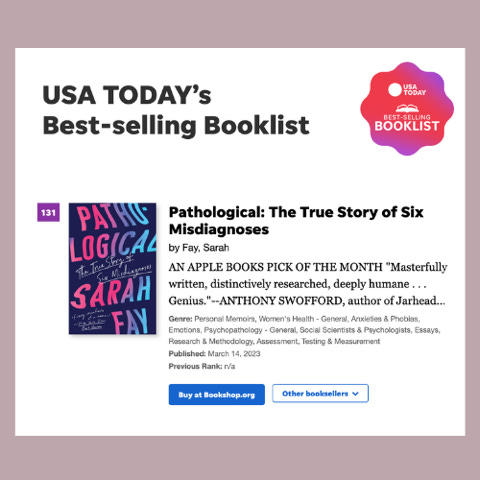
Here’s my favorite recent example: Sarah Fay originally published Pathological: The True Story of Six Misdiagnoses in March 2023. A little over two years later, after building a substantial and highly engaged Substack following, she relaunched the book (July 2025), and it became a USA Today bestseller.
Your book doesn’t have just one moment. It has as many moments as you’re willing to create for it.
More from Author Insider
Author Insider is where writers get the real story of publishing: thoughtful conversations with bestselling authors and industry insiders, clear-eyed analysis of where the market is headed, and practical strategies for building a sustainable writing career. Whether you’re just starting out or several books in, the goal is the same: helping you make smarter decisions about your work.
If you’re new to Author Insider, here are a few reader favorites:
Until next time,
Panio Gianopoulos
Editorial Director, Author Insider & The Next Big Idea Club
Panio: I'm so happy to see Sarah's book profiled in your newsletter! As a Sarah Fay fan, follower, and admirer (and student), I witnessed the re-launch rollout after I had already read her book. Sarah is inspiring as a writer, champion for other writers, Substack Writers-at-Work guru, and someone dedicated to doing the work.