
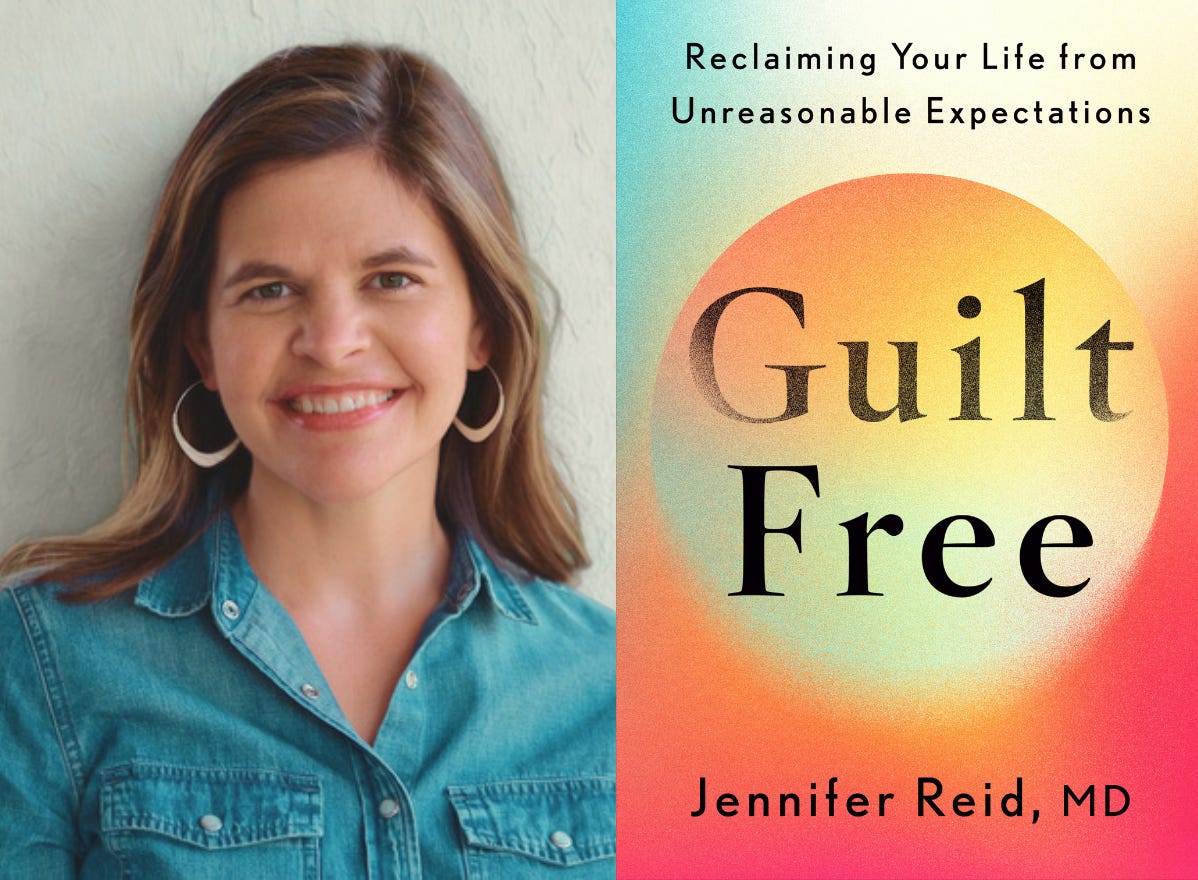
After years of sitting across from women carrying invisible burdens, psychiatrist Jennifer Reid noticed a common thread: guilt.
Guilt for working too much. Guilt for not working enough. Guilt for saying yes. Guilt for saying no. Guilt for complaining about feeling guilty (yes, it gets that meta). It’s a shape-shifting emotion that seeps into every role women occupy and quietly erodes their sense of joy and self-trust.
Drawing on years of clinical work, research on emotion and social conditioning, and her own lived experience as a working mother, Reid asks a radical question: What would life look like without the constant, crushing weight of guilt? Through her SPEAK framework, she offers women a practical path toward loosening guilt’s grip and reclaiming agency over their choices.
Here, Reid answers 21 questions about writing between orthodontist appointments, raising boys while researching women’s mental health, ignoring unhelpful advice that begins with “Well, since you’re a woman…,” and helping people step out of over-functioning and into something freer.
21 Questions with Jennifer Reid
1. I couldn’t have written my last book without…
The thousands of patients I’ve seen as a psychiatrist, sharing their challenges and frustrations, as well as their successes and growth. It’s an incredible honor to sit in a room with someone who trusts me enough to open up, often about experiences or fears they haven’t shared with anyone before. My book grew from these conversations, especially with women, where I noticed recurrent themes around guilt, self-criticism, and a sense of overwhelming responsibility.
2. What’s the thing most people get wrong about being a writer?
I think there is a common misconception that you need some external source of validation, such as a book, a paper, or some kind of certification, to call yourself a writer. I suppose many of us like to have a clear path to credibility, but writing doesn’t necessarily work like that. It can be a pleasurable catharsis, a way to inform others, a creative expression, and so much more.
During medical school at Columbia, I took a course with Dr. Rita Charon, one of the pioneers of Narrative Medicine. I was very science-focused in college, so this was one of the first writing classes I took, and I was deeply inspired by Dr. Charon’s commitment to combining medicine and the arts, challenging the idea that physicians couldn’t benefit from creative activities.
3. What’s something you wish you’d started doing five years ago?
Feeding the birds in my yard. It is such a wholesome and satisfying way to take a break from writing or other activities requiring deep thought. I’ve never been able to study well in complete silence, needing at least a low level of stimulation to stay on track.
This is why, for the price of a cup of coffee, I spent countless hours in a little coffee shop studying for the MCAT. (Shout out to Michelangelo’s Café in Madison, WI!) When I needed a break, I’d look up and see what was happening at the counter, or who may have walked in while I was absorbed in some biological process. Now, I can take a break and look out at the cardinals, house finches, and woodpeckers eating from the feeders, and it helps me re-center and then get back to work.
4. Hemingway wrote standing up; Edith Wharton, lying down. What are your quirks?
My approach to writing probably echoes that of many working mothers around the world. Essentially, I write whenever and wherever I can find a quiet moment. This has included the orthodontist’s office, the dentist’s office, my son’s tennis lesson, my other son’s trumpet lesson, my gym, the library, several local coffee shops, multiple airports, in my car, and a Six Flags Great Adventure park while my sons rode brain-jumbling roller coasters. When I read about writers who have a designated study where they spend several focused hours a day, I can’t help but smile. Maybe one day…
5. Do you read your reviews?
I imagine I will, but only occasionally. This has been my approach to reviews from patients, residents, medical students, and other trainees. I always remind myself that people are allowed to have their opinions about me, and the only way to be free from others’ judgement is to stop trying. I’m certainly not immune to negative reviews, but some stick with me longer than others.
For example, my eldest son, during a period of heavy Roald Dahl consumption, was upset with me about something dinner-related and drew an unflattering portrait of me, labeled, “Mom is a TWIT,” which I found hilarious. That Post-it is still stuck to the wall in my closet, and continues to make me laugh.
6. Is there a book you wish you’d written?
When I read Why We Sleep by Matthew Walker, Ph.D., I was absolutely blown away. If you think about it from an evolutionary standpoint, our need to spend up to eight hours each night unconscious and vulnerable suggests a fascinating truth: the risk of these hours must be outweighed by the powerful benefits of sleep.
He so clearly describes the mechanisms of sleep, how it affects our entire body, from the immune system to our metabolism to our risk of cancer and heart disease, not to mention our mental health. If I had written this excellent book, I would be insufferable with knowledge at the family dinner table.
7. What new tools or distribution channels do you want to try?
This is a little embarrassing to admit, but I’ve always loved singing and performing, so I have a not insignificant desire to create TikTok videos where I sing about concepts of mental health and women’s experiences throughout their lives. I would call myself the “Singing Shrink,” and I might even incorporate some dance moves. This is currently on the back burner because my kids would be mortified. Maybe when they leave for college.
8. Where do you find new ideas?
One of the beautiful aspects of my work as a psychiatrist is that I’m surrounded by fascinating human behavior. Brief conversations in the grocery store, an overheard argument at a neighboring table in a restaurant, or meetings at my children’s school can inspire an essay or future chapter.
I’ve also written several humor essays, which tend to be inspired by responses to my aging body or mischievous kids, or perhaps a long conversation with my older sister about the hazards she encounters caring for her kids and many pets, including two donkeys, a hedgehog, a bearded dragon, and a flock of chickens.
9. How do you keep track of new ideas?
I tend to purchase bright, new notebooks and then set unachievable goals such as “I will carry this with me everywhere and write down ideas.” Inevitably, I lose the notebook, can’t settle on the ideal pen, or simply forget the plan in the general bedlam of life. Occasionally, ideas jump into my head when I actually have time to sit down at my computer and at least sketch out an essay. These are very exciting moments, like spotting a rare bird at our birdfeeder.
10. What’s the best piece of professional advice you’ve ever received?
My husband and I like to quote our CPR instructor from medical school, who told us, “You know, sometimes it’s a profession, sometimes it’s a career, and sometimes it’s just a job.”
I continue to find this helpful because any choice you make in your working life will have days when things go wrong, you feel disconnected and unmotivated, and you dream of opening your own bookstore (this last one might be more specific to me). Remembering this quote is a reassuring reminder that I don’t have to feel deeply engaged and satisfied every single day of my career. On the days it just feels like a job, I can finish my work, set it aside, and connect with another aspect of my life, because we can’t find absolutely everything we need in our work.
11. And the worst?
Anything that starts with “Well, since you’re a woman…” because I’ve found the rest of the sentence tends to limit my options, suggest I should focus on whatever they believe the ideal woman should do, or incorporate my appearance into my list of qualifications.
12. Whose career do you most admire and why?
My maternal grandparents. My grandfather was a physician, and my grandmother was a nurse, and they cared for their entire community in rural North Dakota, beginning in the 1930s. Because they were the only shop in town, my grandfather delivered babies, set broken bones, carved dentures, and even provided the occasional veterinary service as the pet owners looked on. My grandmother was known for her painless shots and ability to feed their six kids, plus whoever wandered in from the neighborhood, without any outward sign of distress. They were a remarkable duo, and I think about them often, especially when I need a little courage in my own endeavors.
13. What’s on your nightstand right now?
At this moment, I’m reading a memoir, Arundhati Roy’s Mother Mary Comes to Me, as well as The Social Conquest of Earth, by Edward O. Wilson. Mother Mary Comes to Me is a remarkable story about the author’s mother, a complicated yet fascinating woman who loomed large s lives. Ms. Roy’s intimate and honest description of even her most difficult moments with her mother are so compelling, like sitting with her in a therapy session as she shares her oldest memories.
I checked out E.O. Wilson’s book after a recent visit to the Harvard Museum of Natural History, which housed his office for decades. It is an incredible museum, and his legacy of scientific inquiry is present throughout. This book is a comprehensive description of the origin of the human species, particularly our complex social networks, and he compares us to ants, his particular expertise, with wisdom and excellent storytelling.
Lastly, I forgot to mention that I recently found a used copy of the Prehistory Far Side Gallery by Gary Larson, which is hilarious and a favorite of the entire family.
14. Coffee, tea, or something stronger?
Coffee, for sure. One of my favorite ways to start the day is when my husband wakes first (which is often, because he’s a surgeon) and brings me a fresh cup of coffee so strong, the smell alone wakes me. He knows just the right amount of cream I like, and chooses a favorite mug to present. It’s just lovely. My second cup of the day is typically at my desk after lunch, not quite as delicious, but helpful to prevent an unscheduled afternoon nap.
15. What’s the best non-writing skill that’s helped your writing career?
As a psychiatry resident at UCLA, I remember receiving some feedback from my supervising attending, which, on the surface, seemed like a compliment, but his tone suggested he wasn’t so sure. He pulled me aside one day and said, “I think you’re honestly the most efficient resident I’ve ever worked with.” I’ve decided to take it as praise, and it has served me well over the years. I can break down tasks into smaller parts and organize my efforts into the best path toward the finish line. Of note, this sometimes interferes with storytelling at cocktail parties, because I just jump to the most salient details rather than building suspense. This is why I leave these kinds of stories to my husband, as opposites most certainly attract.
16. Can you describe your ideal workday?
I begin with a cup of coffee in bed, while I reach for the notebook I always keep on my side table, along with an excellent pen (low-smearing ink because I’m left-handed). After collecting my thoughts on the page, I stroll downstairs and find my kids in the kitchen, preparing themselves (and me) a healthy and filling breakfast, wearing clean, matching clothing, and ready to bike to school.
After they leave, I sit down at my desk for several hours of satisfying writing, the time sailing by as I combine research and insights into something fresh. After lunch, which is definitely not just a bowl of cereal, I receive a call from one of my favorite writers, such as George Saunders, and he says he would be thrilled to join me on the podcast.
After scheduling this recording, I jump on a call with my colleague to discuss our ongoing research project that will revolutionize mental health for women everywhere. After a very promising update, I take a few moments to respond to the emails in my nearly empty inbox. It’s been a terrific day.
17. How does that compare to your actual workday?
I still start with the coffee. My kids refuse to get out of bed, so I turn on every light in their rooms and head downstairs to make them each a bagel, realizing too late that we only have enough cream cheese for one. It’s raining, so I have to drive them to school, spending the next hour inching along the car line in the daily traffic jam.
When I return home, I eat a few bites of their uneaten breakfast, and then remember I left some clothes in the washing machine overnight. They smell, so I start them again, and then head downstairs to my office. I write for a few minutes, but then the neighbor starts up his leaf blower, and the noise is thunderous. Too distracted to continue, I just repeatedly refresh my email while organizing my desk, vowing to work after lunch.
This doesn’t happen because I’ve forgotten that the kids only have a half day of school, and I need to get back in line. Once they’re home, I follow them from room to room to make sure they’re doing their homework instead of watching YouTube on their school computers. Maybe I send off a few emails before dinner, but this is not guaranteed. I take a moment to delete the Gmail warning that my inbox is almost out of storage.
When I can finally go to bed, I decide to write down an idea I had for a new essay, but I can’t find my notebook, and instead, I just fall asleep with the light on.
18. What do you wish you’d known when you were starting out?
I wish I would have realized how long and winding my career would be, and to slow down and enjoy all of the learning each step provided. I also wish I would have recognized that goals are important, but waiting to be happy or feel successful until some particular hurdle was cleared or degree was obtained was a missed opportunity to enjoy my life along the way.
19. What is your new book about?
Guilt Free is about that lurking sense that we, as women, have messed something up, didn’t do enough, or let someone down. It’s about our unreasonable expectations for ourselves, influenced from our earliest years by those who cared for us, and the culture of our time. It’s an explanation to help women recognize why they feel so much guilt, and a step-by-step guide to moving away from this draining emotion, toward more agency, meaning, and joy.
20. Any new projects the Author Insider community can help support?
This book is certainly something I’d love to share with readers everywhere. Also, I started my podcast, A Mind of Her Own, during the COVID pandemic, as a way to cope with personal loss and the negativity I was seeing all around me.
I set out to interview the helpers, people who are working in health care, public health, scientific research, and other areas to try to make this world a healthier, happier, and safer place. It’s been a lifeline for me, and I hope it can be the same for others.
21. Any questions or feedback you would like from authors in the community?
Do you like me? Just kidding, but I’d love to hear what you think of my first book.
More from Author Insider
Author Insider is where writers get the real story of publishing—thoughtful conversations with bestselling authors and industry insiders, clear-eyed analysis of where the market is headed, and practical strategies for building a sustainable writing career. Whether you’re just starting out or several books in, the goal is the same: helping you make smarter decisions about your work.
If you’re new to Author Insider, here are a few reader favorites:
Until next time,
Panio Gianopoulos
Editorial Director, Author Insider & The Next Big Idea Club