
Hello Insiders!
You may already know this, but in addition to running Author Insider, I’m also the Editorial Director of our sister company, The Next Big Idea Club. Over there, we focus on curating the most compelling nonfiction books of the year, titles that combine big ideas with practical takeaways, helping to change how you think and live.
We just announced our latest pick, and it’s a standout:
A World Appears: A Journey into Consciousness by Michael Pollan.
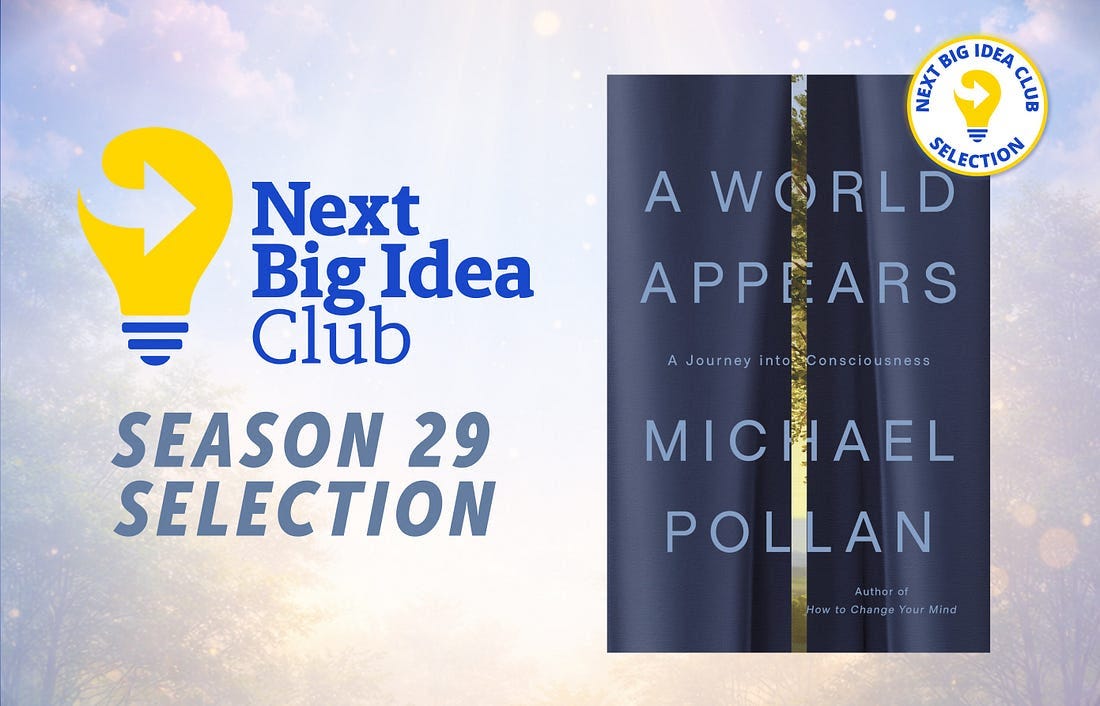
Pollan has written some of the most influential nonfiction of the past two decades (The Omnivore’s Dilemma, How to Change Your Mind, In Defense of Food), and his new one is equally ambitious. A World Appears explores the nature of consciousness through neuroscience, psychedelics, philosophy, and AI. It’s already been named one of the most anticipated books of 2026 by The New York Times and TIME.
A World Appears embodies the new direction we’re taking things this year. We’ve been working hard to make the Next Big Idea Club more timely, more exciting, and more interactive. We want it to be a book club that surprises you, sparks new thinking, and gives you something you can’t wait to talk about with friends.
So what do you get if you’re a Next Big Idea Club member?
A hardcover copy of A World Appears shipped to your door on or around release day (Feb 24)
A personal note from Michael Pollan
An invite to a private Q&A with Michael Pollan on March 10 at 1 PM ET
Copies of all our upcoming official selections, plus exclusive access to live author Zoom sessions (with surprise guest drop-ins from our curators Susan Cain, Adam Grant, Daniel Pink, and Malcolm Gladwell)
Access to our archive of thousands of audio “Book Bites”—quick, 15-minute summaries of the best nonfiction books of the past decade (available in our app)
If this sounds like your kind of thing, we’d love to have you. And as an Author Insider subscriber, you get 20% off a Next Big Idea Club hardcover membership.
👉 Click here to join the Club (Use promo code: AUTHORINSIDER)
Whether or not you join, I thought you might like seeing what’s happening across the hall. It’s shaping up to be an incredible year in books.
Best,
Panio Gianopoulos
Editorial Director, Author Insider & The Next Big Idea Club
It's becoming clear that with all the brain and consciousness theories out there, the proof will be in the pudding. By this I mean, can any particular theory be used to create a human adult level conscious machine. My bet is on the late Gerald Edelman's Extended Theory of Neuronal Group Selection. The lead group in robotics based on this theory is the Neurorobotics Lab at UC at Irvine. Dr. Edelman distinguished between primary consciousness, which came first in evolution, and that humans share with other conscious animals, and higher order consciousness, which came to only humans with the acquisition of language. A machine with only primary consciousness will probably have to come first.
What I find special about the TNGS is the Darwin series of automata created at the Neurosciences Institute by Dr. Edelman and his colleagues in the 1990's and 2000's. These machines perform in the real world, not in a restricted simulated world, and display convincing physical behavior indicative of higher psychological functions necessary for consciousness, such as perceptual categorization, memory, and learning. They are based on realistic models of the parts of the biological brain that the theory claims subserve these functions. The extended TNGS allows for the emergence of consciousness based only on further evolutionary development of the brain areas responsible for these functions, in a parsimonious way. No other research I've encountered is anywhere near as convincing.
I post because on almost every video and article about the brain and consciousness that I encounter, the attitude seems to be that we still know next to nothing about how the brain and consciousness work; that there's lots of data but no unifying theory. I believe the extended TNGS is that theory. My motivation is to keep that theory in front of the public. And obviously, I consider it the route to a truly conscious machine, primary and higher-order.
My advice to people who want to create a conscious machine is to seriously ground themselves in the extended TNGS and the Darwin automata first, and proceed from there, by applying to Jeff Krichmar's lab at UC Irvine, possibly. Dr. Edelman's roadmap to a conscious machine is at https://arxiv.org/abs/2105.10461, and here is a video of Jeff Krichmar talking about some of the Darwin automata, https://www.youtube.com/watch?v=J7Uh9phc1Ow