
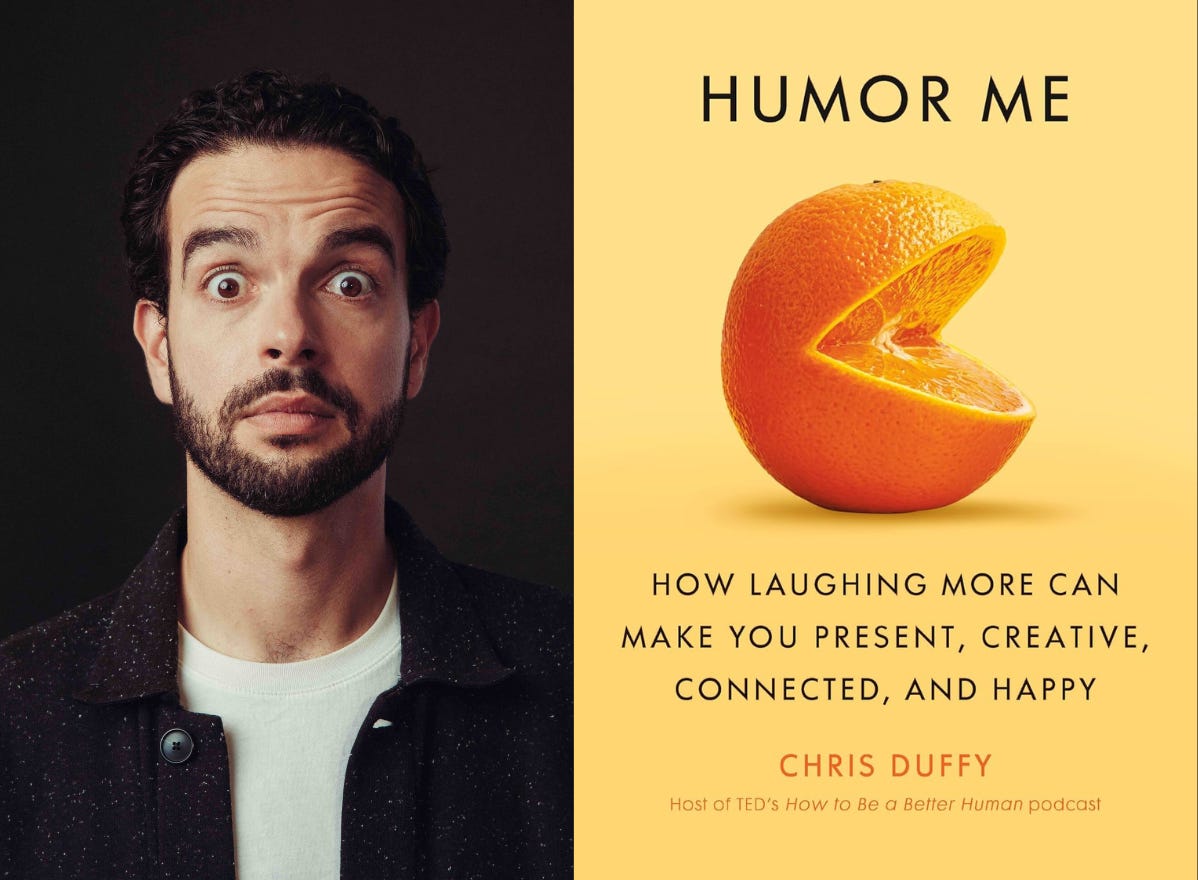
Chris Duffy’s work lives at the intersection of comedy, curiosity, and connection. A comedian, television writer, and the host of TED’s How to Be a Better Human podcast, he’s spent years talking with psychologists, artists, scientists, and everyday people about what helps us feel more present, creative, and connected. Along the way, he’s written for HBO, appeared everywhere from NPR to Good Morning America, and delivered a TED talk on finding laughter in unlikely places.
That mix of humor and intellectual curiosity comes through in his new book, Humor Me: How Laughing More Can Make You Present, Creative, Connected, and Happy. The book draws on conversations with an eclectic cast—neuroscientists, Navy SEALs, clowns, comedians, centenarians, and even a ten-year-old food critic—to make the case that humor isn’t a personality trait you either have or don’t. It’s something you practice.
In his Author Insider questionnaire, Duffy reflects on procrastination as an art form, why editing matters more than talent, and what happens when you stop taking yourself quite so seriously. He also invites readers into his ongoing experiment: paying attention to the small, strange moments that make us laugh when we least expect it.
21 Questions with Chris Duffy
1. I couldn’t have written my last book without…
The looming fear of being yelled at and/or sued by my editor if I didn’t actually write the book I promised her.
2. What’s the thing most people get wrong about being a writer?
Turns out that most of writing a book is actually procrastinating writing a book by doing every other conceivable task inside your home besides writing and then feeling extremely guilty about it. I think people vastly underestimate how much they could get a writer to do for them by simply offering up an activity that is an excuse to not write. If you’re looking for someone to paint your house on the cheap, help you move, or bake you a lasagna, just find a friend who has a book deadline looming.
3. What’s something you wish you’d started doing five years ago?
Investing in stocks that are much higher today than they were five years ago. Unfortunately, if you asked me right now what an example of even one of those stocks would be, I couldn’t tell you. So it turns out that even a time machine isn’t going to be able to make me financially savvy.
4. Hemingway wrote standing up; Edith Wharton, lying down. What are your quirks?
I like that this question is framed as though my only quirks could be the relative horizontal/vertical positioning of my body while writing. You’ll be relieved to know that I wrote almost all of Humor Me while dangling from the ceiling, attached to an elaborate system of harnesses and ropes. A lot of people call me the Hemingway of the rock climbing community, actually.
5. Do you read your reviews?
I know you’re supposed to say that you never read reviews, but I read every review of everything I’ve ever put out publicly. How else would I know what the rock climbing community calls me? And how else would I be able to fixate on even the tiniest, slightest criticism and then wake up thinking about it in the middle of the night for years to come? One time, someone online said under a photo of me that I looked like if Bob Saget and the Tin Man from The Wizard of Oz had a baby, and I’ll think about that until the day I die. I think they’re right.
6. What income streams make up your writing business?
Most of my stable income comes from hosting TED’s “How to Be a Better Human podcast,” and I write the narration and interview questions for those episodes. I also host a live comedy show and write the scripts for that. For years, TV writing was a big part of my income, but between the industry contractions and strikes and the pandemic, that’s become much less reliable for me.
For the past few years, working on this book has been a lot of my focus and time. And then some of the most fun writing I get to do is when I’m hired to give a speech or lead a workshop, and I get to write a customized script for the event with lots of fun inside jokes that only people in the room will get.
7. Is there a book you wish you’d written?
When I read an excerpt from Elizabeth Gilbert’s new book where she talked about how she made so much money off Eat, Pray, Love that she was just casually buying houses for her friends, I was like “Damn! I wish I wrote THAT book!” Impulse buying a house for your friend sounds like so much fun. But as far as a book that makes me jealous on a craft level and I wish I had that mastery and genius, I’ll say Sigrid Nunez’s What Are You Going Through. I have not stopped thinking about that novel since I read it. It’s a funny, heartbreaking work about mortality and friendship, and also at one point, randomly, a cat is the narrator!
8. What new tools or distribution channels do you want to try?
I’m very interested in anything that brings me into face-to-face contact with readers. I want to do as many live shows, book talks, and panel discussions as I possibly can. I want to visit book clubs and schools and libraries and all sorts of places. That’s what’s getting me most excited these days, the direct human connection that you can’t get any other way.
9. How has AI changed your writing process?
AI writing has made me much more hesitant to ever use a bullet-pointed list or em-dashes. I’m trying to write in a way that’s so human that Chat GPT goes “Damn! I wish I had written THAT!” (Side note: I once read a book by Brian Christian called The Most Human Human about a competition where people tried to prove, typing only through a computer, that they were actually a person and not a computer. It’s very funny and interesting, and it came out in 2011 and yet explains more about 2026 than almost any other book I’ve read.)
10. Where do you find new ideas?
I truly find new ideas everywhere, especially in daily life and mundane details. I’m a big believer and huge evangelist for paying close attention to the world around you and noticing the odd, unusual bits that can spark a new idea or just make you laugh.
I learned about the work of Sister Corita Kent from the artist Wendy MacNaughton. I love how Sister Corita used a small cutout rectangle to make herself look more deeply at tiny corners of the world and see as much as she could.
I’m also a big fan of the Dull Men’s Club (now open to all genders), who celebrate their passion for even the most seemingly boring activities like watching paint dry or organizing USB sticks. There’s so much comedy (and so many new ideas) to be found in what we’d otherwise dismiss as unremarkable.
11. How do you keep track of new ideas?
I have a list in the notes app on my phone where I write down everything that strikes me as funny or interesting. I also write a newsletter each week where I share a list with one thing I found interesting, one thing that made me laugh, and one thing that I thought was great. Going back through those archives is very helpful material for me. I try to journal every day as well, but even though I think it’s going to be a way to keep track of new ideas, instead it mostly ends up being a way to flush out my brain onto the page.
12. What’s the best piece of professional advice you’ve ever received?
Doug Berman, the public radio genius who created both “Car Talk” and “Wait, Wait… Don’t Tell Me” was generous enough to meet with me when I was just starting out. I came to him with this big list of questions about how to format audio shows and how to frame comedy for public radio and set up the business and money side of it all. I was getting so deep in the weeds before I’d even gotten started. Doug stopped me and told me the single most helpful thing anyone has told me to date. His advice was that the only thing you need to worry about when you’re making work for the public is how to make something that’s good enough that a person who doesn’t know you would recommend it to another person who doesn’t know you. If you can do that, you’re going to be a success.
13. And the worst?
The worst piece of advice probably has to do with how important business cards are because I printed like 300 in 2012 and I still have 298.
14. What is the one piece of advice you would give to recent graduates that want to make a living as a writer?
There is no set path in creative work so anything that has worked for me might very well not work for you. But two general guidelines that I have found to hold true for almost every writer and artist I know are: 1) to treat other people well and 2) to worry less about making one perfect masterpiece (which often is so intimidating that you never do it or put anything out into the world) and instead to focus on getting better by making art. That is to say, write a lot!
It’s ok if your first essay is awful and your twenty-seventh essay is bad, because the way you get better is by doing it consistently and improving in small, often imperceptible ways over time. It’s much better to have written 100 not very good things than half of one potentially good one.
Writing is a practice, and I have much more admiration for the person who completes a terrible, plot-hole-ridden self-published novel and is working on another than the person who has been talking about their brilliant idea for a decade but never actually puts words on the page. Embrace the beautiful humiliation of trying and failing because that’s the path to all greatness! Elizabeth Gilbert’s friend house money didn’t come from her first book, but her fourth!
15. Foreign rights, audio rights, film rights: which have been the most valuable to you?
So far, foreign rights have been the most valuable and it’s also very exciting to imagine my book being read in other languages! I always loved the idea of American bands that were huge in Japan but not very well known in the U.S. and I would be so delighted to find out that I’m a literary superstar in Armenia or South Korea but just a regular guy in the U.S.A.
16. How did you find your agent?
I emailed people I knew who had already written books and sent them a few paragraphs about my idea for a book on how to laugh more every day and develop your sense of humor even when life/the world feels overwhelming. I asked them if they felt comfortable connecting with their agent or another book agent who they thought might be a good fit. People were extremely generous in doing that, and I ended up with the fantastic Pilar Queen and Albert Lee at UTA.
17. What’s the best non-writing skill that’s helped your writing career?
Being willing to laugh at myself and not take myself too seriously. I know I am a buffoon and have the ability to get very full of myself and confident in my own ideas. Occasionally laughing at my own ridiculousness and welcoming a return back down to earth has been extremely helpful for finding laughter but also genuinely connecting with people and staying open to new ideas and approaches.
18. How many drafts before you show your editor?
I don’t like to get too attached to anything I’ve written before I send it to the editor for their initial feedback, so I aim for only 2 or 3 drafts before I show the editor, and then I do more revisions after I’ve gotten their feedback.
19. What do you wish you’d known when you were starting out?
I wish I had known that the people who will be meaningful to your career are almost never the impressive, important gatekeepers at the top, but instead the peers you are starting out with, the people whose work you admire and are learning from and collaborating with. It’s more effective and way more fun to focus on building the horizontal relationships rather than worrying about the unreachable people currently at the top of the pyramid.
20. What is your new book about?
Humor Me: How Laughing More Can Make You Present, Creative, Connected, and Happy is about how to laugh more every day and how to find the humor and delight in the world. I wrote it by interviewing psychologists, neuroscientists, a Navy SEAL, a Parisian-trained clown, a woman who runs a nursing home in Hong Kong, famous comedians, extremely not famous comedians, a 10-year-old food critic, and a 104-year-old world champion swimmer, and finding out what makes them laugh and why.
21. Any new projects the Author Insider community can help support?
I write a funny personal essay every week in my newsletter Bright Spots, so if you’re looking for a way to laugh on Saturday mornings, check that out! But mostly I want people to read my book!
Bonus Question!: Any questions or feedback you would like from authors in the community?
One practice I learned while writing my book is keeping a list of the videos/books/memes/cartoons/etc that make you laugh so you can return to them when you’re feeling drained and need a little dose of humor.
I’ve been trying to assemble my own list of things that never fail to make me laugh, like this video of an Australian reporter being startled by a large chicken. I would LOVE for anyone reading this to share their own go-to, can’t miss, laughter inducers. What never fails to make you laugh?
One of Many
Author Insider publishes conversations like this regularly, plus interviews with publishing insiders and bestselling authors, reporting on industry trends, and strategies to help establish and grow a writing career.
If you’re curious, you can check us out here.
Until next time,
Panio Gianopoulos

Editorial Director, Author Insider & The Next Big Idea Club
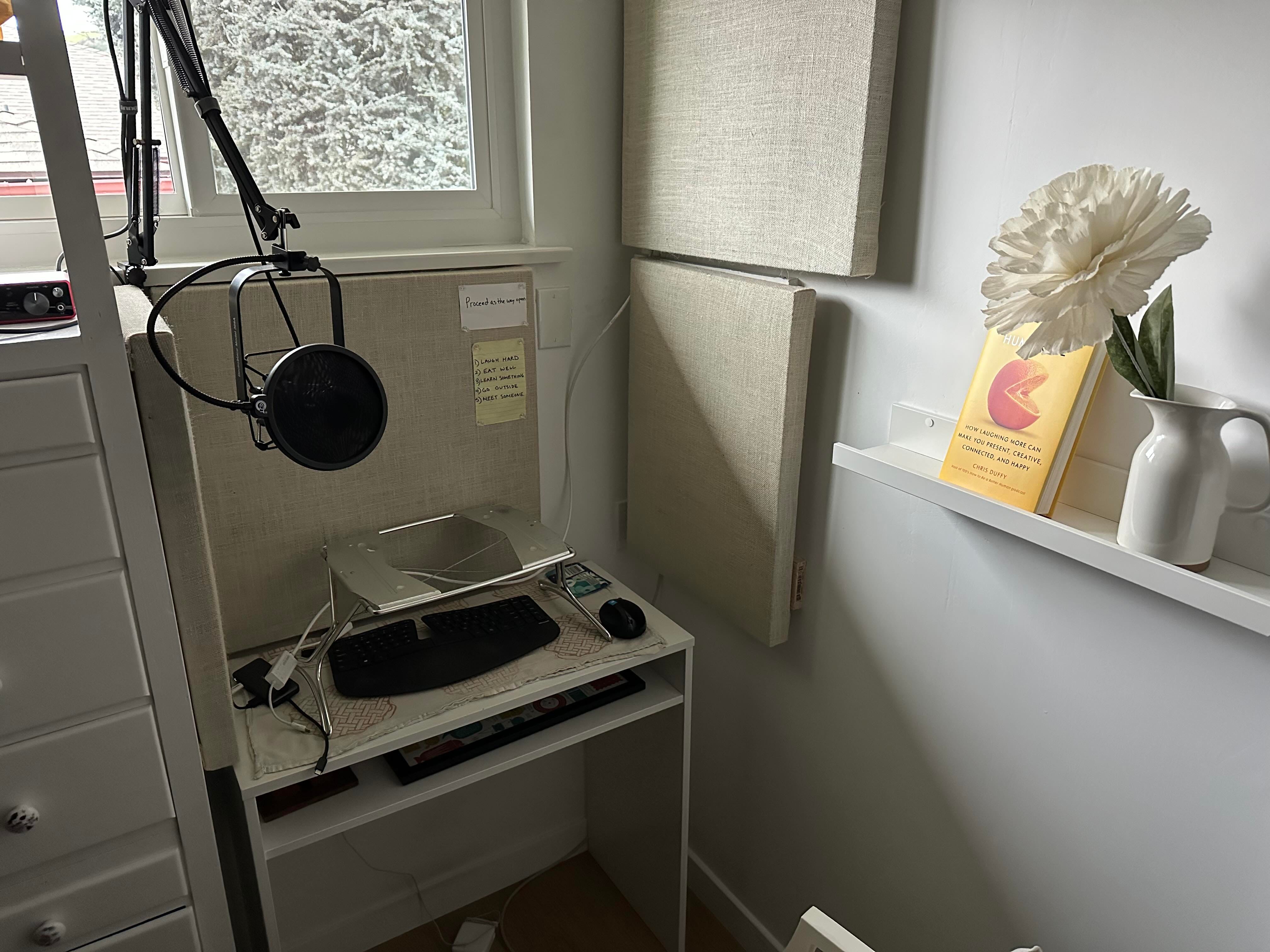
I noticed from the pic of Chris Duffy's workspace, given the position of the mouse, that he's likely right-handed. Yet the desk abruptly ends. There are no pens or pads of paper, and no analog writing surface. Is that how everyone does it now? All computer, paper-free, pen/pencil-free writing? But maybe that's just his podcast persona space and I'm reading too much into it.... And I'm just procrastinating (because, well, you know, I should be working on my book).
Thanks for sharing these insights. I signed up for his Substack and it’s absolutely delightful! Fresh and creative and I love it.