
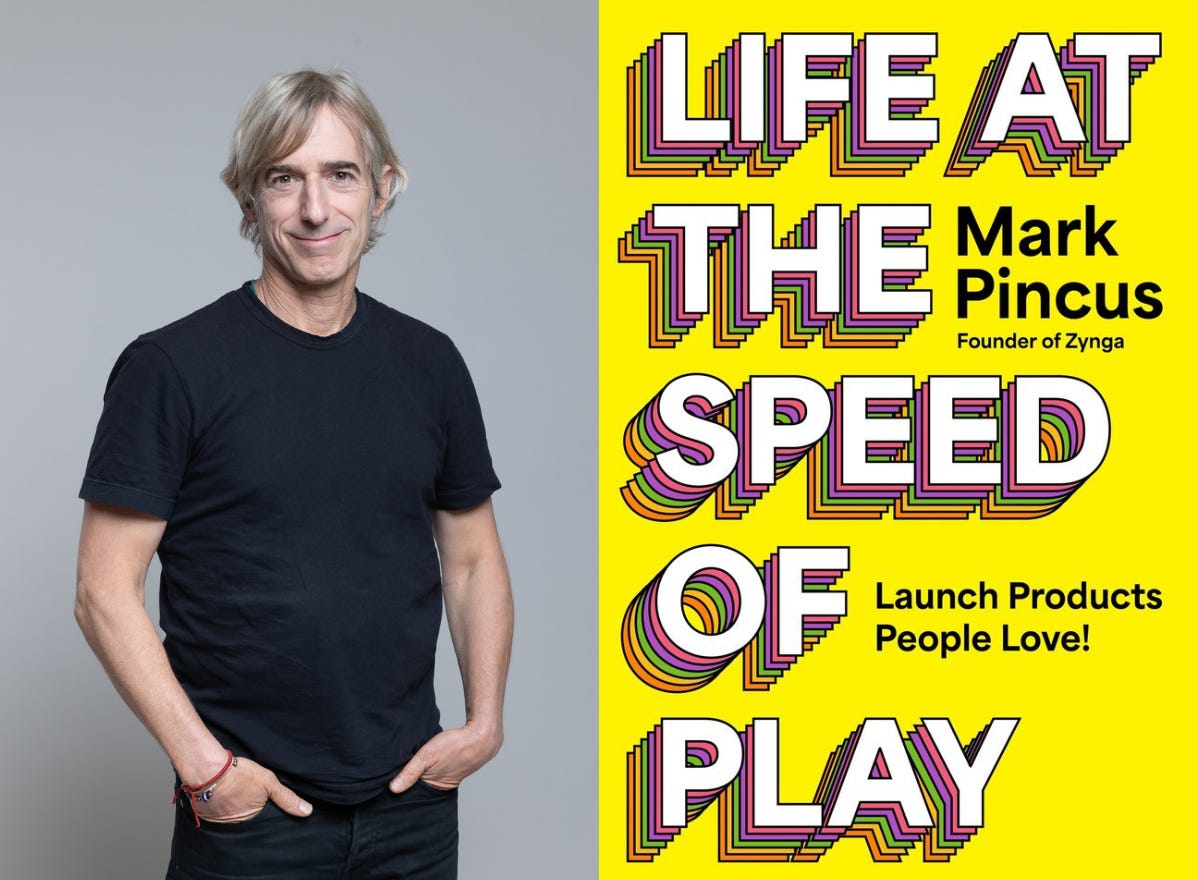
Before founding Zynga, Mark Pincus had already started multiple companies. But it was Zynga—the creator of FarmVille, Words with Friends, and other social gaming hits—that made him one of Silicon Valley’s best-known entrepreneurs. His new book, Life at the Speed of Play, distills decades of product-building into a practical framework for turning ideas into products people actually love.
In this installment of 21 Questions, Mark talks about procrastination, AI, and the lessons that only failure seems willing to teach.
21 Questions with Mark Pincus
1. I couldn’t have written my last book without…
Thirty years of learning and pattern recognition. Most of the lessons were hard-won and were burned into me over my entire career as an entrepreneur, but pretty much all of them were proven or reiterated while building Zynga. Hyperscaling a company—having to grow a company in four years to one billion users and $1 billion in revenue—forces you to learn really fast and doesn’t give you a lot of room to be wrong.
Other lessons, like separating your winning instincts from your losing ideas (which I write about in the book), were burned into me through failures, like the company I founded, Tribe Networks, and other projects. Still other lessons came from individuals. My father taught me to “be a CEO” and to “control my destiny.” Cadir Lee taught me how to understand technology, software, and engineers, and along with Colleen McCreary, taught me how to motivate teams. Coaches like Fred Wilson, Bing Gordon, and Bill Campbell taught me how to believe in and bet on myself—and how to scale.
2. What’s the thing most people get wrong about being a writer?
Writing a book is the ultimate long-form medium. It’s about unapologetically telling something in your own voice and going deep on your stories, without worrying about perfect editing, wording, or how much airtime you’re taking up.
One surprising lesson I learned was that the more fun I had talking about—and then writing about—something, the more fun it was going to be to read.
3. What’s your most common form of procrastination?
I have what I call a “lazy on-ramp to curiosity.” I am a deeply curious person, but I have extreme ADHD, and I procrastinate about getting started. I need something that forces me to focus—a catalyst—but once I get into it, I’m deep in it.
Katie, my chief of staff, would add, “There is no better example than chapter four, roadmapping. Our coauthor, Carlye, and I forced Mark to sit down and write it one Tuesday under threat of a deadline the next day. He shocked us all and typed it out in one sitting!”
4. Do you read your reviews?
Yes. I solicited early feedback and received incredible direction from friends and fellow founders. Eric Ries, author of The Lean Startup (and now Incorruptible), told me to go deeper on my stories. Fred Wilson was also most interested in the stories. My best friend, Gary Leff, read the book four times and seemed to know my voice better than I did.
Mostly, I like to read reactions on X, where I can reply to what people say because I like to be part of the conversation.
5. Kiss, marry, kill: podcasts, newsletters, and speaking gigs.
Marry podcasts. I love long-form podcasts, both being on them and listening to them.
I’d kiss speaking gigs—but only if they’re informal conversations with multiple people.
Kill newsletters. I never read them.
6. What’s a writing habit you’re embarrassingly superstitious about?
I write in a journal I call the Book of Life in the exact same way every year, both the timing and the process. I always have to do it the same way I did when I started in 1994.
7. What’s something you wish you’d started doing five years ago?
There are so many! I wish I had learned music and to play guitar. I write in the book that I regret not dedicating one of my “lost years” to it because I’d still be playing today and thanking my past self.
8. Where do you find new ideas, and how do you keep track of them?
I get ideas as I wander through the world. I don’t keep track of them—the good ones come to the surface.
The best ideas keep coming back, almost to haunt me. Over time, I’ve learned that when that happens, there’s an instinct driving it that’s usually right.
9. What’s the best piece of professional advice you’ve ever received?
The best professional advice I’ve gotten came from Bing Gordon, who was channeling Jeff Bezos, whom he worked with on the Amazon board.
The advice was consistently inspiring, and there were so many facets of it. I immediately acted on whatever Bing told me: never have one-on-ones, train your own “tech assistants” (people who can channel you when you’re not in the room), and remember that it’s more important to be right than to be liked.
10. And the worst?
The worst advice I got came from my VC board members at Support.com and Tribe. In both cases, they wanted me to hire a “scalable CEO.”
Every time I’ve been told to hire a scalable CEO, it’s been the worst advice imaginable. It created a death—or near-death—experience for my company.
11. Whose career do you most admire and why?
Elon, by far, because he’s done it all. He embodies the full definition of a founder: someone who looks for the biggest problems in the world and attacks them within the bounds of physics (and maybe capital).
He’s willing to sacrifice everything—from his ego to his capital to his sleep—in service of his ideas. When everyone is betting against him, he stays calm, convicted, and deep in the details rather than focusing on pleasing investors. And he’s been right.
12. What’s on your nightstand right now?
About five Dragon Masters books that we’re reading to our four-year-old, Enzo, plus a milk bottle and pacifier for our baby, Chia.
13. What’s a writing rule you’ve happily broken?
I learned through writing this book that I enjoy imperfections. I don’t care if I use bad grammar if it’s the way I naturally communicate.
My favorite example is that I like referring to people by their first names, like Elon or Reid. It was a constant battle with my editors, but I enjoyed saying, “I don’t care.”
14. What tech tools (AI included) do you actually use—and which ones do you actively ignore?
GPT and Claude are amazing brainstorming partners. I have active conversations with them while I walk around. I have agents work on ideas for me overnight, researching different ideas and playing out debates.
I actively ignore vibe-coding tools. I tried some, like Claude Code, and didn’t think they were ready for prime time.
15. What’s the best non-writing skill that’s helped your writing career?
For me, talking rather than writing first was the most helpful way to get ideas onto the page.
16. How many drafts before you show your editor?
My co-author, Carlye, would say tens—or even a hundred! It took a couple of years of drafts before we both thought the content was good enough to show our editor.
In the end, we cut 80 percent of what we wrote.
17. Can you describe your ideal workday?
My ideal workday is one that doesn’t feel like work—it feels like play.
It has zero minutes of managing people, because I think every day you manage is a day of work. The bulk of it would be spent with amazingly creative, productive product teams iterating on live ideas in front of users.
18. If you could write one book in a totally different genre than you usually do, which would it be?
I really want to write a Black Mirror episode – I have an idea about a society where people from the past are born into a distant future.
19. What’s something about the writing life that still surprises you?
How long it took to write something good—and how hard and introspective the process was.
At times, it really felt like therapy.
20. What is your new book about?
Life at the Speed of Play is about the product mindset—a playbook for how to approach life and how to build winning products. It’s a guide for anyone with an idea they want to bring to life.
It will massively improve your odds of success because it reduces the likelihood that you’ll fail for the wrong reasons. The book goes deep on the strategies I’ve used to rapidly iterate, test, and build products, as well as how to manage and scale a company once you achieve product-market fit.
21. Anything you’d like to ask or crowdsource from fellow authors in the Author Insider community?
I’m excited to be part of this broader ongoing conversation around writing, and I’m curious about how writers get better at the craft of product-making.
What’s the last idea you built? What did you learn?
If you enjoyed Mark’s Q&A, you can learn more about his new book here: Life at the Speed of Play.
More from Author Insider
Author Insider is where writers get the real story of publishing—thoughtful conversations with industry insiders and bestselling authors, clear-eyed analysis of where the market is headed, and practical strategies for building a sustainable writing career. Whether you’re just starting out or several books in, the goal is the same: helping you make smarter decisions about your work.
If you’re new to Author Insider, here are a few reader favorites:
Until next time,
Panio
Author Insider is a reader-supported publication. To receive new posts and support my work, consider becoming a free or paid subscriber.