

Starting a book is easy. The hard part is keeping going. In today’s guest post, book coaches (and authors) Marisa Solis and Elizabeth Dougherty explore three of the biggest reasons that writers stall out, and offer proven, practical ways to get moving again.
This piece is excerpted from The Complete Expert-to-Author Guide: How to Plan, Write, and Publish Your Nonfiction Book by Marisa Solis and Elizabeth Dougherty, published by The Collective Book Studio. I’ve made a few minor edits and added interstitial images.
You can also watch or listen to my Q&A with Marisa and Elizabeth, “Why the Reader Is the Hero of Your Nonfiction Book.”
-Panio Gianopoulos
Writing takes more discipline, effort, and fortitude than most people realize. It can be even harder if you’re less confident in your writing skills. Maybe you struggle with expressing yourself in a language other than your native one, or you still believe you’re a bad writer because a teacher once told you so. For a number of reasons, sustaining your momentum after the initial excitement of getting started can be difficult. It’s all too easy for work to come to a standstill, and for months to go by, despite your best intentions to spend quality time with your keyboard. We understand. Life can get in the way.
In this article, we address the top reasons authors get stuck: procrastination, perfectionism, and impostor syndrome. You’ll add to your arsenal proven strategies—including time management, habit formation, and accountability—to keep your work from stalling and help you bounce back more readily when progress halts.

Common roadblock: procrastination
We’d wager that procrastination is the most common reason books don’t get finished. After all, if you intend to write a book but don’t do it, by definition you’re putting it off; you’re procrastinating. You might tell yourself that you’re just “too busy,” or maybe that you’re waiting for the perfect time to write. And yes, curveballs derail your good intentions and expectations on a daily basis, and excuses can seem so undeniably legitimate when you make them. But can you truly not find fifteen minutes to write?
Procrastination, especially if you’re a perfectionist, often stems from fear, anxiety, or overwhelm. Avoidance feels much easier, at least in the moment. But you’re here to finish your book, so here’s some tough love: When you procrastinate, you choose to procrastinate, according to Neil Fiore, author of The Now Habit. This isn’t because you’re lazy or lack willpower, but because it temporarily helps you cope with fear and pressure. Knowing that you have a choice empowers you to make a different one.
Also understand that procrastination is a self-reinforcing behavior. The more you do it, the more prone you are to continue to do it. Make no mistake about it. The good news is that the adage “success begets success” is true, too—the more you write, the more apt you’ll be to continue to write. The sense of accomplishment that follows taking action feels good, which means you’ll likely want to write the more you do it.
Elizabeth’s history of procrastinating dates back at least to fourth grade, when her teacher, Miss Pike, made her look up the word in the thick, red Merriam-Webster’s dictionary on her desk. Suffice it to say, the definition wasn’t a deterrent. It wasn’t until much later that the work of time-management guru Edwin Bliss inspired two of her favorite, most successful strategies for combating her tendency to put things off until the very last minute: Take one next step, and prioritize tasks that are important but not urgent.
Take one next step
In 1976—decades before David Allen trademarked the phrase “Getting Things Done” and wrote his bestseller of the same name—Edwin Bliss wrote a brief, humble book also called Getting Things Done. Both authors built on ideas from Alan Lakein’s 1973 book How to Get Control of Your Time and Your Life.
Elizabeth read Bliss’s book in 2010, and it rocked her world. Bliss advocates for finely slicing and conquering tasks by breaking them down into instantly achievable steps and capitalizing on tidbits of time. Each “one next step” can be as granular as you want. Three next steps might take less than a minute: Sit down, wake up your computer, and open a file. Your next step might be to write one sentence. Once you do one step, you’re very likely to keep going. That one minute in front of the screen magically becomes ten or twenty minutes of writing. That one sentence becomes a paragraph. Paragraphs transform into chapters. To keep her to-do lists from becoming overwhelming, Elizabeth still simply lists one next step per project.
Prioritize tasks that are important but not urgent
Bliss’s book also introduced Elizabeth to what has become known as the Eisenhower matrix, based on President Dwight David Eisenhower’s method of ranking tasks by importance and urgency. Tasks are grouped into quadrants:
• Important and urgent: Do now the most significant tasks with the most rapidly approaching deadlines.
• Important but not urgent: Schedule on a calendar significant tasks that don’t have pressing deadlines.
• Not important but urgent: Delegate time-sensitive tasks that are less significant.
• Not important and not urgent: Eliminate tasks that are insignificant and not time-bound.
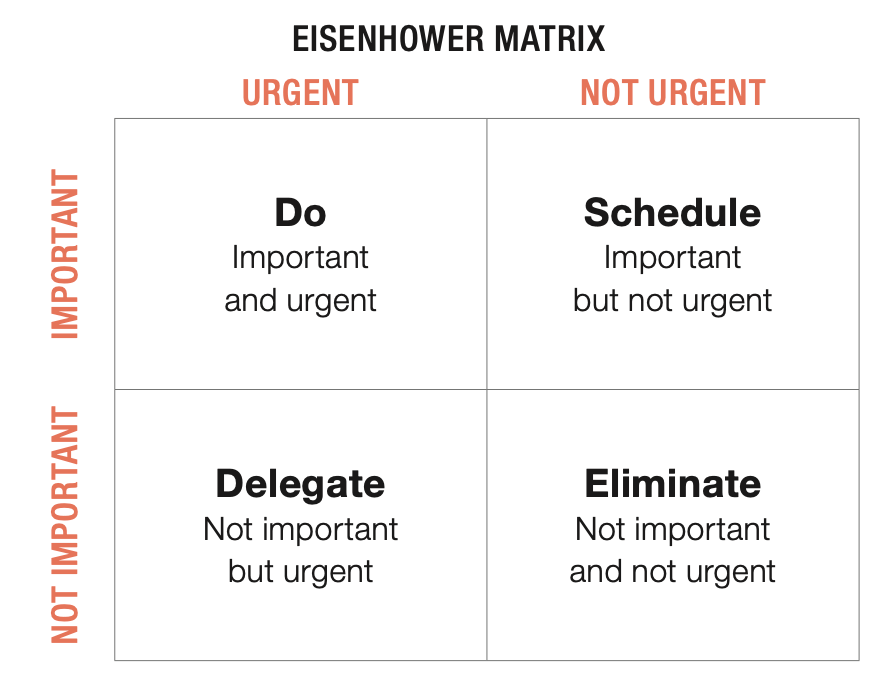
Unless you have a publishing deadline that adds front-burner status to the equation, writing a book often falls into the “important but not urgent” quadrant—the quadrant that has a high payoff but is too often overshadowed by anything that’s time-critical. That’s why it’s so easy to spend years “writing a book” and have almost nothing to show for it.
One way to avoid this common pitfall is to schedule time for writing, which we discuss in more detail later.
You’re managing a lot in your life, and, yes, “important and urgent” tasks demand a great deal of time, energy, and attention. But when you ruthlessly evaluate the “importance and urgency” of the multitude of things you do in any given day or week, you may very well discover that “not important” tasks take up more time than you perceived. Actively cull tasks that are urgent but not important, and say no to what’s not urgent and not important. Then devote the time you save to tasks that are important but not urgent—your manuscript, for example.
Don’t wait for the perfect time to write
If you wait for the stars to perfectly align before you write, you’ll never get your manuscript done. You will always find excuses to delay. Instead, accept that the definition of a writer is someone who writes. Not perfectly, but consistently. You need to sit your butt down in a chair (unless you’ve embraced a standing desk, which we’ll allow) and start putting words in a document. You write, and you rewrite. Put it on repeat. Just like athletes and musicians practice, so must you write. The more you do, the easier it gets.

Common roadblock: perfectionism
Writing is an iterative process. It’s not a single perfect take. A first draft is just that, the first of many iterations, but you still have to get it done. Trust us when we say it does not have to be flawless. In fact, it won’t be. Nothing will slow you down faster than trying to write perfect prose at this stage. Yet, with so many authors, a fear of not executing perfectly at every step becomes the reason they stop putting words on the page—or never start in the first place.
Yes, as writers, we may obsess over alluring alliterations and correctly placed modifiers, but these stylistic things do not matter when the premise of your book isn’t finely tuned and it’s taking ten months to write ten thousand words. So here are some tips.
Remember that “some things you just get done”
In addition to being a recovering procrastinator, Elizabeth has had to learn to let go of her very-Virgo tendency toward perfectionism. Now she listens to her mom’s voice in her head saying, “Some things you do, and some things you just get done.” The advice is easier to follow now as an adult than when she was a teenager and her mom insisted that getting sleep was more important than nailing the subjunctive tense in her French homework at midnight.
The first draft of your book will not be perfect. You simply need to get it done. Fais-le, c’est tout!
A corollary: Don’t waste time on lower-priority things, such as transitions between paragraphs. Save that time, focus, and energy for more important things, like finishing a full first draft. You can and will spit-polish every word—but in much later drafts, not now.
Quiet the critic in your head
A common downfall when you’re a perfectionist is listening to that critical voice in your head that insists you must edit and refine whatever you’ve written before moving on—and absolutely before anyone else sees your writing. This inner voice will slow down your thinking (and consequently your writing) and wear down your confidence. You’ll get stuck spinning your wheels very early in the manuscript, maybe never moving beyond the first chapter you write.
But let’s say you do manage to write a complete first draft—and a beautifully crafted one at that. You still need to revise it, and you may need to cut text for reasons such as removing repetition, improving flow, or meeting a word count limit. If you’ve spent hours wordsmithing those sentences, you may be reluctant to make needed cuts. Remind that voice insisting that your writing be flawless that you (or a copy editor) will remedy any blemishes later.
Acknowledging the critical voice and then choosing to move on anyway—a strategy recommended by Shawn Costello Whooley and Holly Yates in The Inner Critic Workbook, which Marisa worked on—can make you feel more empowered. You’ve got this.
Embrace the journey
So now you know that your first draft won’t be perfect, not even close. If you’re a perfectionist, this truth bomb may make you anxious and even give you the heebie-jeebies. Consequently, you may be less willing to give yourself the freedom to get the words down when you suspect (much less expect and accept) that they could be better. Rest assured, the words will get better, but meanwhile, something on the page is better than a blank document. We encourage you to embrace the process of writing—the journey—complete with its bumps and imperfections.
Along these lines, we’re a bit enamored with Carol Dweck’s research on success, particularly her focus on the value of process versus product in achieving goals. If you haven’t already, read her book Mindset. When you focus on the process of improvement, like revising your manuscript, you’re more likely to be intrinsically motivated to persevere, tackle challenges head-on, and not only do the work but enjoy doing it. With this approach, you can recognize that the necessity of revising and improving your manuscript is simply part of the writing process, not a judgment on you or your abilities.
If, instead, you focus primarily on the product or current outcome, you’re extrinsically motivated—and more likely to stall out for fear of failure, judge yourself as inadequate, or more easily give up when faced with challenges. The magic happens in the revising, not in getting it right the first time. Instead of aiming to write the perfect book, aim to write consistently and revise thoughtfully. Your final manuscript, a polished diamond, will emerge from this process.

Common roadblock: impostor syndrome
Whereas perfectionism has roots in the fear of being seen as flawed, impostor syndrome has roots in the fear of being seen as a fraud. It’s what stops many writers from being published. According to 2022 data from the Survey Center on American Life, impostor syndrome is felt by roughly half of all adults ages eighteen to forty-nine. And it’s not difficult to imagine that, if you’ve never written a book before, you may be feeling insecure in your ability to pull it off.
This is how we see impostor syndrome affect authors: Like the insect in Eric Carle’s Very Hungry Caterpillar, it gnaws at your self-worth. First, it chews a hole in what you believe you are capable of—creating a compelling premise, putting together a strong outline, writing an engaging chapter—stuff you have the intellectual and physical capacity for, yet now feel somehow beyond your ability to do. Then, it takes a bite out of what you believe you know—your studies, research, lived experiences—things you’ve been taught or have done for years somehow start to seem invalid or inadequate. Finally, it chomps right through what you believe about yourself—that you’re credible, authoritative, worthy—qualities that are core to your identity suddenly seem untrue.
If you have stalled in your writing, check whether impostor syndrome may be a factor. Do you find yourself second-guessing how to write (your ability) or what to write (your knowledge), or asking yourself, Who do you think you are to be writing? (your identity). Are you deeply concerned that peers may expose you as a fake? Are you worried that you’ll be attacked for writing the “wrong” thing?
Let’s look at some strategies for countering impostor syndrome.
Understand the fear response
Perhaps you didn’t feel like an impostor when you started writing. But then things got challenging, and you started to doubt your ability, your knowledge, and yourself. Maybe negative thoughts flooded your mental space. But consider this: Those thoughts aren’t true; they’re a reaction to your fear of being judged.
What’s true is that your situation is new and scary. Your mind is trying to keep you safe. The negative messages are your brain’s insurance policy against suffering; if it can keep you from the pain of shame, it’s done its job. The critical thoughts will likely continue the more you find success with writing. The best thing to do, according to acceptance and commitment therapy, is to acknowledge each thought and say, “I get it, you’re hoping I’ll stop writing. But what you’re saying isn’t true—it’s just a fear response—and I’m going to keep writing. Bye!”
Act “as if”
We don’t love the “fake it ’til you make it” expression, partly because we want to encourage you to be authentic—for example, by refining your unique voice as an author. So if you lack confidence in your ability to write a book, don’t fake being an author. Instead, as you work toward seeing yourself as one, act “as if.” Psychologist William James first suggested in 1884 that acting as if something is true can help make it happen. In the early twentieth century, psychologist Alfred Adler developed “act as if” as a therapeutic technique. Today, fields as varied as business and the dramatic arts have also embraced this concept. We recommend you do too.
Put the title of your upcoming book in your email signature. Tell friends and colleagues about the book you’re writing. Give webinars or in-person talks. Post about your book on social media. These types of activities can help boost your confidence and build your author platform.
Don’t underestimate the power of simply saying to yourself and others, “I am an author.” Repeat as necessary. In a similar vein, banish the word “trying.” Do not tell people, “I am trying to write a book.” Say instead, “I’m writing a book!”
Amy Sherman, a friend of Elizabeth, left a corporate branding job to become a food writer. How did she make the switch without feeling like an impostor? She simply ordered Moo business cards that listed her title as “food writer” and handed them out. (The original Moo card format stood out for its quirky smaller size and color images.) Her cards also had the URL of her then-nascent, now award-winning cooking blog, Cooking with Amy. She has since published multiple cookbooks.
Be kind to yourself
Imagine you signed on as your BFF’s writing buddy. Things have been going surprisingly well—their outline and first four chapters were, in your opinion, fantastic. You offered constructive feedback, and your friend has been gracious and excited about making revisions. But suddenly your BFF stopped sharing chapters and started making excuses for not writing. When you finally pin your friend down to ask what’s going on, they reply, “I’m not qualified to write this book. No one will read it anyway. I was dumb to believe I could do this.”
What would you say in response?
Take your cue from Kristin Neff, author of Fierce Self-Compassion: Whatever compassion, kindness, inspiration, or advice you’d offer your BFF, say it to yourself. Every time you have doubt, every time you think you’re not worthy enough, say to yourself what you’d say to a friend in the same situation. In fact, say those words to your amazing self right now.

Accountability
While in the end we’re all responsible for our own actions, let’s explore how to enhance accountability when it comes to getting your book done.
Make a schedule and stick to it
Earlier, we talked about how writing a book can fall into the “important but not urgent” quadrant if you don’t have a publishing deadline. We highly recommend creating a schedule that includes specific milestones with deadlines. To set yourself up for success, book time in your calendar and set realistic interim deadlines. Also, take your schedule seriously. It’s so very easy to be “too busy” to write. We challenge you to set daily and weekly goals.
If you have blocks of time, like weekends or early mornings, you can devote to writing, great. But if you don’t, take advantage of smaller nuggets. You might be surprised by what you can achieve in fifteen minutes, especially if you devote that much time every day to writing. This is similar to the Pomodoro Technique—developed by Francesco Cirillo and inspired by a tomato-shaped timer—where you work without distractions (for example, turn off all digital notifications) for twenty-five minutes and then take a five-minute break.
Track your progress
We’re big believers in giving yourself props for what you did accomplish versus beating yourself up over what you didn’t. One way to do this is to document on paper the things you get done. Consider using a wall or desk calendar (along with stickers, as Elizabeth does) to track the time you spend writing and what you accomplish; it’s old-school but a good tactile and visual reminder of your achievements. It can also be a resource to help troubleshoot if you get off-course—you can use it to identify patterns, such as being less productive at certain times of day.
Digital tracking also works. For instance, while we were writing this book, we didn’t delete tasks on our shared to-do list when we finished them. Instead, we put a giant check mark next to each one and moved it to the bottom of the list. It felt terrific to have this visual reminder of just how many tasks we had completed.
Recruit an accountability buddy
Just as we encourage you to consider partnering with a writing buddy, consider finding an accountability buddy to offer you support—your own personal cheerleader. Look for someone you feel comfortable confiding in, who will encourage you to meet deadlines, puzzle through problems, and persevere. Choose a person who has a positive attitude about you accomplishing your goal to write a book and who will give you affirming feedback—preferably someone who knows you well enough to nudge or even push you if needed and not let you get away with making excuses.
A BFF or sibling who understands you deeply can be a good choice. When they say something motivating, put that supportive voice on a playback loop in your head. For example, Elizabeth would replay Marisa saying, “Writing is hard; you can do hard things.”
Hire a pro
Another way to stay accountable is to hire a book coach. Put simply, sometimes money talks. If you’re paying for a person to create an editorial schedule and hold you to deadlines, you might have a better chance of success. That’s how gym memberships ostensibly work, right? Of course, book coaches are more than glorified schedule setters. They serve as confidants, word wizards, organizational mavens. They challenge you to write the best version of your book, guide you through the process, and hold you to high standards.
Form helpful habits
Sometimes everything you do, or don’t do, boils down to good habits—or a lack thereof. There are a bazillion books on habit formation, and some of them are profoundly helpful. If you feel that you need structure to complete your book, there are many proven strategies that can help you build a consistent, dependable system for writing.
Marisa prefers the habit stacking method, borrowed from S. J. Scott’s book of the same name and popularized in James Clear’s Atomic Habits. Basically, you create a new habit by hitching it to an existing one. So, for example, if you have a cup of tea every morning, you can attach the task of writing to drinking your tea. Ultimately, the writing itself becomes a habit by association.
Of course, no matter how dedicated you are in establishing a habit of working on your manuscript, the process can fall apart if you lose sight of your why. Therefore, we strongly encourage you to reflect back on the reasons you are writing this book in the first place.
Whether you’re writing this book to help people, advance your field, or experience the sheer joy of accomplishment, let that reason motivate you. If procrastination, perfectionism, or impostor syndrome is keeping you up at night, let your why be the reason you get up in the morning. If you didn’t print out “The Premise” homework, shape it into a sign, and post it nearby, consider doing that now to give yourself a visual reminder of your North Star as an author.

Set SMART goals
When setting a goal—whether a writing goal or anything having to do with getting published—it can be helpful to revisit Carol Dweck’s process versus product orientation. You’ll recall that a product goal is what you hope to ultimately achieve, the end result. For example, “publish a book.” The challenge with going all in on a product goal is that the outcome might not be entirely within your control. A publisher might reject your proposal, or another person might come out with a virtually identical manuscript weeks before you’d planned to launch yours.
On the other hand, a process goal is the thing you do to get to the end result. It’s task-oriented—for example, “write thirty minutes a day” or “write 350 words a day.” If you do the work regularly, it becomes a habit, and the outcome gets met naturally over time. Because these are tasks you’ll naturally refine as you repeat them, your work becomes streamlined and more efficient—even enjoyable. Dweck encourages a process orientation, and so do we.
To set an effective process goal, we recommend using the SMART framework, originally developed by George T. Doran in 1981 and slightly massaged over the years:
SPECIFIC: I will write the first half of chapter 3, which explains the first week in my ten-week program.
MEASURABLE: I will spend four hours total writing the first half of chapter 3, which will be about 2,500 words.
ACHIEVABLE: I will write for two hours today and two hours on Thursday.
RELEVANT: Chapter 3 will be my sample chapter, serving as a model to write similar chapters more efficiently.
TIME-SENSITIVE: My writing buddy agreed to review my draft over the weekend, so I need to have the first half completed by Friday.
Surround yourself with inspiration
Sometimes, when you’re feeling stuck, a simple change in your environment might help. Can you optimize your soundscape, for instance? Some authors get energized in a noisy, crowded coffee shop. If you thrive in quietude, noise-canceling headphones might be a nonnegotiable. Or maybe you just need the perfect playlist to get you in the groove. “When I was working on my book, I was productive under the dryer at the salon and getting my car serviced at the dealership,” shared Billye Jones. “I work best in places where I can’t escape.”
Surround yourself with objects that speak to you, if you’d like. Write inspirational messages on sticky notes. Hang artwork. Create an inspiration board with keepsakes like photos, greeting cards, and handwritten notes. Clear away clutter.
The simple task of turning her desk ninety degrees was a game changer for Elizabeth. Her desk now faces glass patio doors overlooking the greenery-filled backyard, rather than a kitchen wall. Marisa prefers olfactory stimulation; she adds several drops of lavender and lemongrass essential oils to an infuser with a one-hour timer and writes until it stops.
The right writing environment may even help you experience flow, the positive mental state where you’re so fully immersed in what you’re doing that it feels effortless, described by Mihaly Csikszentmihalyi in his bestseller Flow. If you can get there, there’s nothing like going with the flow.
Take time to celebrate
While a lot of the tips we shared are about overcoming obstacles, we’d also like to remind you to celebrate victories, large and small. Go ahead and reward yourself whenever you sit at your desk and crank out text—especially if you had scheduled it but really did not want to do it. We find celebratory cocktails do the trick, but chocolate also works.
Give yourself a pat on the back when you stop yourself from making excuses or procrastinating. Got positive feedback? Soak it up like a sponge. Heard from a beta reader that your advice changed their life? That’s gold. Silenced that inner voice that drags you down? Awesome. We’re so proud!
Surround yourself with people who believe in you and your book. Share your victories. Say thanks to compliments. You deserve the accolades.
About the Authors
Marisa Solis is a book coach, developmental editor, and cofounder of Book Structure Pros, a boutique editorial services company. Since her start in travel guidebook publishing in 1999, she has worked on more than 500 nonfiction books. Her specialties are self-help and wellness. Marisa lives in Los Angeles.
Elizabeth Dougherty is a book coach, developmental editor, and cofounder of Book Structure Pros. She has worked in publishing since 1988 and was an executive editor at Weldon Owen. Her focus is on parenting, health and wellness, and women’s leadership. Elizabeth holds a master’s from Northwestern’s Medill School of Journalism and lives in Palo Alto, California.

