
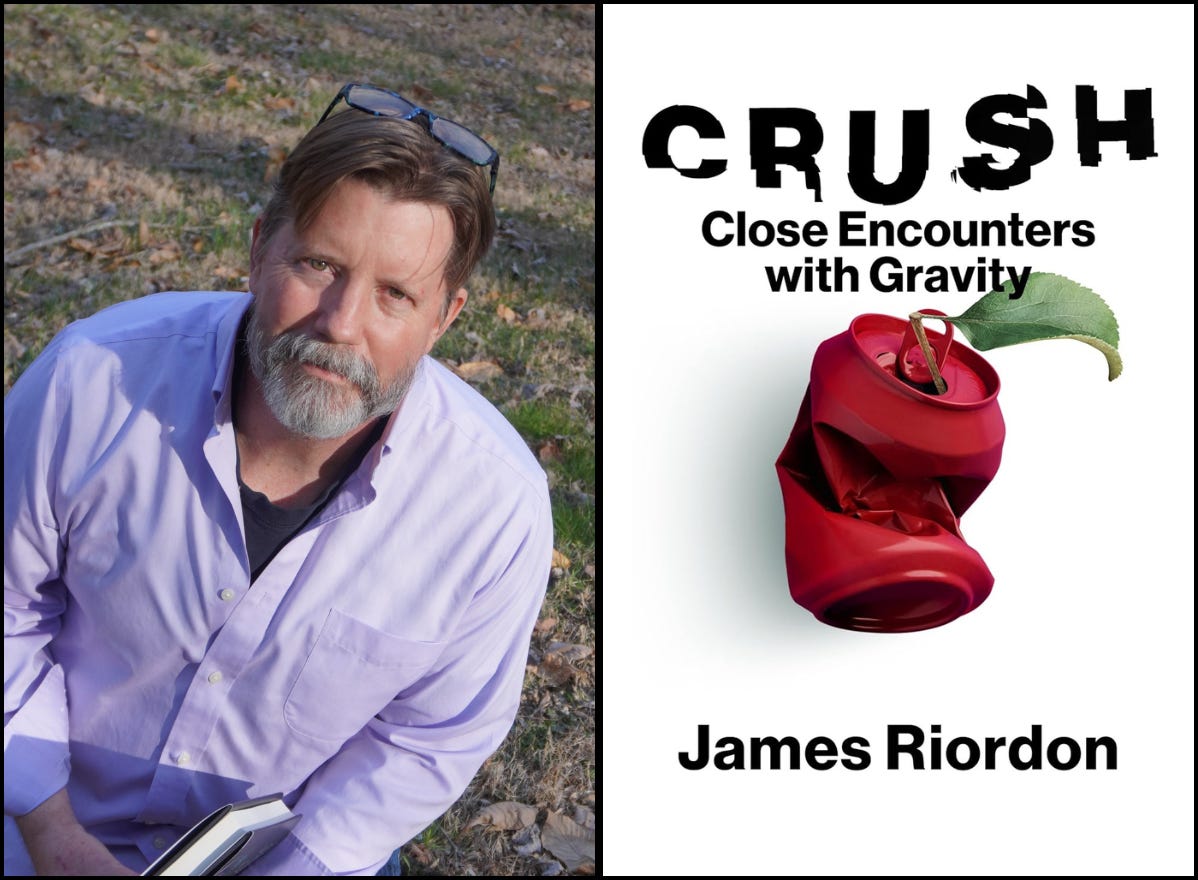
Some subjects lend themselves to neat narratives. Gravity isn’t one of them. It operates across scales that are hard to imagine and remains, in key ways, unfinished science. Writing about it requires patience, restraint, and a tolerance for ambiguity.
James Riordon brings all three to Crush: Close Encounters With Gravity. A longtime science journalist whose work has appeared in Scientific American, New Scientist, Popular Science, The Washington Post, and Physics Today, Riordan specializes in translating complex ideas without sanding down their complexity. In Crush, he treats gravity not as a tidy concept to be explained away, but as a force that refuses simple answers, one that shapes our bodies, our technologies, and the ultimate fate of the universe.
In his Author Insider questionnaire, Riordon reflects on editing as the real work of writing, the role of curiosity (and nosiness) in science journalism, and what it means to keep returning to questions that refuse easy answers.
21 Questions with James Riordan
1. I couldn’t have written my last book without…
Gummy bears. I think it’s the combination of texture, sugar, and artificial coloring that keeps me going when I write early in the morning and late at night. I’m sure they’re terrible for me, but at least it’s better than smoking, which I did a lot when I first started writing. I ate so many gummy bears while working on my last book that my kids have said Haribo deserves coauthor credit.
2. What’s the thing most people get wrong about being a writer?
That it’s important to be good at writing. What really matters is editing—both editing your own work and accepting the edits of others.
3. What’s something you wish you’d started doing five years ago?
Submit Freedom of Information Act requests. It can take a long time to get information from the government.
4. Hemingway wrote standing up; Edith Wharton, lying down. What are your quirks?
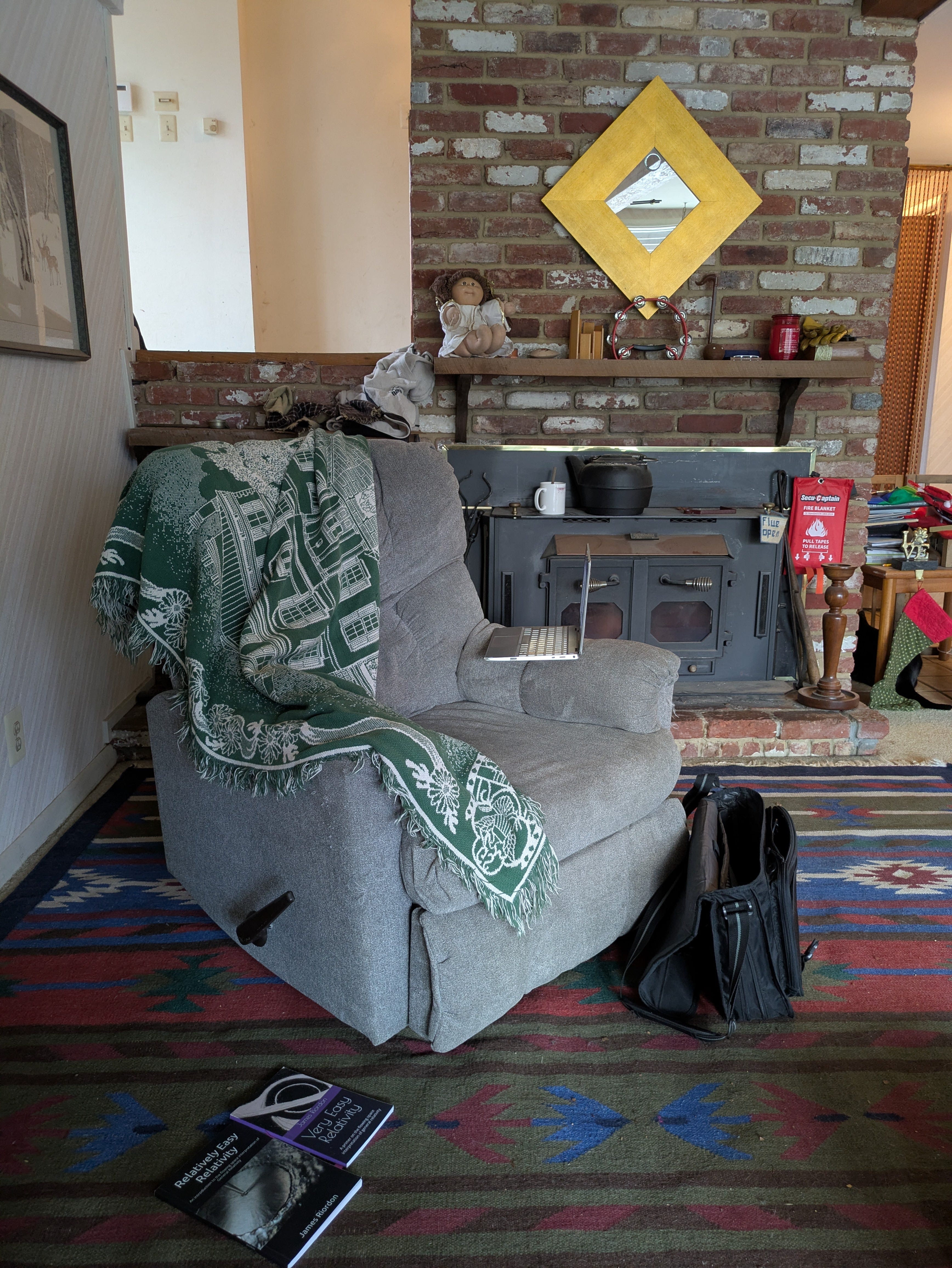
I write on a laptop while stretched out in a lounge chair. I find that it’s easier on my back and shoulders for long writing sessions. The chair faces a large window opening onto the woods out back. More often than not, I start writing at 2 am and take a nap around 5 am before making lunches for the kids. The dogs and I walk my kids to the bus stop, then I get back to writing in the lounger. Most of my writing happens before 10 am.
5. Do you read your reviews?
I do. Obsessively. It’s the negative criticism that I find most helpful. Generally, though, the reviews tend to confirm things I already know about where my writing is weak and where it’s strong.
6. What income streams make up your writing business?
I earn far more with my news stories and features than I do writing books. I wish it were the other way around. For now, covering science news supports my book-writing habit.
7. Is there a book you wish you’d written?
Longitude by Dava Sobel is my favorite book in popular science, which is my primary genre.
Before Sobel, I never imagined that I could love a story about a watchmaker or the challenges of finding your location at sea. Her book is exciting, beautifully written, and short. Those are things I aspire to when I write. I wish I’d written Longitude, but before I held Sobel’s book in my hands, I had no idea a book like hers could exist. I’m informally calling my current project “my Longitude book.” It’s on a completely different topic from the one Sobel covered, but I want it to make readers feel the way Longitude made me feel when I first read it.
8. Have any tech tools made your job easier?
I’m mildly dyslexic and a terrible speller, so I rely heavily on spell checkers. In the old days, word processing programs could tell you if a word was misspelled but would blithely accept homonyms—rain for reine, any version of their/there/they’re, and so on. The best thing about smart, AI-driven spellcheckers is that they consider context. That goes a long way in making sure I don’t look like I can’t tell raise from raze, great from grate, or led from lead.
9. How has AI changed your writing process?
Primarily, AI has affected my research. It can be a helpful launch pad for finding resources, much as Wikipedia has been for years. All too often, AI tools are happy to lead you into a minefield of errors and bias-confirming nonsense. I use AI the way I use Wikipedia, as a source of inspiration and preliminary research before digging into primary sources.
10. Where do you find new ideas?
I’m a science journalist. In the past, most of my ideas were sparked by one new discovery or another. The problem I had wasn’t finding ideas, it was choosing which among so many fascinating ideas are the ones I want to spend months or years on as I write a book. More recently, one book has led to another for me. There will be one or more subjects in a book I’ve written that deserve to be expanded on in a book of its own.
11. How do you keep track of new ideas?
Google Docs! I have many folders dedicated to book ideas that I hope to get to eventually. There’s no way I’ll live long enough to write them all. The nice thing about Google Docs is that I can drop references in them, edit manuscripts, and browse my ever-growing list of ideas anywhere and on any device, as long as I have an internet connection, which is pretty much everywhere these days.
12. What’s the best piece of professional advice you’ve ever received?
Get out. Go places, see things, talk to people. I’ve read books and articles that seem to have emerged from behind a desk. They feel like long Wikipedia articles to me. I rarely finish a book that doesn’t have an angle or material beyond what’s available with a few mouse clicks.
13. And the worst?
Write about what you know is the worst bit of advice I’ve heard.
That might work in other genres, but not in popular science writing. Knowing too much can be a problem for science journalism, generally, because it’s harder to tell what your readers need you to explain if you’re intimately familiar with a subject. More importantly for me is that writing is as much a voyage of discovery as it is an act of creation. The discovery is what keeps my attention and keeps me interested enough to keep hammering away at the keyboard.
14. What is the one piece of advice you would give to recent graduates who want to make a living as a writer?
Don’t believe the AI doomsayers. There are facets to writing that AI can’t do (and I think never will). Personal connections that come from living and interacting in the environment, the random and unpredictable experiences that life is built on – these are the sorts of things I can’t imagine AI systems mimicking well any time soon.
15. Whose career do you most admire and why?
I deeply admire Mary Roach. She approaches difficult, but riveting, topics with humor and sensitivity that she has used to build an amazing science writing career. Roach has written about corpses, sex, space travel, the digestive system, and more. Whatever the topic, her books are clever, surprising, and fun. I never know what adventure her next book will bring, but I always know I’ll love it. If I could trade places with one writer alive today, it would be Mary Roach.
16. What’s on your nightstand right now?
In no particular order:
Irma Rombauer’s Joy of Cooking (1974 edition). I find recipes and cooking advice riveting, even though I rarely have time to try cooking new things.
Charles Lyell’s Principles of Geology. The stories of his travels are at least as interesting as the science, as told by the most important geologist in history.
Mary Roach’s Replaceable You. It’s gross, funny, smart, surprising, and a total joy.
17. What’s the best non-writing skill that’s helped your writing career?
Is nosiness a skill? Several of my favorite portions of the things I’ve written so far stem from sticking my nose in places that, at the time, seemed unwise, rude, and occasionally dangerous.
What makes nosiness different from research is that it doesn’t involve a long-term goal or focus. When I snuck away from a guided tour to poke through the abandoned labs at Biosphere 2 a decade ago, I had no idea that the memories and photos would contribute to my latest book. At the time, I simply had to know what was in a random decrepit cabinet, under a decaying tarp, and behind every rusted lab door. Is it a skill or an obsession? I’m not sure, but it’s helped my writing either way.
18. How many drafts before you show your editor?
My editor at home (my spouse, Martha) is involved page by page. As far as my editor with the publisher goes, I’ve never counted how many drafts I went through before sending a manuscript in. Based on the foot-and-a-half-tall stack of double-spaced pages that I dropped in the recycling recently, I’d guess that I churned out eight to twelve drafts before formally submitting it to the publisher’s editorial team.
19. Can you describe your ideal workday?
Ideally, I’d write in the early morning; take a nap; walk the dogs; write until lunch; research for a few hours; go to the gym; have dinner with my family, walk the dogs again, then read until bed (~9 pm).
20. How does that compare to your actual workday?
My actual workday follows roughly the time line above, along with the insertion of many other additional activities: making lunches for my kids and walking them to the bus stop around 7 am; chatting about the news with my editor/spouse; caving to the dogs’ multiple requests for walks, treats, and roughhousing; taking one daughter to dance class; cooking dinner every other day (Martha and I take turns); helping with homework; and cajoling the kids to go to bed (usually, well past 9 am). I get most of my writing done before everyone else wakes up, during the first few hours after the school buses are safely on their way, and while typing with my thumbs in docs on my phone as I sit in the hall outside dance class.
21. What is your new book about?
Crush is about gravity, from its mundane influence on our daily lives to sculpting the cosmos, and from its crucial role setting the stage for life at the Big Bang to determining the ultimate end of everything eons from now.
One of Many
Author Insider publishes conversations like this regularly, plus interviews with publishing insiders and bestselling authors, reporting on industry trends, and strategies to help establish and grow a writing career.
If you’re curious, you can check us out here.
Until next time,
Panio Gianopoulos

Editorial Director, Author Insider & The Next Big Idea Club
It's good to know that someone else wants to go to bed as early as 9 pm. Hey, don't you agree these are great interview questions? What did you like most about the questions?
This is fun to read! Thanks!