
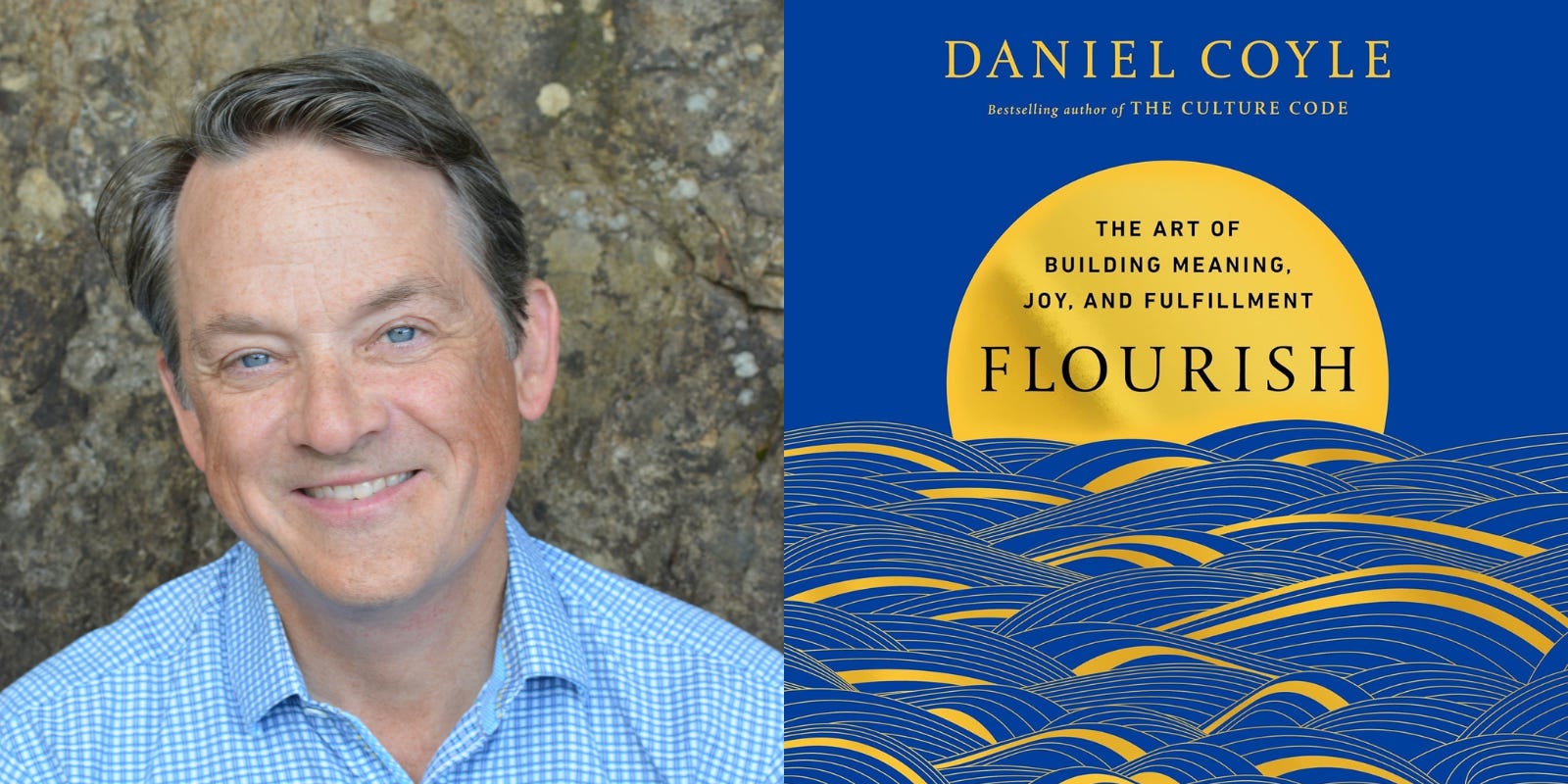
Why do some groups thrive while others stall out? For years, Daniel Coyle has been chasing this simple but slippery question.
Coyle is the New York Times bestselling author of The Culture Code and The Talent Code, books that explore the hidden patterns behind high-performing teams. Over the years, he has reported from locker rooms, classrooms, and companies in search of the forces that help groups succeed.
His new book, Flourish, looks at the communities that generate unusual levels of belonging, energy, and shared purpose—from Chilean miners trapped underground to a small Michigan deli that grew into a $90 million ecosystem of businesses.
In this edition of 21 Questions, Coyle talks about curiosity, notebooks, and why writing is really a form of carpentry.
21 Questions with Daniel Coyle
1. I couldn’t have written my last book without…
My parents passing away rather suddenly. Dark but true! No matter what age you are (I was mid-fifties), the experience of being an orphan knocks you out of your usual patterns and toward a deeper set of questions. What’s a good life? How do you create strong relationships? How do you build community?
2. What’s the thing most people get wrong about being a writer?
Writing ability matters far less than you think. Editing ability—the carpenter stuff—matters far, far more.
3. What’s your most common form of procrastination?
Doing more research, which feels virtuous, and rarely is.
4. What’s the first thing you do after you finish a draft?
Send it to someone, most often my brother (who’s a great editor). I find that the mere act of hitting SEND – suddenly imagining someone else’s eyes on the page – catapults me into a clearer perspective. Suddenly, fault lines I’d ignored become glaringly clear – likewise with possibilities I might have missed.
5. Kiss, marry, kill: podcasts, newsletters, and speaking gigs.
Kiss: podcasts.
Marry: speaking gigs.
Kill: newsletters. I know this is an unpopular theory, but here goes: Newsletters can be a terrific laboratory, but they are quietly dangerous, because they can lead you into thinking and behaving like a one-person media company. What serves your audience doesn’t always serve a writer’s long-term interest.
6. What’s a writing habit you’re embarrassingly superstitious about?
I am hopelessly addicted to Mead’s five-subject wire notebooks: 175 pages of letter-ruled bliss. That’s where most notes and outlines happen; which makes me feel like I’m living in a pre-Internet world. They create a rhythm and depth that goes deeper than typing on a screen.
7. What’s something you wish you’d started doing five years ago?
Morning Pages—three daily pages of freewriting, as prescribed by Julia Cameron, author of The Artist’s Way. It feels strange, particularly when you’re accustomed to crafting sentences – and maybe that’s why it’s so liberating.
8. Where do you find new ideas, and how do you keep track of them?
My approach to every project is to find something that looks like magic—a performance, an achievement, a phenomenon—then to go in search of the machinery beneath. So I’m always on the lookout for unlikely stories, and the best barometer is my own reaction to them. If there’s a mystery that I can’t stop thinking about—for instance, how did those Chilean miners survive those weeks buried underground together?—that’s a strong signal.
For each idea, I keep folders, both real and in Google Docs. The folders function like shoeboxes: I put a bunch of stuff inside and let it rattle around, and see what connections emerge. Of course, a lot ends up on the cutting-room floor. The ratio of notebook pages to finished-book pages is around 20:1.
9. What’s the best piece of professional advice you’ve ever received?
When I was in my early twenties, an editor told me that journalism is a license to be curious. In what other profession can you call strangers out of the blue and ask them questions? It feels almost illegally fun.
10. And the worst?
“Stay in your lane.” One of those things that sounds wise but isn’t. All the good stuff lies at the intersections.
11. Whose career do you most admire and why?
Michael Lewis, because of his uncanny ability to sense where the world is moving, and to follow his curiosity and delight.
12. How did you find your agent?
Summer 1991, I was working at a magazine and dreaming about writing a book. The guy in the office next to mine told me I needed an agent, and scribbled the name “David Black” on a Rolodex card. Thirty-five years later, having never signed a contract, we are still together.
13. What’s a writing rule you’ve happily broken?
“Write the title last.” A title is not a summary; it’s a navigational tool, a compass. Write it first, and use it to find your way.
14. What tech tools (AI included) do you actually use—and which ones do you actively ignore?
I used Zoom’s translate feature recently to interview a French journalist, and it was kinda magical. I avoid all the note-taking apps—I love taking my own notes, and won’t give that to anybody.
15. What’s the best non-writing skill that’s helped your writing career?
Optimism.
16. How many drafts before you show your editor?
Around one hundred.
17. Can you describe your ideal workday?
Editing a draft, moving the pieces around, feeling them clicking into place, noticing connections that I hadn’t seen before. It feels like music. Time moves very quickly.
18. How does that compare to your actual workday?
There’s a lot of ditch-digging before you get to that point.
19. If you could write one book in a totally different genre than you usually do, which would it be?
Kids books. Because no one has ever written anything that surpasses Dr. Seuss.
20. What’s something about the writing life that still surprises you?
The spooky connection between the writer and the reader. You write words on a page, and people are moved. How is that even possible?
21. What is your new book about?
Flourish is about the transformative power of community: how to create joy, meaning, and collective growth—kind of like you are doing here!
More from Author Insider
Author Insider is where writers get the real story of publishing—thoughtful conversations with bestselling authors and industry insiders, clear-eyed analysis of where the market is headed, and practical strategies for building a sustainable writing career. Whether you’re just starting out or several books in, the goal is the same: helping you make smarter decisions about your work.
If you’re new to Author Insider, here are a few recent reader favorites:
Until next time,
Panio Gianopoulos
Editorial Director, Author Insider & The Next Big Idea Club