
Every month, it seems there’s another big news story about AI and publishing. A 2 million-dollar crime novel deal just collapsed after the publisher got spooked about the author allegedly having used AI to create the book. Hachette canceled Shy Girl, a debut horror novel, back in March for similar concerns. And there are alarming stats left and right, such as 31 percent of Amazon’s new bestseller slots are AI-generated (or heavily assisted), and 50 percent of all newly self-published e-books are AI-generated.
While I have some strong opinions about AI and writing (I plan to write that essay soon), today, I thought I’d share someone else’s thoughts on the matter. Yes, a guest post! I don’t run them often, but recently I was emailing with Natalie Nixon, author of The Creativity Leap, and I was intrigued by her perspective. So without further ado, here’s Natalie.
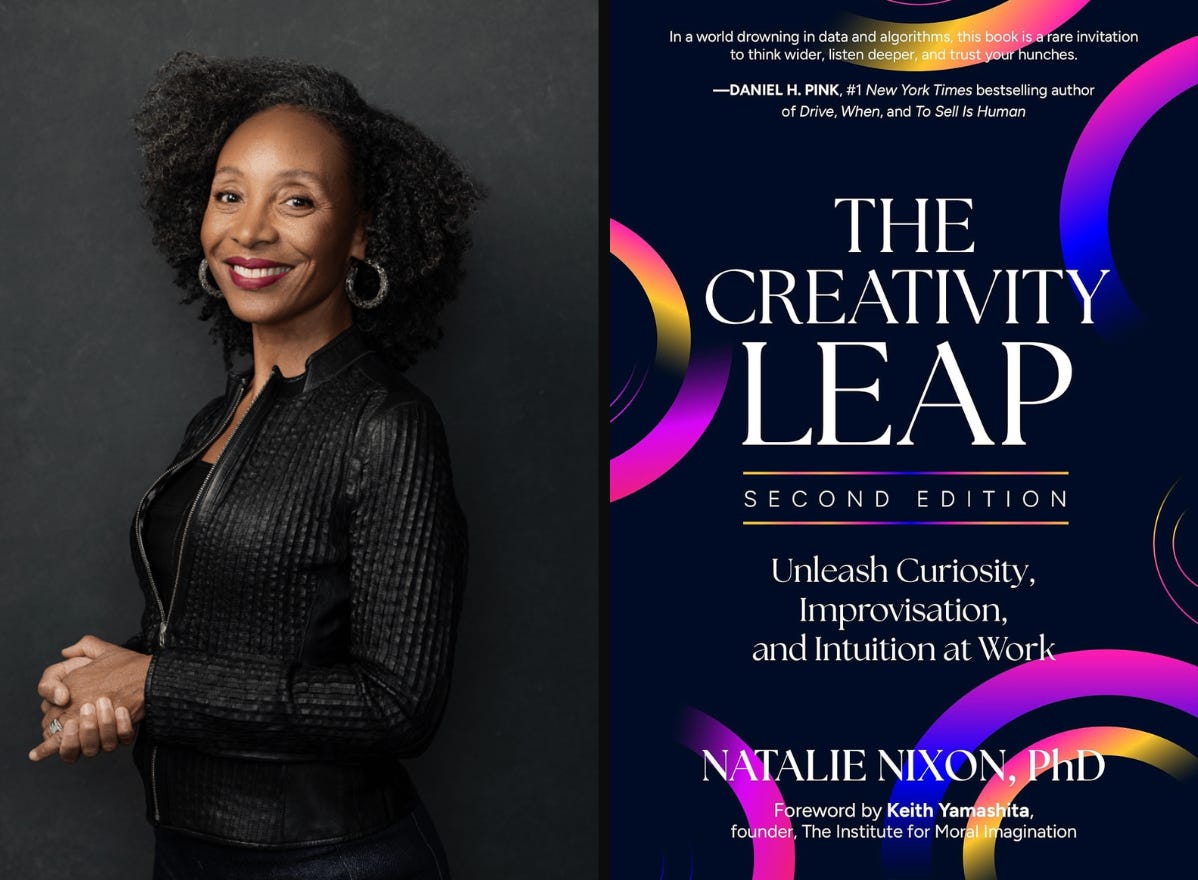
At the 2025 Adobe Summit in Las Vegas, CEO Shantanu Narayen made a declaration that is near and dear to my heart: “Creativity is the new productivity!” I loved that pronouncement. That’s partly because it resonated with what was consuming my attention as I prepared to launch my 2025 book, Move. Think. Rest., a fresh and human-centered take on productivity. But I also loved Narayen’s perspective because the notion that creativity is the means to our best productivity serves as a bridge to my newest work, the second edition of my very first book, The Creativity Leap.
In the new Chapter 10, “Algorithms & Awe,” I make the case that if we want AI technology to amplify what makes us uniquely human, then we must take agency to ensure that a dystopian future does not “just happen to us.” To counter that potential outcome, we must consistently ask questions of the technology to ensure ethical and meaningful outcomes.
Increasingly, our productivity feels like it’s gaining a boost from AI. However, that promise of greater efficiency can lead us into the trap of working like an AI-Human-AI sandwich. That is to say, we start with the AI and end with the AI while the human dimension (for example, our curiosity, intuition, and improvisational inclinations) becomes an afterthought.
Instead, we’d be better off working like Human-AI-Human sandwiches, where the AI can help us build on our initial human conception, and then we take the baton to further develop ideas and answers through in-person conversations, collaborations, critical thinking, and pondering.
“We’d be better off working like Human-AI-Human sandwiches.”
The foundational principle of The Creativity Leap is that creativity is your ability to toggle between wonder and rigor to solve problems, deliver novel value and discern meaning. Creativity is not a nice-to-have; it’s a critical requirement and strategic capability in a world of burnout, tech FOMO, and morphing rules for work. I make the case that fortifying our minds with awe, wonder, and human consciousness will be increasingly crucial alongside the rigorous critical thinking and experimentation that ultimately amplifies what makes us uniquely human.
Here are five questions I propose we consistently ask in order to build creativity as a strategic capability alongside AI.
“But, why…?” Pausing to ask this question is ideal before electing to automate, for example, a workflow. This question requires us to pause and question whether the tech makes sense situationally and contextually. We are often seduced by speed. But if a computerized tool is applied incorrectly, then haven’t we ultimately wasted time?
“Is this tool sharpening my thinking, or replacing it?” These days, not only do we need to be concerned with AI slop, but also with brainrot. This sounds harsh, but if we do not exercise critical thinking, mind wandering, and curiosity, well, we stand to lose those tools of human intelligence.
“How can AI help people flourish?” Burnout rates are pretty staggering. According to the Anatomy of Work Index, it’s estimated that 71 percent of US workers have experienced burnout. This amounts to a $300 billion cost to businesses (according to the American Institute of Stress) due to resulting absenteeism, turnover, and higher insurance rates. If we fill the saved time with more work, instead of time for creative activity such as problem solving, reframing questions, prototyping, reflection, and daydreaming (yes, daydreaming!), then we will die a slow death at work.
“What if…?” This question helps us to use AI as a springboard. And it nicely encapsulates the WonderRigor™ dynamic where wonder is the catalyst and spark to imagine audaciously, and rigor is the tool to help us excavate and go deeper on a particular topic.
“At whose expense?” People’s lives, ideas, and experiences make the training data for AI possible. I know this from personal experience as the first edition of The Creativity Leap was included in the class action lawsuit against Anthropic. Ease’s elegance can blind us to the workers and thinkers behind the scenes.
Here’s what we must remember. We are in the midst of a human revolution, not simply a technological one. Algorithms and code are only as good as the questions people pose and probe. What if we are at an inflection point where we can harness technology in ways that amplify what makes us uniquely human? We cannot lose sight of that possibility.

I love your perspective to think about AI in a way we can harness it to make us uniquely human, instead of replacing our own creativity and point of views.