
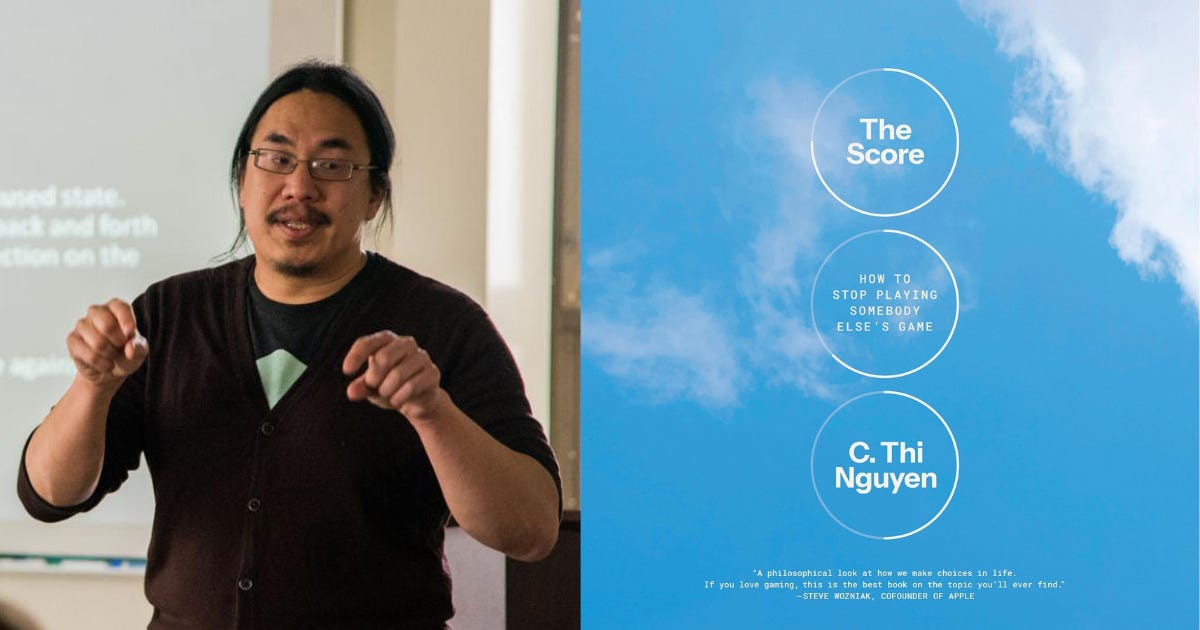
Games are supposed to be fun. Metrics are supposed to be useful. But somewhere along the way, many of us ended up obsessing over scores, rankings, and numbers that don’t actually reflect what we care about, and letting them quietly dictate how we live and work.
In The Score, philosopher C. Thi Nguyen, one of the leading thinkers on the philosophy of games and data, asks a deceptively simple question: Is this the game you really want to be playing? Drawing on everything from video games and sports to cooking, fly-fishing, and bureaucracy, Nguyen shows how scoring systems can either liberate us or trap us. In games, scores help us experiment with values and rediscover the pleasure of action itself. In institutions, metrics often do the opposite: flatten what matters, outsource our judgment, and nudge us toward what’s easiest to count rather than what’s most meaningful.
Here, Nguyen answers 21 questions about games, metrics, and how we decide which ones are worth playing.
21 Questions with C. Thi Nguyen
1. I couldn’t have written my last book without…
About twenty people who believed in my utterly absurd project and kept pushing me to keep at it.
2. What’s the thing most people get wrong about being a writer?
That the easier it is to read, the easier it was to write. The truth is that it’s easy to turn out technical, complex, exhausting sentences. Refining difficult ideas into clean, easy-to-read, digestible packets—without losing complexity—is gruelingly hard.
3. Hemingway wrote standing up; Edith Wharton, lying down. What are your quirks?
If I have an intellectual puzzle or writing puzzle, I sketch it on a whiteboard, and yo-yo at it. And if that doesn’t work, I go fishing or hiking and try to forget about it completely. Halfway up the mountain, the solution normally appears.
4. What income streams make up your writing business?
I have the luck of being a philosophy professor, which means I have the financial support to not depend on writing, and a career which encourages intellectual exploration. It also takes up 80% of my working time.
5. Have any tech tools made your job easier?
Scrivener is the most lovingly made piece of software that actually offers tools to think and organize complex ideas, instead of tools made for graphical layout.
6. What new tools or distribution channels do you want to try?
I want kids to make memes of the ideas in my books. But they’re probably all too cool to actually do it.
7. Where do you find new ideas?
Inhaling piles of other books—history, philosophy, anthropology, literature, sci-fi, and fantasy. And then doing weird junk in my spare time.

8. How do you keep track of new ideas?
Written physical notebooks help me think and formulate ideas. Notes on my phone are actually searchable and findable. Transcribing physical notes into electronic notes is often a good way to start thinking.
9. What’s the best piece of professional advice you’ve ever received?
At a creative writing workshop: “Look around this table. There are 15 other students. About 12 to 13 of them will give you critical advice that is completely useless to you. That’s fine and normal. What matters is finding the two or three who truly get what you’re doing, and will help you push it to be better.”
10. And the worst?
“Nobody wants personal stories in your philosophy work; it’s unprofessional.”
11. What is the one piece of advice you would give to recent graduates that want to make a living as a writer?
Every weird new idea goes in a notebook, no matter how dumb. Every idea gets a chance to breathe and some attention. No instant dismissals as “dumb.”
12. Whose career do you most admire and why?
Tove Jansson, who managed to create strangely moving and bittersweet children’s cartoons—the Moomins—and also wrote some of the strangest, most incisive, most bitingly clear adult novels. Though the same bittersweet thread runs throughout.
13. What’s on your nightstand right now?
Gideon the Ninth by Tamsyn Muir.
14. Coffee, tea, or something stronger?
Coffee to wake up, Chinese oolong taken slowly to keep the caffeination level at the right level.
15. What’s the best non-writing skill that’s helped your writing career?
Talking like a human being about abstract philosophical issues in live settings, like Q&As and podcasts.

16. How many drafts before you show your editor?
5 to 20.
17. Can you describe your ideal workday?
Morning: stare at outlines, earlier drafts, sketches on the whiteboard. Then zen out and do something engaging with the fingers and body, but nothing too complicated, and space out completely. Let the subconscious process and take over. Lunch. Edit yesterday’s writing. Find the flow state. Around 2 to 3 pm: hopefully get a few hours of absorbed writing of new material.
18. How does that compare to your actual workday?
During the academic summer, pretty close. During the term, it’s snatches of writing desperately torn between classes, meetings, emailing, and grading.
19. What is your new book about?
Games and metrics. It’s about scoring systems: why scoring systems are often so fun in games, and so grindingly miserable in institutions, rankings, metrics, and social media scores. The answer lies in how games cultivate true freedom to play and choose your activities – and how metrics usually press down a distant conception of the good, on you.
20. Any new projects the Author Insider community can help support?
My new project is about how trust leaves us essentially vulnerable, but how humans cannot leave without trust—both in science and engineering, and in social life.
21. Any questions or feedback you would like from authors in the community?
Is my book too utterly batshit crazy?
One of Many
Author Insider publishes conversations like this regularly, plus interviews with publishing insiders and bestselling authors, reporting on industry trends, and strategies to help establish and grow a writing career.
If you’re curious, you can check us out here.
Until next time,
Panio Gianopoulos
Editorial Director, Author Insider & The Next Big Idea Club
Want to make a living as a writer?
Author Insider is for writers who take their craft—and their careers—seriously. Get behind-the-scenes publishing insights, tactical advice, and conversations that help you stay in it for the long haul. Subscribe for free, or upgrade to paid to access our live workshops and expert interviews.