
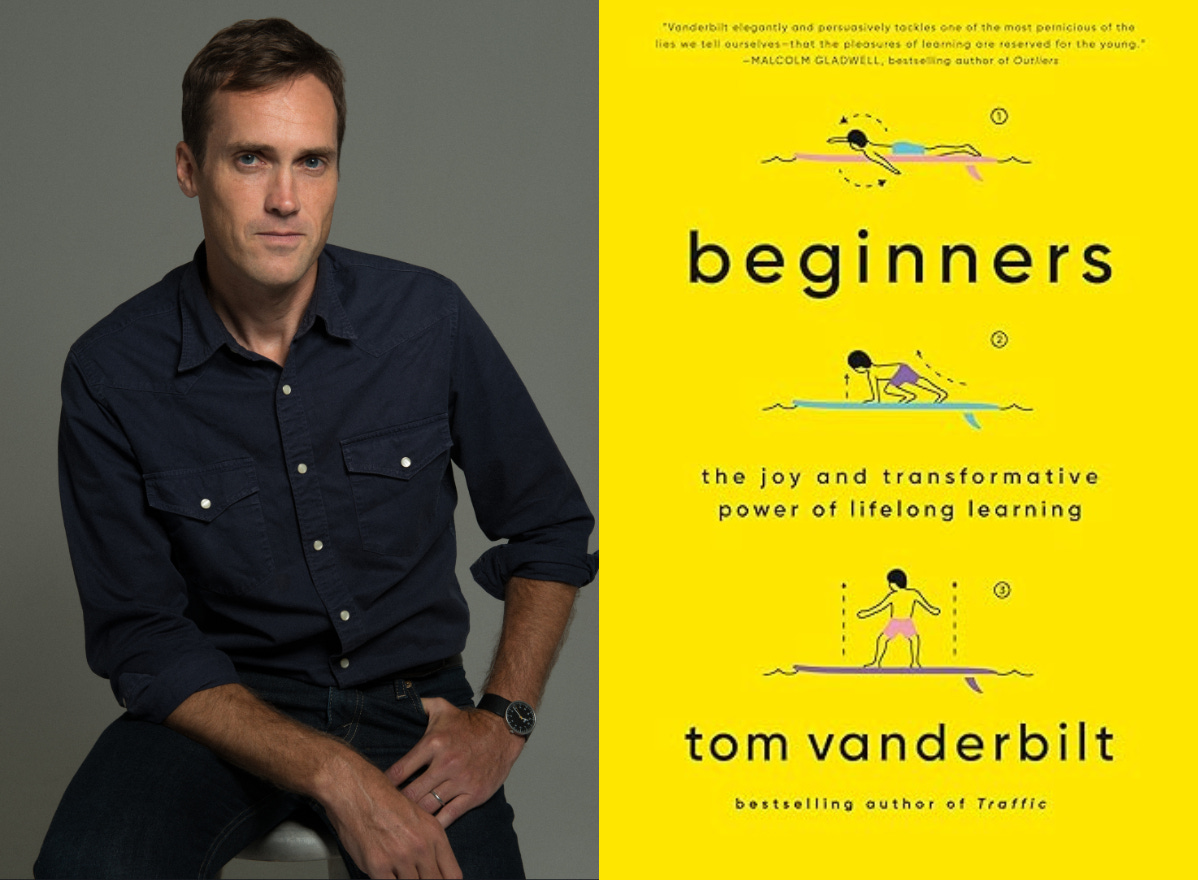
Few writers move as fluidly between the profound and the pedestrian as Tom Vanderbilt. He’s written about traffic jams, Cold War bunkers, sneakers, and the design of everyday life—revealing, in each, something unexpectedly human. His books include Traffic: Why We Drive the Way We Do, Survival City: Adventures Among the Ruins of Atomic America, You May Also Like: Taste in an Age of Endless Choice, and Beginners: The Joy and Transformative Power of Lifelong Learning, a witty, heartfelt look at what happens when we stop coasting on expertise and start learning again from scratch.
Now, he’s taking that same curiosity to the skies—well, to the terminals. His next book, still in progress, is about airports: those overlooked ecosystems of design, logistics, and collective behavior that somehow keep modern life aloft.
In this Author Insider Questionnaire, Tom talks about juggling (literally), deadlines, and the unexpected pleasures of being a professional observer in a world that never stops moving.
26 Questions with Tom Vanderbilt
1. I couldn’t have written my last book without…
Logistically, I’ll say my publisher. I’ve been lucky enough to have the same publisher (Knopf) for four books now, with a lot of the same editorial staff intact — which is rare. Spiritually, though, it would be my wife, who listens to my kvetching and entertains my crazy ideas but, also being a writer, can relate to the vicissitudes of the life.
2. What’s the thing most people get wrong about being a writer?
At least for me, it’s the idea that writing is some kind of mystical process in which the Muse must be summoned in some remote off-the-grid cabin during a writer’s retreat. For me, if I can channel a bit the sci-fi writer Harlan Ellison, writing is a trade, and I’ve always taken as a weird sort of inspiration the no-nonsense work ethic one sees from plumbers or house painters. Whether you particularly feel up for it or not, you show up and do the work. Like Graham Greene, who made sure to get in his 500 words a day — though I aim for more like 1000 to 1500 — my process is largely habit.
3. What’s something you wish you’d started doing five years ago?
Buying Applied Digital stock.
4. Hemingway wrote standing up; Edith Wharton, lying down. What are your quirks?
I’m very fidgety, so every twenty minutes or so I bounce out of my chair, do some juggling with a set of balls I keep nearby, or run to the kitchen for endless coffee refills—and second or third breakfasts—or do push-ups, or listen to something loud and energetic (this morning Bad Brains’ “I Against I”), before settling back into my chair. I usually complete the “stand goal” on my Apple Watch before noon.
5. Do you read your reviews?
Without fail. I consider it free product testing, of a sort, and it’s always instructive to see what someone else makes of something you’ve been working on, alone, for several years. I used to also write quite a few book reviews myself, so I’m empathic to and respectful of the critical enterprise.
6. What income streams make up your writing business?
I would say roughly half of it comes from books, and roughly half comes from the world of traditional media (newspapers like the New York Times and Wall Street Journal, magazines like Travel and Leisure, Monocle, Inc., Outside, among many others). This is supplemented a bit from various forms of copywriting and sponsored content sort of work, for clients whose products I can generally get behind. In the years following the publication of a book, particularly Traffic, speaking engagements loom larger.
7. Is there a book you wish you’d written?
Barbarian Days by William Finnegan. But then I would have had to live that life, which doesn’t sound bad either.
8. Have any tech tools made your job easier?
Transcribing interviews was always the bane of my existence—tiring and time-consuming—so the emergence of ever more robust A.I. transcription tools (I use Rev Max) has been nothing short of revolutionary. Secondly, my iPhone. It still amazes me, when doing field reporting, that virtually every tool I would need to do the job is contained on one device.
9. How has AI changed your writing process?
It hasn’t, in that I don’t use any A.I. tools to edit passages from my work, or make editorial suggestions. I have asked A.I. platforms, once in a while, to do something like generate a headline for an article, but I’ve found the results competent to a point, but also predictable and flat, not passing the writerly Turing Test.
I do use it sometimes in the research process, but it presents some of the same problems for me as does having a research assistant (which I don’t) — i.e., in the time I spend setting up the exact contours of what information I’d like, I probably could have just found it myself.
Also, I find it just tends to deliver the most rote, readily accessible information that it can scrape, whereas I tend to be looking for the curious, unexpected nuggets, the kind found buried in endnotes, the sort of things that give your non-fiction brain a tingles, and that, hopefully, your readers may pass on to their partner at bedtime as they read your book.
10. Where do you find new ideas?
I sometimes think of a great scene in the movie Heat, where Robert DeNiro is asking the hacker character, wonderfully played by Tom Noonan, about some bank blueprints he has procured. “How do you get this information?” DeNiro asks. “This stuff just flies through the air. You just got know how to grab it. See, I know how to grab it.”
So, I’ll be reading some long article in The Financial Times, for example, and there will be some throwaway line near the end about something that strikes me as, or more, interesting, than what the article itself was about. I also read more tertiary publications, like trade or alumni magazines, sometimes finding stories that might have a more mainstream interest. And then just always keeping my eyes and ears open, when talking to friends or walking down the street.
My Traffic book literally came out of a random moment driving on the highway. A piece I wrote on data centers happened because I was playing Xbox and wondered where the game “lived.” I once wrote a big piece on pallets and how they changed the world of shipping (and thus the world) because I kept seeing abandoned pallets lying around while I went on walks.
11. How do you keep track of new ideas?
I wish I had some cutting-edge application to share here, but honestly, I mostly just write lists in an oversized Moleskine notebook.
12. What’s the best piece of professional advice you’ve ever received?
The eminent, legendary editor Lewis Lapham, ahead of a magazine assignment, once told me: “Don’t try and write a book,” and “Have fun with it.” And what did I do? I turned in a deadly earnest, fantastically overresearched piece that was five thousand words too long.
13. And the worst?
“Write what you know.” Everything I write comes from a desire to know, and then to share that knowledge.
14. What is the one piece of advice you would give to recent graduates that want to make a living as a writer?
Don’t.
But seriously, when I moved to New York years ago, I thought I could just open the New York Times “help wanted” ads and find staff writer jobs for The New Yorker just sitting there. Instead, it was mostly ads for publications in two industries: Porn and finance.
So my own path was just to get an unglamorous, not overly taxing day job and then spend all my spare time writing for whatever publication would have me. The writing landscape has obviously changed massively, but some things have not — e.g., you can still get “discovered” while writing for small, obscure publications (even if that’s your own newsletter these days). And who knows, even that day job you have may, down the line, provide grist for your own writing (would Melville have written “Bartleby the Scrivener” had he not worked as a clerk?)
15. Whose career do you most admire and why?
Werner Herzog. The vision, the audacity.
16. What’s on your nightstand right now?
The Name of the Rose, Umberto Eco; Spent, Alison Bechdel; A Haunting on the Hill, Elizabeth Hands.
17. Foreign rights, audio rights, film rights: which have been the most valuable to you?
Foreign rights, no doubt.
18. How did you find your agent?
Zoe Pagnamenta and I met many years ago, through a sort of literary cocktail party set that was then active in New York City, centered around publishers’ book parties and places like The Paris Review. Zoe was not actually my first agent, but when I needed a new one, my thoughts turned to her.
19. Coffee, tea, or something stronger?
Coffee before noon, tea after.
20. What’s one marketing tip you’d give a new author?
Don’t turn down any opportunity to promote your book; even the small ones keep you tuned for the bigger stuff.
21. How are you using social media to grow your audience?
I post pretty pictures on Instagram—does that help?
22. How many drafts before you show your editor?
At least a few. For big projects I tend to print out material at some point, and edit on paper, which to me feels like a whole different way of looking at what you’ve written.
23. Can you describe your ideal workday?
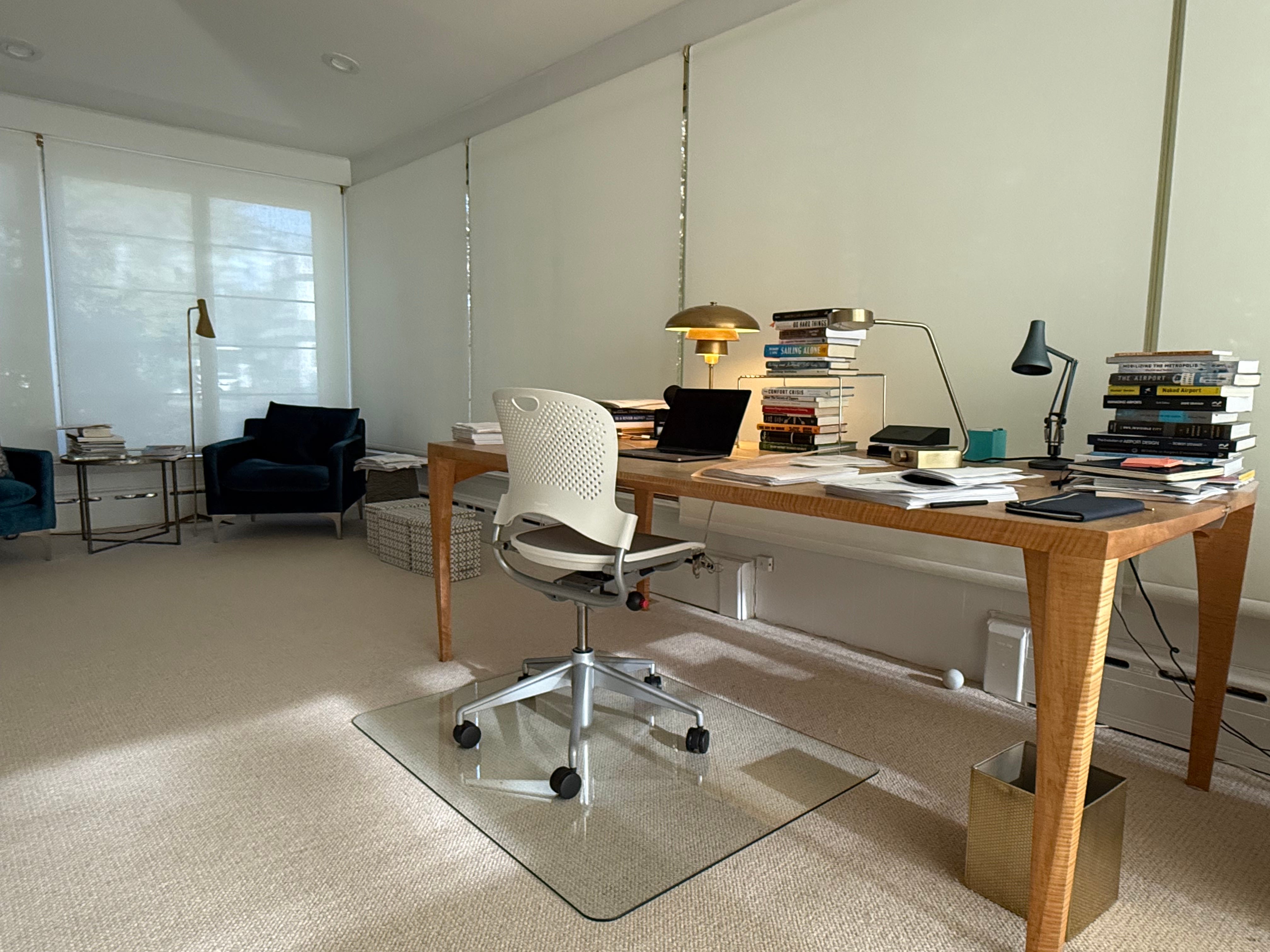
I wake at 6, take a cold plunge, read Turgenev, consume matcha and head to the Zen stillness of my office for an uninterrupted block of deeply meaningful work.
24. How does that compare to your actual workday?
I wake at 7:20, rush to get my daughter to school while wolfing down a buttered bagel, then take my wife to the train. I get home, where there’s 27 emails, five of which demand immediate action (copy edits to approve, fact-checking queries to answer, contracts to electronically sign). By 9:20 I microwave some hours-old coffee, spend two hours writing a 100-word lead paragraph, then forget I have a lunch meeting and scramble out the door. And so on.
25. What do you wish you’d known when you were starting out?
That editorial rates would not only fail to keep pace with inflation, but actually go backwards!
26. What is your new book about?
Airports. Everything you always wanted to know (or didn’t think think you did).
Want More Insights?
If you enjoyed this questionnaire, you’ll love the rest of Author Insider—real talk, publishing insights, and creative wisdom from bestselling authors and industry pros.
Subscribe free (or paid, if you’d like to support our work) and join the community.
Until next time,
Panio Gianopoulos

Editorial Director, Author Insider & The Next Big Idea Club