
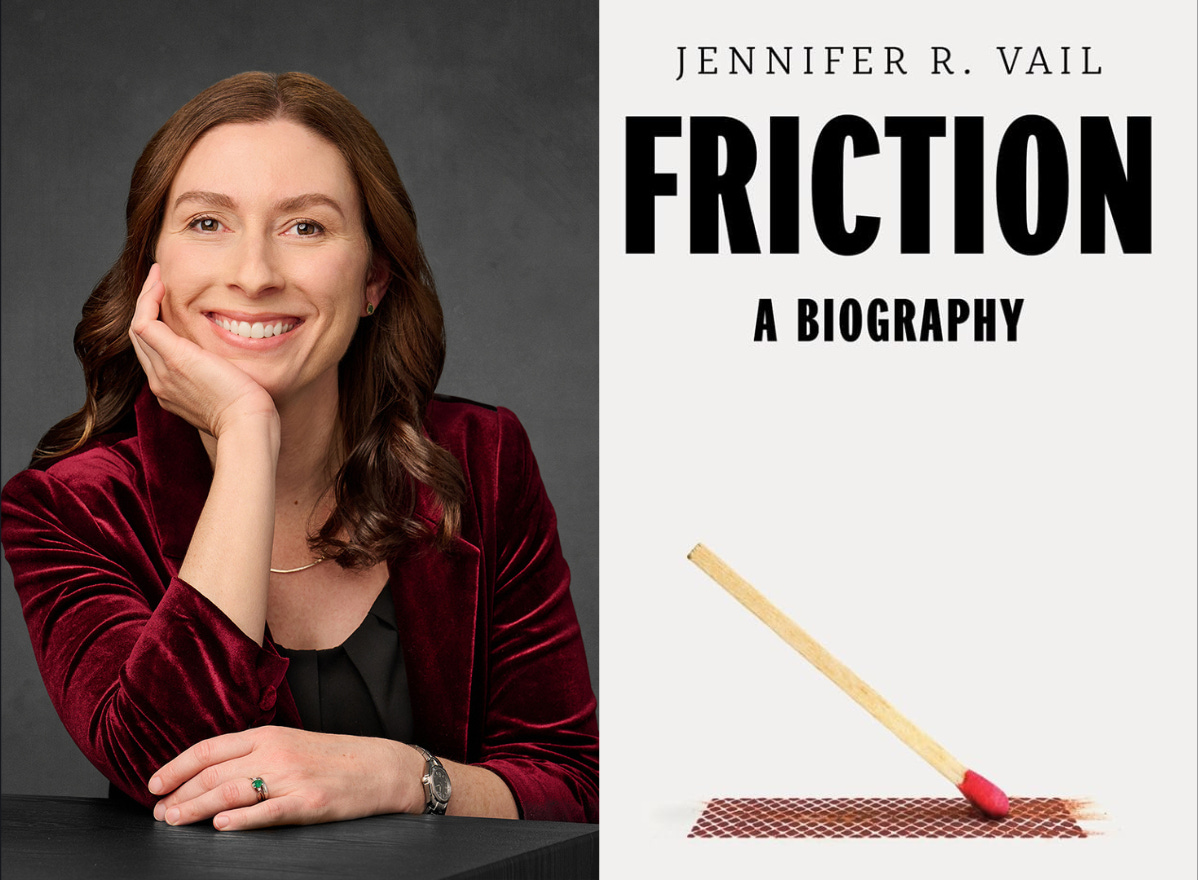
Friction is usually framed as a problem. It’s the reason doors creak, engines wear down, and progress feels hard. But as Jennifer R. Vail explains in her forthcoming book, Friction: A Biography (January 2026), resistance isn’t just an obstacle; it’s a driving force behind innovation, discovery, and human advancement itself.
A materials scientist by training and the founder of DuPont’s first tribology* research lab, Vail has spent her career studying friction at the most fundamental level. Now she brings that expertise to a broader audience, tracing how this invisible force has shaped everything from fire and flight to medicine, space exploration, and climate science. It’s a sweeping, intellectually intriguing exploration that connects Newton and da Vinci to modern engineers.
In her Author Insider questionnaire, Vail reflects on making the leap from scientific journals to narrative storytelling while writing her first trade nonfiction book, learning to trust imperfection, and why saying yes to discomfort has been central to both her career and her creative life.
*Tribology: the study of friction, wear, lubrication, and the design of bearings; the science of interacting surfaces in relative motion (I didn’t know it either.)
21 Questions with Jennifer R. Vail
1. I couldn’t have written my last book without…
My editor and my desktop computer. This book wouldn’t exist without my editor in the very literal sense. She watched my TED talk, approached me, and the rest is history. It was my first time doing non-fiction writing that wasn’t for scientific journals, so she had a lot of patience with me as I figured out the process!
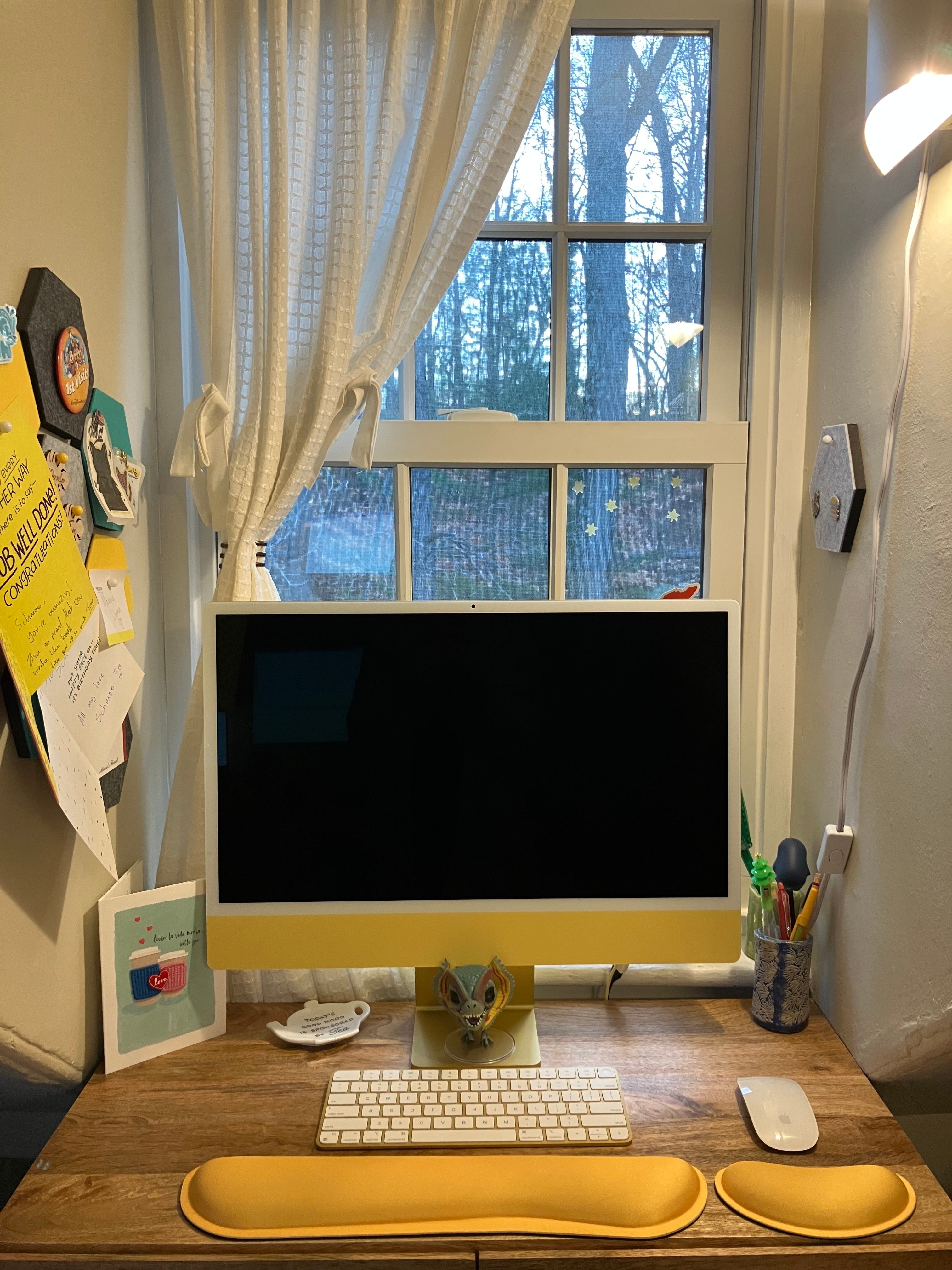
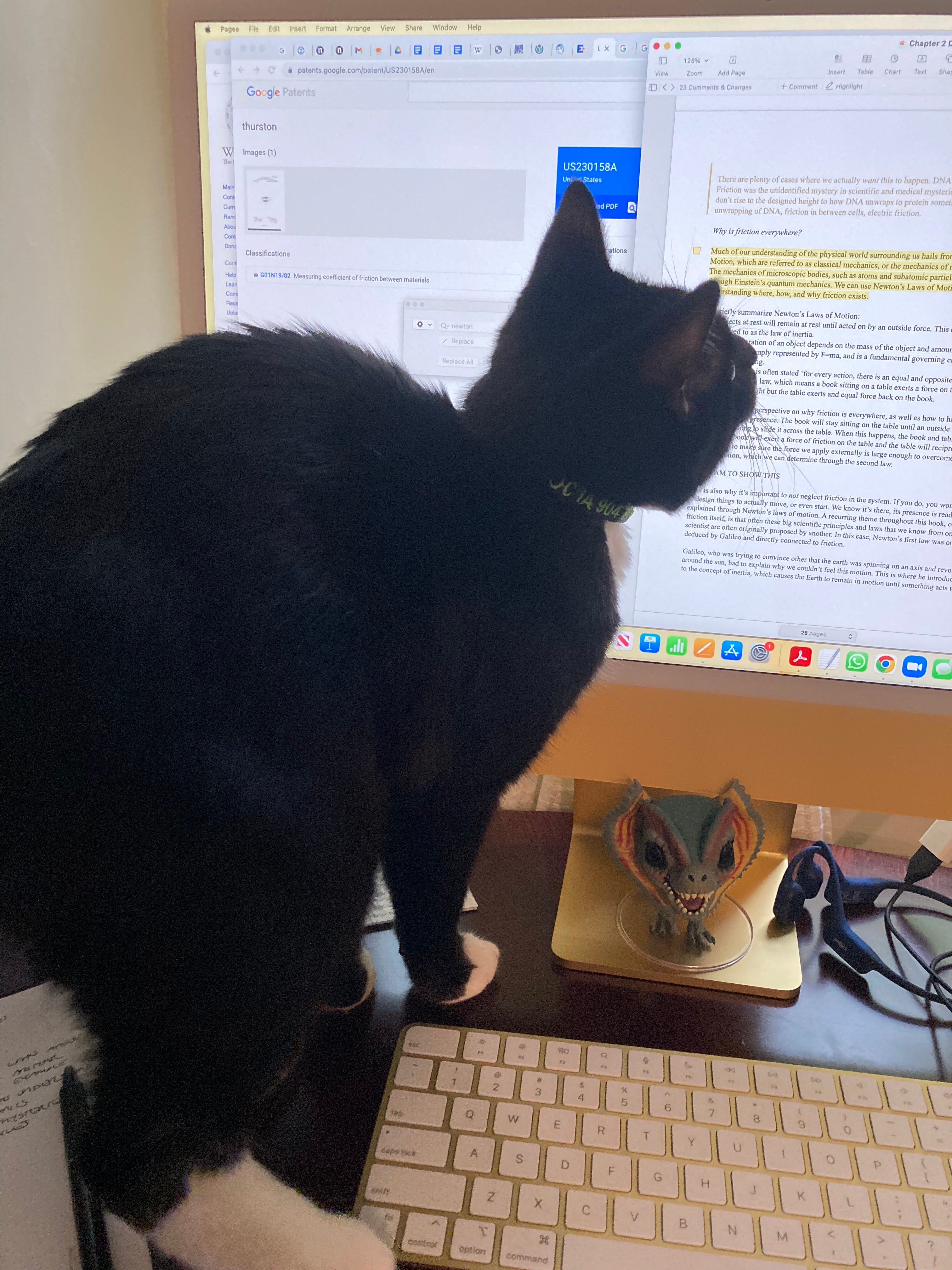
When I started, I only had a small laptop, which just wasn’t cutting it for all the tabs and windows I had open for research. My iMac was a game-changer in that respect, and I surprised myself by getting a yellow one. The color just makes me happy, and when you’re trying to untangle your own thoughts, the happy color really does help your mindset!
2. What’s something you wish you’d started doing five years ago?
More stretching. Always do more stretching than you think you need to do!
3. Hemingway wrote standing up; Edith Wharton, lying down. What are your quirks?
I write wearing a pink t-shirt my husband made me that says I Don’t Wanna. He probably should have made one for every day of the week, but since it’s just the one, I’d put it on over whatever I was wearing and hunker down to work.
4. Do you read your reviews?
I skim them. The feedback is important and helpful, but reviews make me nervous.
5. What income streams make up your writing business?
This is my first book, so my income stream has been solely from my day job and putting my engineering degree to work.
6. Is there a book you wish you’d written?
Number the Stars by Lois Lowry. A teacher read it to my class when I was eight years old, and despite all our different backgrounds and interests, every kid paid attention. That alone felt magical to me. It was the book that taught me the power of writing, the reach of an author, and that stories can transport you to another time and place while making you feel like you yourself are living in it. Lois Lowry opened up an entire world of storytelling for me. I started scribbling fiction stories afterwards and have done so throughout my entire life. My second pick would have been The Giver, which is also by Lois Lowry!
7. Have any tech tools made your job easier?
AI is a helpful tool in the research process. I appreciate how quickly it can compile a list of potential resources. Of course, I read through the material myself, but it can be amusing to look at the AI summaries to see what correct or incorrect conclusions it comes to.
8. How has AI changed your writing process?
While AI has enhanced my research process, it hasn’t impacted my writing process. So many friends and colleagues use AI for things like writing work emails, but instead, I’ve doubled down on writing everything myself. I’m sure AI can make things sound better, but for me, if it’s not coming from my own thoughts, it isn’t authentic. Imperfections are beautiful and human.
9. Where do you find new ideas?
Everywhere! For non-fiction, I have to credit conversations with friends as being a great driver of ideas. Happy hour discussions have led me down endless rabbit holes and revealed what others find interesting. There are parts of my book that I wrote after chatting with friends and realizing that things I thought were fun facts were also fascinating to them.
10. How do you keep track of new ideas?
Sticky notes, which I’ll eventually type into a document or spreadsheet. If paper isn’t available, I type it into notes on my phone.
11. What’s the best piece of professional advice you’ve ever received?
Say yes to things that make you uncomfortable. Not in an unsafe way, of course! Leading projects, stepping outside your comfort zone, developing or flexing a new skill. These are all things that lead to growth, as well as unexpected and exciting opportunities. When I look at things I consider professional highlights, they all stemmed from someone encouraging me to do something I never would have considered on my own.
12. And the worst?
To take a difficult situation and put it in a box, close the lid, and set it aside. You know if something isn’t right, so trust your instinct and don’t let others minimize your concerns.
13. What is the one piece of advice you would give to recent graduates who want to make a living as a writer?
That it’s okay if you have to take on a separate job to pay the bills as you get yourself going. There are a surprising number of roles in a variety of fields that involve writing, which allows you to keep exercising that muscle. Every STEM or engineering company I’ve worked for has had writers on staff.
14. Whose career do you most admire and why?
Katharine Blodgett. I learned about her while writing my book and am in awe of her. She was the first woman to receive a PhD in physics from Cambridge and the first woman to work at GE’s famed research labs in New York. She was a pioneer in STEM who enabled future women like me to follow in her steps with our own PhDs and research.
15. What’s on your nightstand right now?
Midnight in Chernobyl by Adam Higginbotham.
16. How did you find your agent?
I don’t actually have an agent right now (my editor found me through TED).
17. Coffee, tea, or something stronger?
Tea. I avoided both until I moved to England and didn’t want to keep missing out on the tea breaks at work. Herbal and rooibos were my gateways into ceasing my sacrilegious ways. Now I have an entire cupboard of loose leaf blends galore.
18. What’s one marketing tip you’d give a new author?
This would be a fun one to revisit after my book is finally out there. Right now, I am the new author looking for marketing tips.
19. How many drafts before you show your editor?
This book followed an atypical process, so I don’t have a straightforward answer. Since I was a total newbie, I had to learn along the way. I would take a stab at a chapter and send it to my editor to see if I was on the right track. All I can do is grimace, trying to add up the total number of drafts she got subjected to.
The original “first draft” of the entire book is painful for me to read now. I went back and rewrote a lot of the book after taking a breather from the content. Many apologies to Rachel for the gobbledygook I made her suffer through. For future books, I would make sure to write the entire book first and do revisions before subjecting my editor to it.
20. What do you wish you’d known when you were starting out?
It’s an evolving process that will test and push you, but in the end, writing a book is a very forgiving process. You can go back and rewrite something that isn’t sitting well with you. You can change the direction of the book or completely scrap an idea you originally thought was brilliant. There aren’t a lot of things in life that offer that type of flexibility and fluidity; it is one of the most beautiful things about writing. It was easy to forget that along the way and early on, I let the idea of perfection hinder my progress.
21. What is your book about?
The physical force of friction, the unexpected ways it impacts our lives, and its role in our technological evolution.
Want to go deeper?
You can pre-order Jennifer’s book, Friction: A Biography (January 2026), and watch her TED Talk, “The Science of Friction,” which has been viewed more than two million times.
For more conversations like this, and publishing insights from industry pros and bestselling authors, check out Author Insider.
Until next time,
Panio Gianopoulos

Editorial Director, Author Insider & The Next Big Idea Club