
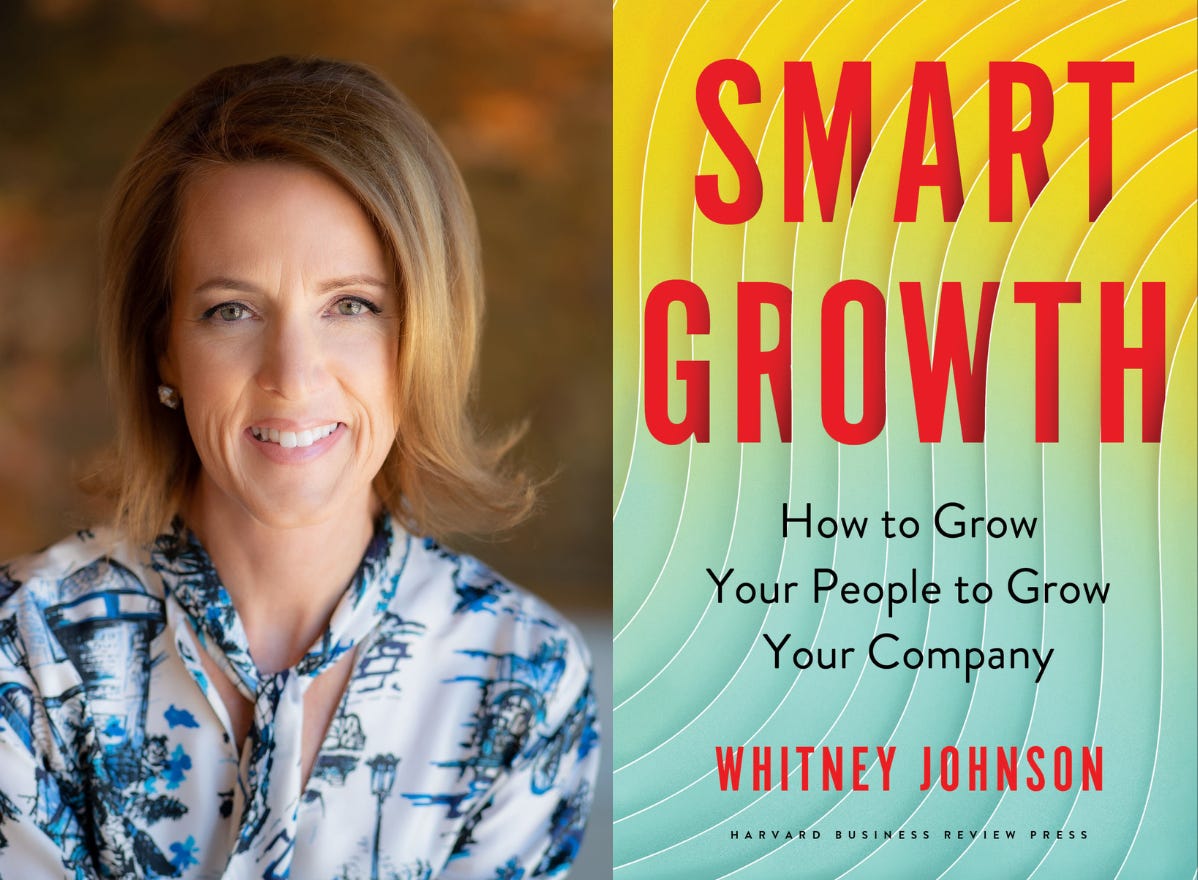
Whitney Johnson has spent her career studying growth—why it happens, how it happens, and what it really takes to transform. As the CEO and co-founder of Disruption Advisors, she helps leaders and teams climb what she calls the S Curve of Learning, a framework rooted in psychology, innovation theory, and her early career as a Wall Street analyst. But behind the models and metrics is something quieter and more personal: a writer learning to claim her own voice.
Her books—including Smart Growth, Build an “A” Team, and Disrupt Yourself—translate big, structural ideas into smaller, human ones. They’re about risk, reinvention, and the courage to change your trajectory. But they’re also about listening—to your work, to your life, and to that restless inner voice when it says it’s time to try something new.
In this Author Insider Questionnaire, Whitney reflects on becoming the person who can write the book you’re meant to write.
23 Questions with Whitney Johnson
1. I couldn’t have written my last book without…
Julie Berry. She’s a New York Times bestselling young adult author—and a long-time friend. When I was about 70 percent of the way there, I handed her the manuscript. She gave it the edit it needed. Generous, but unflinching. (I may have used the word “eviscerated.”) Maybe no book ever reaches 100 percent of what you wanted it to be—but she helped me get close.
2. What’s the thing most people get wrong about being a writer?
That it’s a solo sport. It’s not. (See above.)
3. What’s something you wish you’d started doing five years ago?
Playing more tennis. I love the sound when the ball hits the racket in just the sweet spot.
4. Hemingway wrote standing up; Edith Wharton, lying down. What are your quirks?
I have a workspace, but more often than not, I sit in a cozy chair with my laptop propped up on a pillow (like I’m doing right now).


5. Do you read your reviews?
Of course. Partly because my ego can’t resist. But mostly because the good ones can be shared—and sharing leads to more readers.
6. What income streams make up your writing business?
I don’t have a writing business per se. What I have is a consulting and speaking business built on my ideas. The writing codifies those ideas. Memorializes them.
7. Kiss, marry, kill: podcasts, newsletters, and speaking gigs.
Kill none of them.
Marry podcasts. I love interviewing people. My Disrupt Yourself podcast is on pause while I write my next book, but it’s a love I want to get back to.
Kiss newsletters. I’ve had one for over a decade but haven’t publicized it well. I think I need to do more kissing and telling. That said, there are newsletters I frequently read—Susan Cain’s, James Clear’s, and Dan Pink’s. Always inspiring!
Speaking gigs is a love/hate relationship. On days when the energy is wrong, or I’m off my game, I want to kill them. But mostly, I want to marry them. Because when a speech lands and an audience is ready to hear it, that’s not just kiss and marry—that’s the whole love story. A communal moment when you all feel something. Kiss, marry, have a baby.
8. Is there a book you wish you’d written?
Falling Upward by Richard Rohr or From Me to We by Jim Ferrell.
9. What new tools or distribution channels do you want to try?
When I relaunch my podcast, I want it to be video. I’m working on uploading all my content into an LLM to see what the model helps me create. I’m curious what patterns emerge that I can’t yet see.
10. How has AI changed your writing process?
I now have a 24-7 conceptual, line, and copy editor—a continual reminder that I need to be even more human.
11. Where do you find new ideas?
Everywhere. From making meaning of my lived experience. From my clients. From snatches of conversations. From books, YouTube videos, podcasts. From talking with colleagues, friends and family. From AI. And not infrequently from God.

12. How do you keep track of new ideas?
Notes on my phone. Journal. Excel spreadsheet.
13. What’s the best piece of professional advice you’ve ever received?
“Stop saying you’re not a writer.” This was when I was writing Smart Growth—my fourth book, by the way—and I said, “Well, I’m not really a writer.” My editor stopped me cold (see #1). There was an identity piece I wasn’t owning. That prompted an important shift.
14. And the worst?
Negotiate like a man. It completely backfired. I have learned to negotiate like a woman. Like me.
15. What is the one piece of advice you’d give to recent graduates who want to make a living as writers?
If you love to write and that’s what you want to do, figure out a business model that allows you to do it.
16. Whose career do you most admire and why?
Orit Gadiesh, Chairman of Bain and Company. She’s brilliant, strategic, and fiercely herself.
17. What’s on your nightstand right now?
Immortal Diamond by Richard Rohr
Gone Before Goodbye by Harlan Coben
The Unselected Journals of Emma M. Lion by Beth Brower
18. Coffee, tea, or something stronger?
Diet Coke. Always.
19. What’s one marketing tip you’d give a new author?
Ask people personally to buy your book. Not in a mass email. Not on social media. Personally. One person at a time. It takes a lot more time, but it also signals that not only is this book important, but this person matters to you.
20. What’s the best non-writing skill that’s helped your writing career?
I majored in music in college. Three hours of practice a day taught me discipline. But it also taught me to listen. I structure chapters like movements in a sonata. Paragraphs like phrases—they need to breathe. I love it when a motif shows up early, then returns later, changed. And when something will be read aloud, I’m always listening for the melody.
21. What do you wish you’d known when you were starting out?
That finding my writing voice is a process. A wonderful process. It’s about excavating self. And that takes time. So be willing to be in it. And recognize that sometimes a book can’t be written until you are the person who can write the book.
22. Fill in the blank: In five years, successful authors will all be _____.
Pro-human users of AI. They’ll leverage technology ever more successfully while continuing to disrupt themselves, mining their internal, lived experience for great material. More human than ever.
23. What is your new book about?
Stability. Finding your footing when everything is shifting.
Want More Insights?
If you enjoyed this questionnaire, you’ll love the rest of Author Insider—real talk, publishing insights, and creative wisdom from bestselling authors and industry pros.
Subscribe free (or paid, if you’d like to support our work) and join the community.
Until next time,
Panio Gianopoulos

Editorial Director, Author Insider & The Next Big Idea Club
what good questions !