
There’s a prevalent mythology around the writing life: quiet mornings with pages piling up on a big oaken desk, glamorous Manhattan lunches with literary agents, evenings at book readings. But the reality is profoundly different: writing usually happens between school drop-off and grocery shopping, lunches are quick grabs from the fridge, and nights are a scramble to grade papers and hit reporting deadlines.
In other words, it’s a hustle.
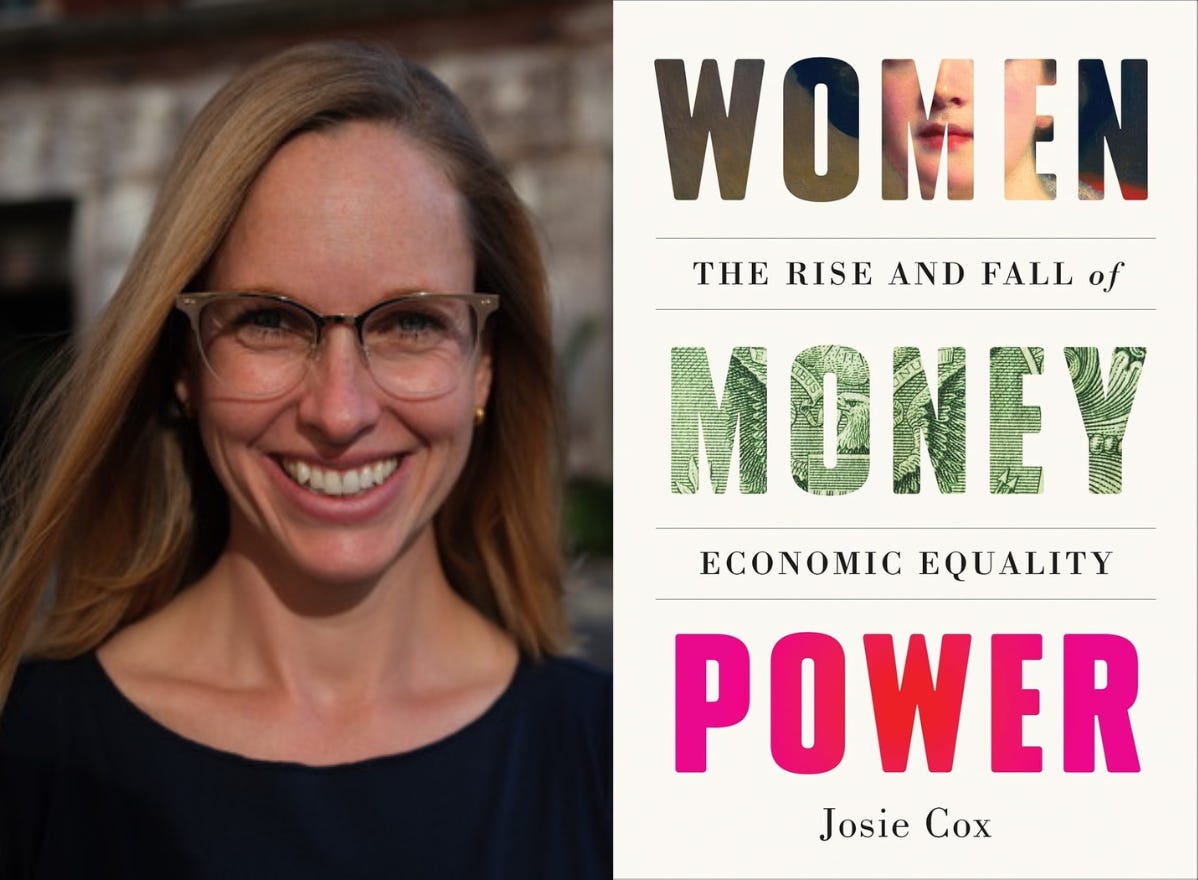
Few writers embody that hustle with more grit and range than Josie Cox. A former business editor at The Independent and a Knight-Bagehot Fellow at Columbia, Josie has reported from newsrooms across Europe and the U.S., ghostwritten books, taught journalism, and, in 2024, published Women Money Power: The Rise and Fall of Economic Equality. It’s a book that demanded deep archival digging, fearless ambition, and the kind of resilience honed over years in a fiercely competitive industry.
In her Author Insider questionnaire, Josie shares the realities behind the writing life: rejection, discomfort, self-promotion, the magic of newspaper archives, and why her next book—about forgotten women who reshaped U.S. history—is the project she can’t stop thinking about.
22 Questions with Josie Cox
1. I couldn’t have written my last book without…
A few things! First, a brilliant mentor who encouraged me to just give it a go (“What’s the worst that could happen?!”) My last book was also my first. I’d ghostwritten books in the past, but taking the leap and doing a book of my own and on my own felt somewhat terrifying. My mentor gave me that little shove I needed to plunge into this weird, wild, wonderful world of publishing.
Second, reliable childcare. When I was working on my book, I was also finishing grad school and working as a freelance journalist. (And before you ask, no, that wasn’t the plan.) So yes, my advance did mostly go straight to paying a part-time nanny who spent time with my then-toddler, and yes, it was an investment that was worth every penny.
And finally—and probably not the least bit surprising or original—lots of tea, coffee, snacks and long runs across New York City for when I hit that writers’ block.
2. What’s the thing most people get wrong about being a writer?
The money! The fame! The glamor! To earn a living wage, I’ve done all kinds of writing- and editing-adjacent jobs over the last few years. I’ve started teaching. I’ve done plenty of ghostwriting. I’ve consulted. I’ve taken on copywriting gigs that were far from fancy and exciting. And, let’s be honest, if I wasn’t covered by my partner’s health insurance I’d almost certainly not be able to do what I do — especially not while living in New York City.
The other thing that people don’t really tend to think of when they think of the life of a writer, is the rejection. In my experience, a huge part of writing books and being a freelance journalist is dealing with being told time and time again: “Not one for us, but good luck!” I’ve had to develop an extremely thick skin, but that’s also made me a more resilient person — even far beyond my writing work.
3. What’s something you wish you’d started doing five years ago?
Reading more fiction! When I started work on my last book I only allowed myself to read non-fiction books that would help me in my research for my own project. As I mentioned, it was an extremely busy time in my life and I didn’t think that I could afford the indulgence of reading “just for fun.” Novels were a no-go; so was non-fiction that didn’t relate in some way to what I was working on.
As it turns out, that was a ludicrous thing to think. Reading is such a joy, it should never be restrictive. Sure, I read books for research and work, but reading is also my main mode of self-care. So, at the risk of sounding melodramatic, I was denying myself something that was actually critical to my wellbeing.
Over the last two years, I’ve given myself carte blanche to read whatever I feel like and I’m convinced it’s made me a more versatile, more dynamic, happier and better writer and human.
4. Hemingway wrote standing up; Edith Wharton, lying down. What are your quirks?
I didn’t know about Hemingway’s standing up trick, but his advice to always stop when you know what’s going to happen next has stuck with me since I read A Moveable Feast a few years ago.
There’s nothing worse than the prospect of a blank page and absolutely no idea what to put on it. So when I’m working on a book, like I am at the moment, I always try to stop for the day in the middle of a paragraph, or even—if I’m feeling particularly brave—in the middle of a sentence. At the very least I jot down a few words and phrases to help me get back on track the next day. It doesn’t always work, but when it does it saves me a lot of “warm-up time.”
5. Do you read your reviews?
Absolutely. I’d like to say I don’t, but curiosity (or perhaps masochism?) always gets the better of me. And no, it’s not something I recommend.
6. What income streams make up your writing business?
Most of my income comes from writing and editing. I have a few commissioning editors at magazines, newspapers, and online outlets for whom I write essays, op-eds, and features regularly. I also do some paid broadcast work—mostly radio hits.
On top of that, in 2025, about 10 percent of my income came from teaching, about 10 percent from book-related revenue, and roughly 20 percent from public speaking gigs. I also did a tiny bit of ghostwriting and consulting this year. All in (*checks spreadsheet that rules my life*), I had eighteen income sources over the past 12 months. Lots of juggling, but I wouldn’t have it any other way.
7. Kiss, marry, kill: podcasts, newsletters, and speaking gigs.
Ha! Marrying is a big commitment. I’d kiss speaking gigs and podcasts. After almost three years, I recently put my own newsletter on ice. I loved writing it, but I’ve got a lot on my plate right now, and I didn’t feel like my heart was in it. And my readers, of course, deserve my heart to be in it. Hopefully, I’ll feel inspired to pick it up again at some point soon. But right now I’m learning to prioritize.
8. Is there a book you wish you’d written?
More than I can count. I’ve never published any fiction, but I love reading it and have such profound admiration for anyone who can develop storylines and characters out of, as far as I’m concerned, thin air.
I’ve just finished reading The Eleventh Hour by Salman Rushdie, and my mind was completely blown. Other great novels I’ve read over the past few weeks include Perfection by Vincenzo Latronico; The Lion Women of Tehran by Marjan Kamali; and Days at the Morisaki Bookshop by Satoshi Yagisawa. All very different but all such beautiful, thought-provoking, and inspiring pieces of writing.
In the world of non-fiction, I’m in awe of authors who write books that take you utterly by surprise. Again, there are too many to count, but a masterful example that springs to mind because I recently read it is Heather Radke’s Butts: A Backstory. It’s exquisite.
9. Have any tech tools made your job easier?
Transcription software and searchable digital newspaper archives. One of the things I hated in the past was having to play and rewind interview recordings a million times to find that single golden quote. Transcription software is imperfect, but it’s saved me countless hours of tedious work.
As for the digital newspaper archives, they’re a veritable trove of delights. Some people have Netflix, I have newspaperarchive.com.
10. How has AI changed your writing process?
I use AI, and especially generative AIs like ChatGPT, the way I’ve always used search engines. When I’m starting a new project or piece, I ask it to point me to credible primary sources. I also use it as a spellchecker and, occasionally, as a thesaurus. It hasn’t radically changed my process, but I’m enjoying exploring its capabilities and limitations. I’m cautious but definitely intrigued.
11. Where do you find new ideas?
At the moment, history. The book I’m working on now is a deep dive into a cast of characters who have largely been written out of an intriguing chapter in U.S. history. When I came across them, I first couldn’t believe they existed, and then couldn’t believe they hadn’t been written about before. It’s a real adventure and privilege telling their story, and I’m ridiculously excited to share it.
I also get ideas from newspaper archives, from other books, and from podcasts and documentaries.
12. How do you keep track of new ideas?
Not original, but the notes app on my phone. I’ve also started recording voice notes. It felt weird at first, but it’s a super-efficient way of capturing those unplanned fleeting thoughts that occur at the least convenient times: the middle of a long run, at school drop-off, while donating blood (yes, really).
13. What’s the best piece of professional advice you’ve ever received?
I don’t know if this counts as professional, but it’s certainly helped me in a professional context. When I went off to college many years ago, my mom urged me—by means of a quote often attributed to Eleanor Roosevelt—to “do one thing each day that scares you.” In the spirit of this, I’ve said yes to TV interviews, to big speaking engagements and to deadlines I wasn’t sure I could meet. In the moment, it’s been scary, but more often than not, it’s helped me understand what I can do when pushed.
14. And the worst?
Early in my career, an editor once put me on a high-stakes story and warned me not to “f*ck it up.” No other advice; just that.
I’m not exactly sure why, but it scared me senseless and dealt a massive blow to my self-confidence. The fear of failure and the repercussions of that failure almost paralyzed me.
So if you’re an editor: choose your words wisely. They’ll probably linger.
15. What is the one piece of advice you would give to recent graduates that want to make a living as a writer?
Be agile, curious, and say yes to the opportunities you think are “below you.” I started my career as an intern at a local TV station. At first, all I was allowed to do was make photocopies and send faxes.
Eventually, I graduated to writing first drafts of scripts for the weather show. That opened doors to better internships and bigger organizations, and eventually a full-time job as a staff writer.
In that capacity, I think what helped me was making myself available for the stories no one else wanted to take on — for the undesirable shifts, for what some might term “grunt work.”
It sounds obvious, but be the kind of person people want to work with. Be collaborative and receptive to feedback. No one wants to hire a writer who’s too precious to be edited.
In terms of book-writing, my last book wouldn’t have come about if I hadn’t been prepared to hear my editor out and be agile. When my agent and I sent him my proposal, he urged me to broaden it out, to be more ambitious in terms of scope and depth. It was intimidating, but it made for a much better book and a much more enjoyable book-writing process.

16. What’s on your nightstand right now?
A pile of old New Yorkers and books so tall my husband keeps telling me it’s going to topple over and crush me to death in the middle of the night.
At the top are Andrew Ross Sorkin’s 1929, Woody Allen’s What’s With Baum, the exceptional essay collection Goodbye to All That: Writers on Loving and Leaving New York edited by Sari Botton, Zadie Smith’s Feel Free, Paul Murray’s The Bee Sting, and Samantha Harvey’s Orbital.
17. How did you find your agent?
By shamelessly asking a former colleague whose books I admire for an introduction. For better or for worse, I think success in the publishing industry often depends on who you know and who’s willing to make an introduction. You may hate it, but never underestimate the power of networking and a good relationship with a former co-worker.
18. Coffee, tea, or something stronger?
(Green) tea and coffee. The occasional glass of prosecco to celebrate good book news. And snacks. Always snacks.
19. What’s one marketing tip you’d give a new author?
You are your own best spokesperson and PR.
Let’s be honest, self-promotion is awkward for a lot of people, but when you’re a new author, you’ve sort of got to suck it up and get over it.
My agent once gave me some great advice: find someone you think strikes the right balance between humility and self-promotion. Then emulate them. I’ve found that approach helpful. I do happen to be the kind of person who cringes at most social media posts, so having a bit of a blueprint definitely helps.
20. Can you describe your ideal workday?
Ideal? Wake up when I feel like it. Drink tea and have a breakfast that I haven’t had to make myself. Go for a glorious six-mile gazelle-like run through some sort of magical forest and, oddly, never once get out of breath. Come home. Take a bath. Have an excellent snack. Write the most profound, genre-defining prose for seven blissfully uninterrupted hours without once getting distracted or hungry. Get a call from my agent telling me I’ve won the National Book Award and that we’ve been offered a movie deal for the book I’m currently working on. Scarlett Johansson and Beyoncé are set to star. Have a delicious dinner with my husband, daughter, and our closest friends to celebrate. Hop into bed. Read for an hour. Asleep by 10 pm, knowing that I’ll wake up tomorrow and do it all again.
21. How does that compare to your actual workday?
I’ll let you be the judge of that!
On an average workday, I wake up at 7 am, get dressed, and wake up my daughter. I make us breakfast, prepare her lunch box, and get her ready for school. Then I walk her to school and usually jog back home while checking for any urgent emails or commissions.
I’m usually at my desk by about 9 am. Then I’ll do a few hours of calls, emails, and writing or edits if I’m working on a piece. If not, I’ll send some pitch emails to my editors or do some admin. You might be surprised how much time it takes to chase overdue invoices. Occasionally, I’ll do a broadcast hit in the morning—usually for one of the BBC radio stations in the UK.
At lunchtime, I’ll either have a lunch meeting with a source or editor, or I’ll head out for a workout—usually a run around the park or the gym—followed by a desk lunch of fridge leftovers or a bagel. I teach on Tuesdays in the fall, so sometimes I’ll have office hours with a student if it’s not a teaching day. At the moment, I’m trying to keep my afternoons free for book work, but I’m not always successful, and I’m generally quite bad at saying no to things. And of course, there’s also life that happens and chores that need to get done: laundry, groceries, doctor’s appointments… especially as a mom, it truly never ends.
When all goes to plan, I get about three hours of book work in before picking my daughter up from her after-school program. Then it’s mom-time: homework, dinner, bath, reading, and anything else that comes up. Between 5 pm and 8pm, I’m usually completely offline. After she goes to sleep, I’ll either have dinner with my husband, who generally works pretty long hours and travels a lot, or I’ll get back to work. If my brain is fried, I’ll read, but I sometimes get my best book-writing done in the evening, when fewer emails and texts are pinging around.
22. What is your new book about?
I’m delving into the almost entirely forgotten lives of the women who started the movement to end Prohibition. They were bipartisan, opposed government overreach, and were among the first to recognize that this supposedly noble experiment to make America dry had massively backfired and was destroying the country. Rebel Spirits is slated for publication in 2027 with St. Martin’s Press.
Want More Insights?
If you enjoyed this questionnaire, you’ll love the rest of Author Insider—real talk, publishing insights, and creative wisdom from bestselling authors and industry pros.
Subscribe free (or paid, if you’d like to support our work) and join the community.
Until next time,
Panio Gianopoulos

Editorial Director, Author Insider & The Next Big Idea Club
"dinner" not donner!
Great Q & A! My "kids" are adults with their own families now, but I well remember the Mom days of grading papers, writing papers, teaching, and going to class followed by the homework-donner-bath-story-bed routine and my quiet, productive time that began at 9 pm. Women, Money, Power, indeed!