
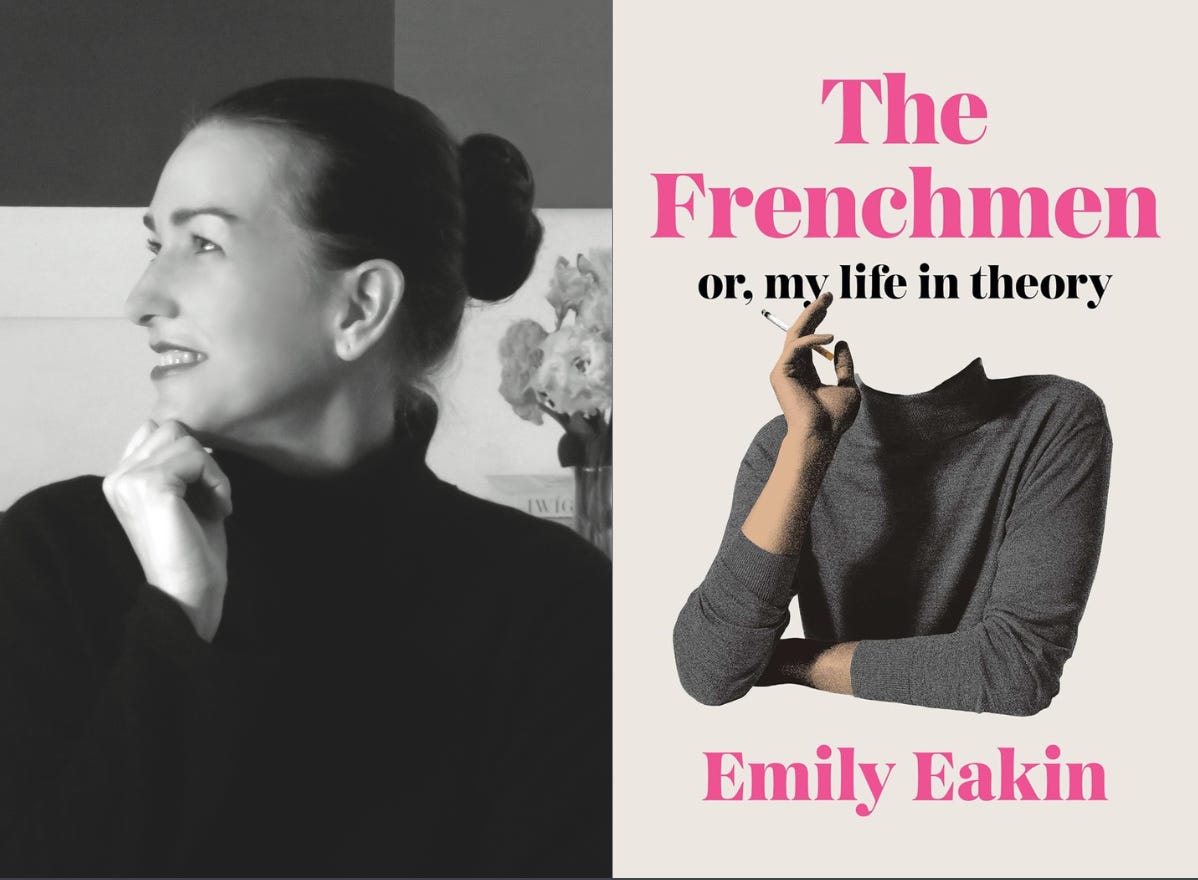
When I was in college in the ‘90s, we didn't use the word performative yet, at least not outside of philosophy seminars. Still, that didn’t keep students from performing plenty of intellectual theater. The preferred prop was a copy of Derrida or Foucault tucked under your arm (occasionally paired with a clove cigarette, because nothing says brilliance like puffing on a spice).
Emily Eakin's fascinating debut explains how we got there. A senior editor at The New York Times Book Review, she first fell headlong into the world of French theory as an undergraduate at Harvard in the late 1980s. A blend of memoir, biography, and intellectual history, The Frenchmen: Or, My Life in Theory, tells the story of how a small group of French philosophers came to wield such extraordinary influence over American campuses, and why their ideas still echo through our culture today.
In today’s Author Questionnaire, Emily talks about reading drafts to her dog, defending long sentences, and the one question every great nonfiction book is trying to answer.
21 Questions with Emily Eakin
1. I couldn’t have written my last book without…
The Rose Main Reading Room at The New York Public Library in Midtown Manhattan. It was impossible to step into the reading room and not feel inspired. For starters, there was the awesome scale and beauty of the space, stretching nearly two city blocks in length and 52 feet high, to a coffered ceiling inlaid with a mural of the heavens. To gaze up at the dazzling blue sky and pink-tinged clouds was to feel the sublime.
Then there were the dozens of other people just like me, spread out along the massive oak tables, heads bent over a book or a laptop, deep into their own research and writing projects.
Plus, the library turned out to have almost every book I needed, even the most obscure French tome.
2. What’s your most common form of procrastination?
Cleaning my desk, then my kitchen, then the entire house. I will literally scrub the walls and window sills before sitting down at my desk. External clutter is a reflection of internal chaos. Clean the house, clean the mind. At least that is what I tell myself.
3. Do you read your reviews?
Why not? I know it’s a brutal world out there.
4. What’s the first thing you do after you finish a draft?
Eat a piece of dark chocolate, 70 percent cocoa, minimum.
5. What’s a writing habit you’re embarrassingly superstitious about?
Reading work aloud. If it doesn’t sound good when I read it to the dog, I need to press delete and start again.
6. What’s something you wish you’d started doing five years ago?
Meditating. The first sentence of my book came to me while sitting cross-legged and eyes closed on a zafu. If I had started meditating years ago, I might have written more books by now.
7. Where do you find new ideas, and how do you keep track of them?
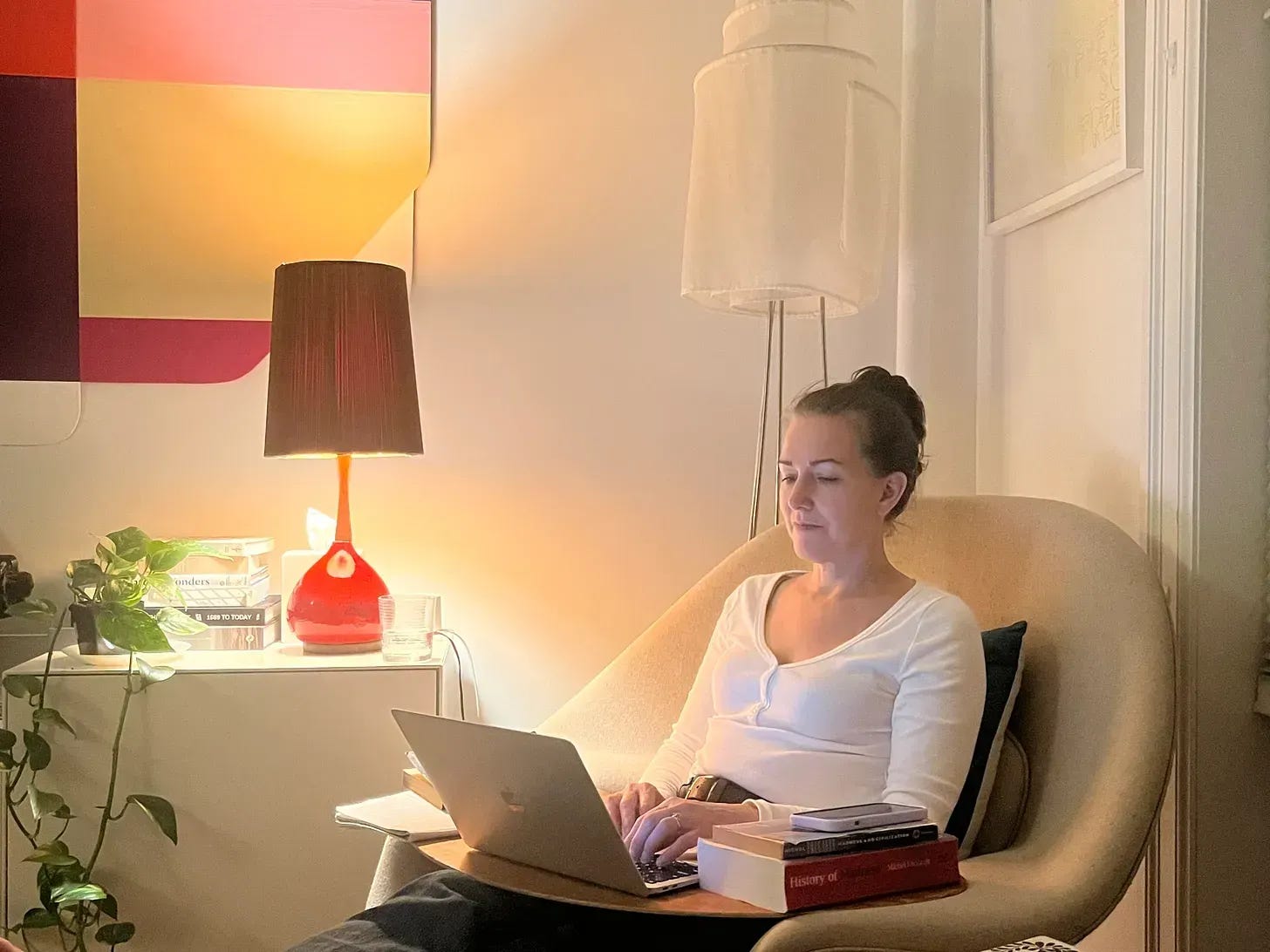
I read a lot of books for my job as an editor at a book review. Whenever I come across a promising idea, I jot it down on my phone and send myself a text.
8. What’s the best piece of professional advice you’ve ever received?
According to my brilliant editor, Ann Godoff, every good nonfiction book is trying to answer this question: How to live?
9. And the worst?
“Write what you know.”
10. Whose career do you most admire and why?
The novelist and playwright Ayad Akhtar is a singular genius, endlessly inventive across mediums and genres, delivering books and plays that are at once playful, cerebral, demanding, and unlike anyone else’s. He entertains while making me think.
11. What’s on your nightstand right now?
Galleys of The Radiance, the new novel by Ayad Akhtar, and The Black Shield, a memoir and work of investigative journalism by Wilbert L. Cooper; a reissue of Ordinary People, by Judith Guest; and copies of The Calamity Club, by Katherine Stockett; Language Machines, by Leif Weatherby; and The Children’s Bach, by Helen Garner.
12. How did you find your agent?
He found me.
13. What’s a writing rule you’ve happily broken?
Long sentences are invariably off-putting to a reader. Contrary to the advice of Gemini, Google’s AI writing assistant, concision is not always better; sometimes an extra beat of explanation, or even just for improved rhythm, is more effective than efficiency.

14. What’s the best non-writing skill that’s helped your writing career?
Teaching profile-writing to journalism students taught me the importance of structure. We broke down long-form magazine profiles and diagrammed their structures. Once you have your structure down, the rest really is typing.
15. How many drafts before you show your editor?
One. It takes me so long to get the words down on the page the way I want them to read that by the time I have a draft, I’m ready to share it.
16. Can you describe your ideal workday?
A latte, a Sumo Citrus mandarin, a walk to the river with the dog. At my desk by 10 am.
17. How does that compare to your actual workday?
If I meet two of these four goals, that is a good day.
18. If you could write one book in a totally different genre than you usually do, which would it be?
I don’t know how to make anything up; if I did, I would write a novel satirizing journalism (my field) in the age of fake news.
19. What’s something about the writing life that still surprises you?
How little you can know about what you will say before you start typing. To put this another way: How much thinking takes place through your fingers never ceases to amaze me.

20. Fill in the blank: In five years, successful authors will all be _____.
Like tech billionaires today: A handful of names will dominate the best-seller lists and the profits, with everyone else vying for crumbs of attention and revenue in their wake.
21. What is your new book about?
Part memoir, part intellectual history, my book chronicles the lives and ideas of the French philosophers who dominated U.S. campuses—and my life—in the 1980s and 1990s.
You can learn more about Emily’s book here: The Frenchmen: Or, My Life in Theory
More from Author Insider
Author Insider is where writers get the real story of publishing—thoughtful conversations with industry insiders and bestselling authors, clear-eyed analysis of where the market is headed, and practical strategies for building a sustainable writing career. Whether you’re just starting out or several books in, the goal is the same: helping you make smarter decisions about your work.
If you’re new to Author Insider, here are a few reader favorites:
Video Replay: Why the Reader Is the Hero of Your Nonfiction Book
What Fatherhood Does to the Brain: 21 Questions with Psychologist Darby Saxbe
Until next time,
Panio
Author Insider is a reader-supported publication. To receive new posts and support my work, consider becoming a free or paid subscriber.