
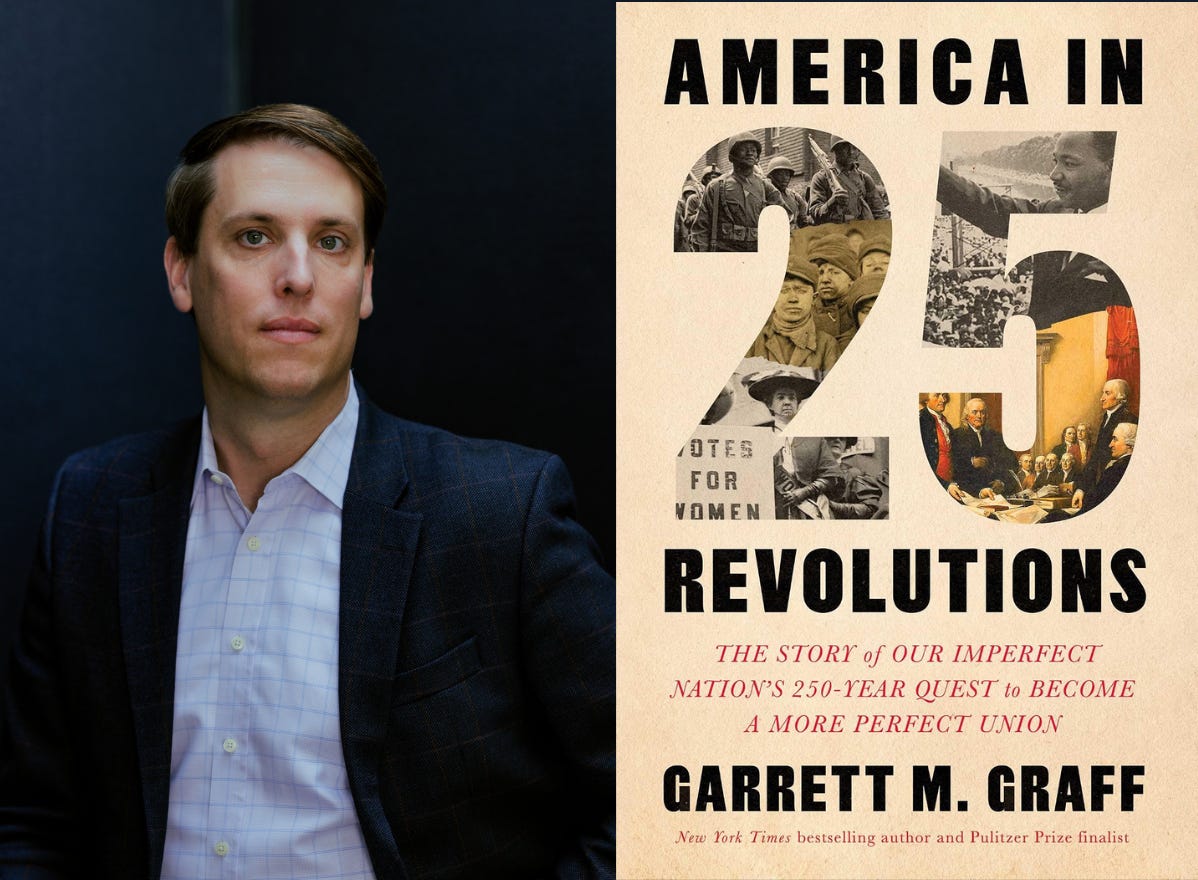
Garrett M. Graff writes history with the urgency and intimacy of firsthand testimony. A journalist, historian, and Pulitzer Prize finalist, he is the author of ten books, including the #1 national bestseller The Only Plane in the Sky, Raven Rock, and Watergate, which was a finalist for the Pulitzer Prize in History. His work has taken readers inside defining moments of American life—from 9/11 and D-Day to the FBI and the government’s nuclear doomsday plans.
His new book, America in 25 Revolutions, takes a wider view, tracing 25 turning points in the country’s 250-year effort to make the founders’ promise of equality more real. Graff doesn’t present history as an uncomplicated march of progress: reforms can be double-edged, and heroes can leave contradictory legacies. But the book remains fundamentally hopeful—a history of how change happens, and why America’s darkest chapters need not be its final ones.
21 Questions with Garrett M. Graff
1. “I couldn’t have written my latest book without…”
A whole community of scholars and historians who have written and explored these subjects for decades—and even entire careers! It sounds trite or hokey, but I got so much joy out of reading these incredibly thoughtful and deeply nuanced books about complex subjects and histories, written by people who understood their topics entirely. I learned so much from them. I read Annette Gordon-Reed’s The Hemingses of Monticello, for instance, and she has thought so deeply and cross-referenced seemingly every letter and paper that ever referenced Jefferson, Monticello, or Sally Hemings. It was awe-inspiring.
2. What’s the thing most people get wrong about being a writer?
That it’s a solitary pursuit. It certainly can be, but any successful book is the product of so many people’s work—from the editor and copyeditor to the design team, the production team, the marketing and publicity team. My publisher, Avid Reader, does this cool thing where they have like a “film credits” page at the back of their books that lists everyone who worked on it, and there are dozens of names there.
3. What’s the first thing you do after you finish a draft?
I never feel like I’m finished with a draft; as soon as I turn something into my editor, I’m working on more research, revisions, additions, and filling in holes. My mother is an author and one of the things she told me early on was how many times you “finish” a book. There’s the first draft, the final draft, the copyedit, the page proofs, the galleys, the finished copies, and then finally the on-sale date. I’m trying to make the book better, more thorough, more nuanced, and more accurate until the last hour of the page proofs—and often, even after that!
4. Do you read your reviews?
Of course!
5. What’s the best piece of professional advice you’ve ever received?
“Walk through open doors.” Basically focus on what you’re good at and what the universe is making possible for you to do. So much of my career has been saying yes to the opportunity that’s presented to me, even if it wasn’t the thing I was intending or trying to do. I spent all of college and my early journalism career trying to be a newspaper writer, but I never got an internship or a job at a newspaper and instead ended up in magazines, where I’ve been immensely happy.
6. Where do you find new ideas, and how do you keep track of them?
I wish I had a better answer to this than the reality: Gmail draft messages! My curse as a journalist and an author is that I have probably what is a two-decade backlog of book ideas I’m eager to write. I’ve said before that I’ve come to understand my editor’s and agent’s greatest value is talking me out of books that I shouldn’t write.
7. What’s something about you that people wouldn’t guess from your bio?
How much fun I have researching—and how fun I try to make my books. If you haven’t read me or don’t know me, my subjects feel so heavy and serious—nuclear war, 9/11, D-Day, the Manhattan Project—but I try to make them enormously entertaining and engaging. I bury so many funny facts and details in footnotes.
8. How did you find your agent?
My current agent is actually my third—my first retired, my second left the business, and by then I’d come to know my current agent professionally. There actually aren’t all that many literary agents who do what you might call “Washington books,” so the universe of possible agents for me was pretty small.
9. What have you stopped doing that made you a better writer, or made the writing life better?
I’m a big believer that there are days you write and days you don’t write—and you can’t do anything to force writing on days where you’re not mentally positioned to write. You can’t force the flow and energy it takes to write—or invent it or trick yourself into it on days where the flow isn’t there. Understanding and accepting this has been enormously valuable for me because it’s given me the peace to not try to spend all day hammering myself trying to force out a couple hundred words if I’m tired, distracted, pulled in other directions, or whatever.
10. What tech tools—including AI—do you use, and which ones do you actively ignore?
I’m trying really hard to figure out if and how and where AI tools can be useful. I’m pretty dubious of them—the acts of writing and research are so central to my process that I’m not eager to find “shortcuts” through them. I think too many people right now are confusing the value of “writing” as only the output, rather than the critical thinking that goes into the input. To me, all of the success and joy of a good writer and writing comes from diving into the digressions, distractions, cul-de-sacs, and the rabbit holes that AI skips right over. Yet a lot of my non-writing professional life is focused on AI and AI risks, so I’m thinking a lot about them.
11. What’s one thing you pay for that has been worth every penny to your writing career?
For maybe fifteen years, I’ve written all my books—and most of my magazine features—in a program called Scrivener, which is mostly designed for academic books and writing. I use a tiny fraction of what it can do, but it’s invaluable organizationally to me. I can’t recommend it enough. Also, Otter.ai. Instant pretty-good transcription has been a gamechanger for me as a researcher.
12. How many drafts do you typically go through before showing the manuscript to your editor?
I normally show my editor one draft earlier than I’d later wish. There’s almost always a moment for me, in revisions, where I realize I should have been embarrassed to saddle my editor with the first draft I did.
13. Describe your ideal workday. How does it compare with your actual one?
For years, I did almost all of my writing before the day started—I’d get up at 5 or 6 am and write for a few hours and then move on to the rest of my day. But I have two young kids, so my “ideal workday” hasn’t been a reality for years now. I do a lot of my writing now once they get off to school. I try to get two or three days a week where I’m actively writing and then, as I said above, am okay losing the other days to chores, meetings, distractions, or other activities. But every day, ideal or not, starts with Speeder & Earl’s Maple French Roast coffee, which is made locally where I live in Burlington, Vermont, and even leaving aside whatever caffeine it provides, that ritual is an incredibly important part of my day.
14. What’s your most common form of procrastination?
Sad to admit: Instagram.
15. What’s the best non-writing skill that’s helped your writing career?
I actually love public speaking, events, and talking to people. I know a lot of authors find the public side of promotion and events tiring, but once I learn a ton about a subject, I love going out there and sharing what I know.
16. What’s the strangest or most unexpected response you’ve received from a reader?
I wrote a book, Raven Rock, about the U.S. government’s doomsday plans—all the weird stuff that would happen during and after a nuclear attack, both during the Cold War and even today—and I have had multiple people recognize or discover accidentally through reading the book that their parents, who they thought had these boring careers as, say, a telephone engineer for AT&T, actually spent their entire careers in secret doomsday bunkers. It’s like a real-life The Americans episode—their parents had these whole secret careers they never knew about!
17. What’s something you’ve changed your mind about recently?
I don’t think that I’ve exactly changed my mind on it, but researching and writing this new book has helped me appreciate just how complex and nuanced American history truly is. So many of our “advances” as a country have been double-edged swords and so many of the heroes of our history have these enormously complex and irreducible historical legacies. I tried to wrestle honestly and forthrightly with those complexities and shadows throughout the book. To me, that’s actually very encouraging—and it should give us hope for our present time. America has some really dark chapters, but we’ve never lost the spirit that our country can be better tomorrow.
18. What are you unwilling to do to sell more books?
I’ve never been on TikTok.
19. If you could write one book in a totally different genre, what would it be?
I’m deeply immersed in children’s books now as a parent and that’s just a total other world of creativity to me. I can’t even fathom how many of our family’s favorite books exploded out of an author’s mind.
20. What’s something about the writing life that still surprises you?
How generous people are willing to be with their time and memories. So much of my career is showing up on people’s doorsteps, metaphorically at least, and saying, “Hi, I know nothing about this thing that you did for your career, can you tell me all about it in excruciating detail?” And then, amazingly, they do just that! When I was working on my history of the FBI, I remember showing up with my researcher at this house in suburban New Jersey to interview a retired counterterrorism agent and he talked to us for almost eight hours without stopping. Journalism and history can be this fabulous all-access pass to some of the most interesting people and places in the world.
21. What is your new book about?
This book is a bit different for me—rather than a deep dive on a single topic, America in 25 Revolutions is a broad survey across all of our 250 years about how change happens in our country. It tells 25 stories of moments when America has gotten “better,” more just, more equal, and more fair, and closer to living the still never-quite-achieved vision of our Founders of a country where all are created equal. It’s a true project of hope and optimism, about how our country goes through dark chapters but then gets better.
You can order Garrett’s book from Bookshop.org here: America in 25 Revolutions.
More from Author Insider
Author Insider is where writers get the real story of publishing—thoughtful conversations with industry insiders and bestselling authors, clear-eyed analysis of where the market is headed, and practical strategies for building a sustainable writing career. Whether you’re just starting out or several books in, the goal is the same: helping you make smarter decisions about your work.
If you’re new to Author Insider, here are a few reader favorites:
Until next time,
Panio