
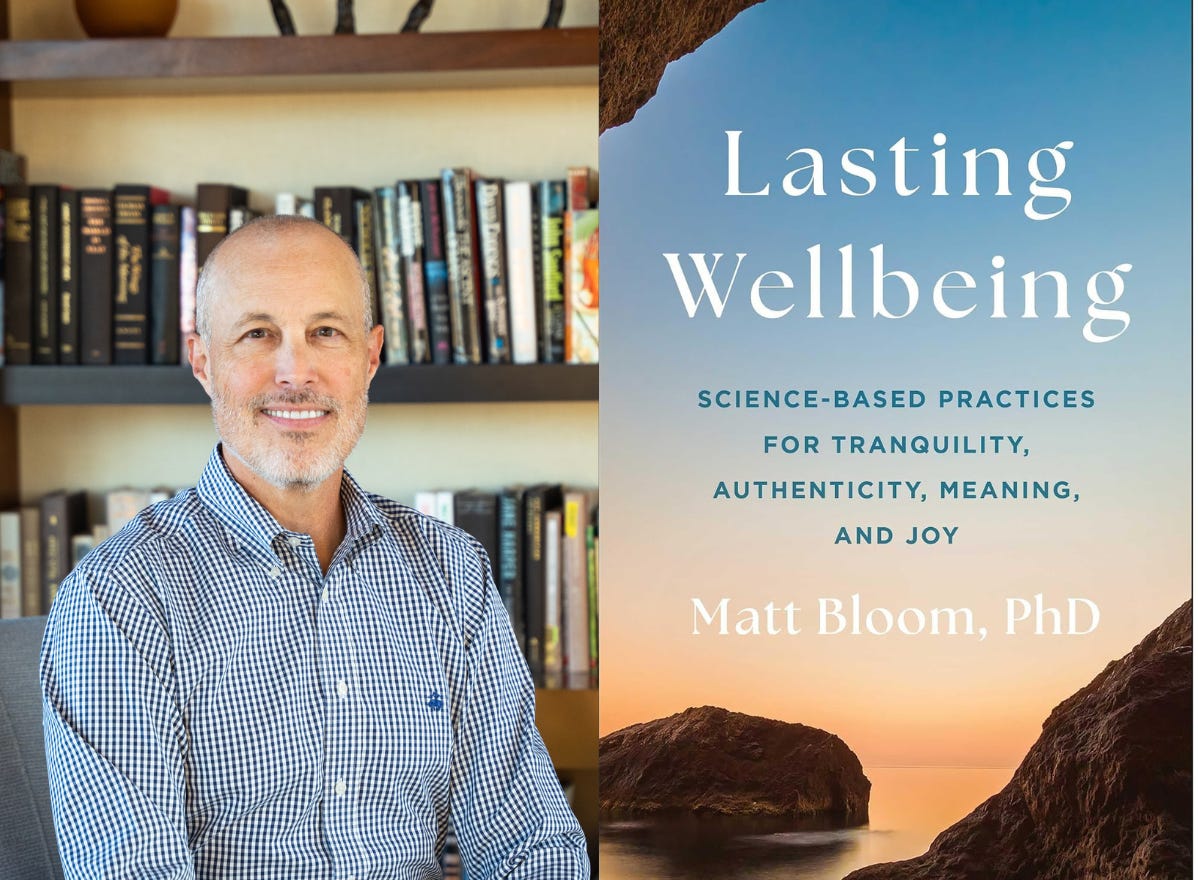
Matt Bloom has spent nearly three decades studying what helps people flourish, particularly those working in demanding helping professions such as medicine, education, and humanitarian work. A psychologist and professor emeritus at the University of Notre Dame, his research has drawn on the experiences of more than 10,000 people across 25 countries.
In his newly released book, Lasting Wellbeing, Bloom translates that research into practical ways to cultivate greater tranquility, meaning, and joy. Rather than prescribing a single path, he offers readers a range of evidence-based practices and a framework for figuring out which ones actually work for them.
In this edition of 21 Questions, Bloom reflects on finding his own way as a writer, the pleasures of creative flow, and why sometimes the best thing you can do is go for a walk.
21 Questions with Matt Bloom
1. I couldn’t have written my last book without…
My wife, Kim, and my brother, Steve. They read draft after draft, gave me great feedback, and were enthusiastic throughout the process. I learned that, for me, writing is a communal experience, and I am grateful to have such wonderful people to work with as I write. I’d also add coffee and lots of music. Both were really important during my writing time.
2. What’s the thing most people get wrong about being a writer?
That it’s really hard. At least that’s what the people I know get wrong. It can be tough at times, but when things are flowing, I’m caught up in something bigger than myself. It’s a wonderful experience. I’ve read a lot of books about writing by authors and have learned that I have to find my way of doing it. Fortunately, I have. It took a while, but it was well worth the time trying different approaches.
3. What’s your most common form of procrastination?
Reading books “for inspiration.” I tell myself, “one chapter,” and thirty minutes later I’m still reading. I can get lost in great writing.
4. Do you read your reviews?
Yes, for sure. I have a lot to learn and reviews can be very helpful. Some of them help me see where I can improve (ouch!). And some are really encouraging.
5. What’s the first thing you do after you finish a draft?
Crank rock music. Rush’s “Tom Sawyer,” U2’s "Where the Streets Have No Name,” and Springsteen’s “Born to Run” are favorites. I listened to those songs when I was in high school, driving around on a warm summer evening. They are still celebrations of life for me.
6. What’s a writing habit you’re embarrassingly superstitious about?
Reading my own finished first drafts. I worry that I will be so disappointed I will toss everything. Kim and Steve are my stalwart first draft readers.
7. What’s something you wish you’d started doing five years ago?
Writing books! I thought about it for way too long. My friend and writing coach, Michael McGregor, finally got me going. He told me to write from my head and heart, write what I really cared about. That was the catalyst that finally got me going.
8. Where do you find new ideas, and how do you keep track of them?
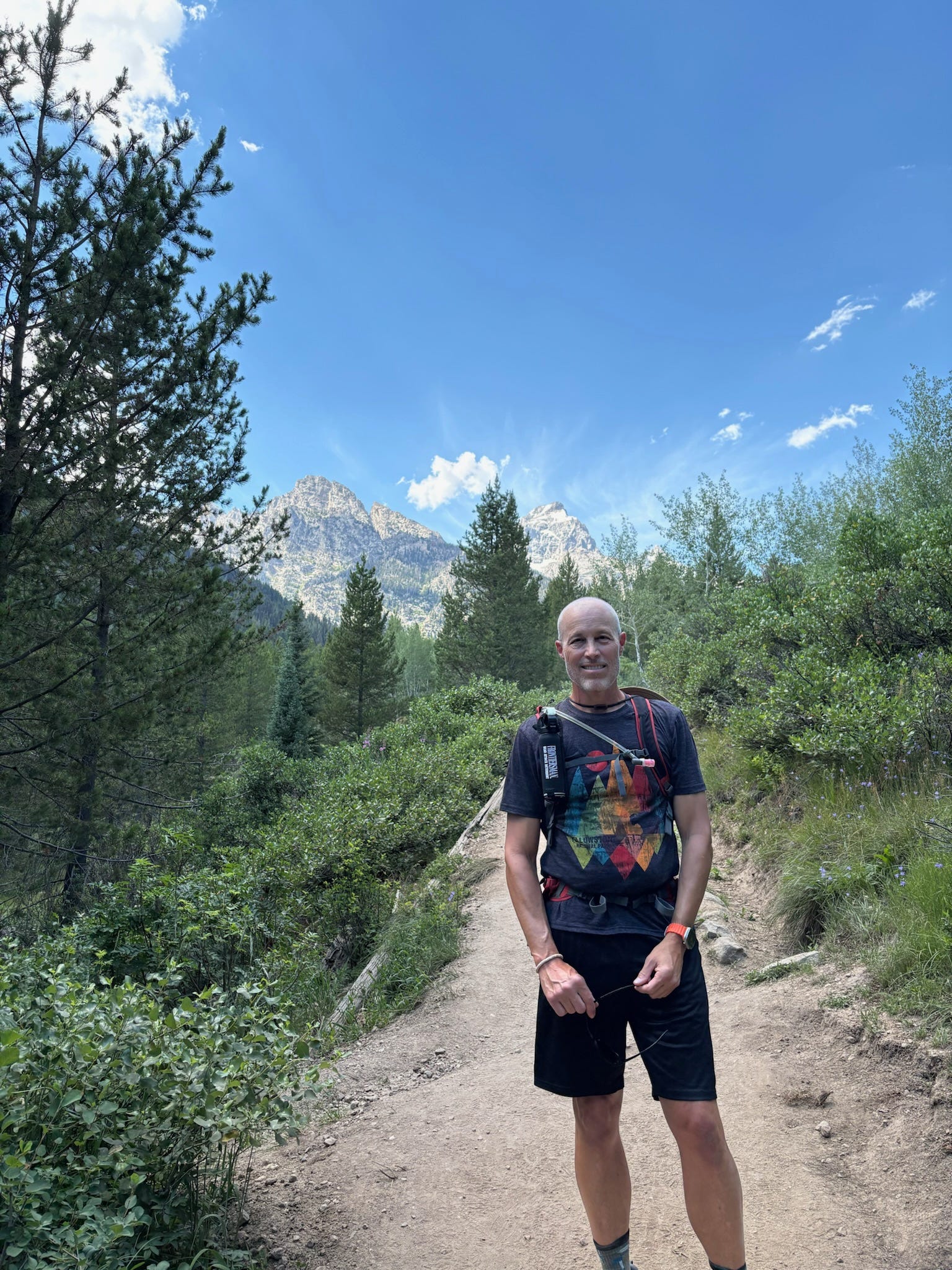
Hiking. There is an ancient motto, solvitur ambulando, a Latin phrase meaning, “It is solved by walking,” and that really works for me. I take a small notepad and pen to write down ideas. It’s all about physical engagement for me, so I avoid digital ways of recording things.
9. What’s the best piece of professional advice you’ve ever received?
“Call yourself a writer!” Again, my writing coach Michael McGregor was the source of this advice. He meant I had to claim that I am a writer. Writing is not just something I do; being a writer is something I am. It’s still hard for me to claim this sometimes, but it’s liberating when I do.
10. And the worst?
Write at the same time of day, for the same amount of time every day. That doesn’t work for me. I do need to write almost every day, but staring at a blank page for several hours is depleting. I tend to write in chunks rather than continuously.
11. Whose career do you most admire and why?
This is a tough one because there are quite a few! I admire Cal Newport and Adam Grant for writing so well for a general audience while also being great scholars. I admire Barbara Brown Taylor for her beautiful nonfiction prose and gracious and generous spirit. And I admire Marilynne Robinson for her wonderful novels and skillful, erudite essays.
12. What’s on your nightstand right now?
Country People by Daniel Mason and my iPad. I always try to fill my head and heart with uplifting things before I sleep, so a really great book and an episode of Ted Lasso or Shrinking are always good choices.
13. How did you find your agent?
I sent proposals to five agents, cold. One told me my book wouldn’t sell, three did not respond. Laurie answered with an enthusiastic email. She is an incredible person and a wonderful agent. I am very fortunate I sent a proposal to her.
14. What’s a writing rule you’ve happily broken?
To write every day and at the same time. I had to figure out what worked for me.
15. What tech tools (AI included) do you actually use—and which ones do you actively ignore?
An online thesaurus and dictionary are key for me. Scrivener is the writing platform I use, and it works great for me. I don’t use AI to write or help me write because I want whatever has my name on it to be from me, even if it’s bad. I tried it once and what was produced was very inauthentic.
16. What’s the best non-writing skill that’s helped your writing career?
Speaking in front of live audiences and leading workshops. I learn so much from the responses, questions, and interactions I have with people during the session and in conversations after it ends. I will accept every speaking invitation I can.
17. How many drafts before you show your editor?
Dozens! One of my worst habits is messing with my writing to the point that I make it worse, so I have had to discipline myself to let my readers tell me when a draft is ready to send. I had a wonderful editorial team at BenBella—Leah Wilson and Clara Tamez were immensely helpful, kind, encouraging—so it was never worrisome to send things to them
18. Can you describe your ideal workday?
Get up by 5 am. Cup of coffee, read poetry and something inspirational. Write for a couple of hours. Work out or go for a hike. Write again for a bit. I also volunteer at local non-profits, so some mornings are occupied with those commitments. Late afternoon, read research or a good book. Then meet Kim for a glass of wine.
19. How does that compare to your actual workday?
Pretty close. Some days I don’t write as much as I hope to, but that’s ok. The writing will flow another day.
20. If you could write one book in a totally different genre than you usually do, which would it be?
Poetry. I love reading poetry, and wish I was able to write good poems. I cannot.
21. What’s something about the writing life that still surprises you?
How sometimes something seems to be writing through me. The words are coming into my head; I’m not thinking them myself. It was eerie at first, but I can now accept it. It still thrills me when it happens.
You can learn more about Matt’s book here: Lasting Wellbeing: Science-Based Practices for Tranquility, Authenticity, Meaning, and Joy
More from Author Insider
Author Insider is where writers get the real story of publishing—thoughtful conversations with industry insiders and bestselling authors, clear-eyed analysis of where the market is headed, and practical strategies for building a sustainable writing career. Whether you’re just starting out or several books in, the goal is the same: helping you make smarter decisions about your work.
If you’re new to Author Insider, here are a few reader favorites:
Until next time,
Panio
Author Insider is a reader-supported publication. To receive new posts and support my work, consider becoming a free or paid subscriber.
Your content is exceptional, thoughtful, generous, and deeply aligned with the spirit of our Tribe of Supstackers and Dream‑Stackers. I explored your full landscape, from the architecture of your website to the cadence of your podcast episodes and the clarity of your services, and I’m genuinely impressed by the depth intention, and value you offer to your community. So, Thank you for being authentic, uplifting and caring.