
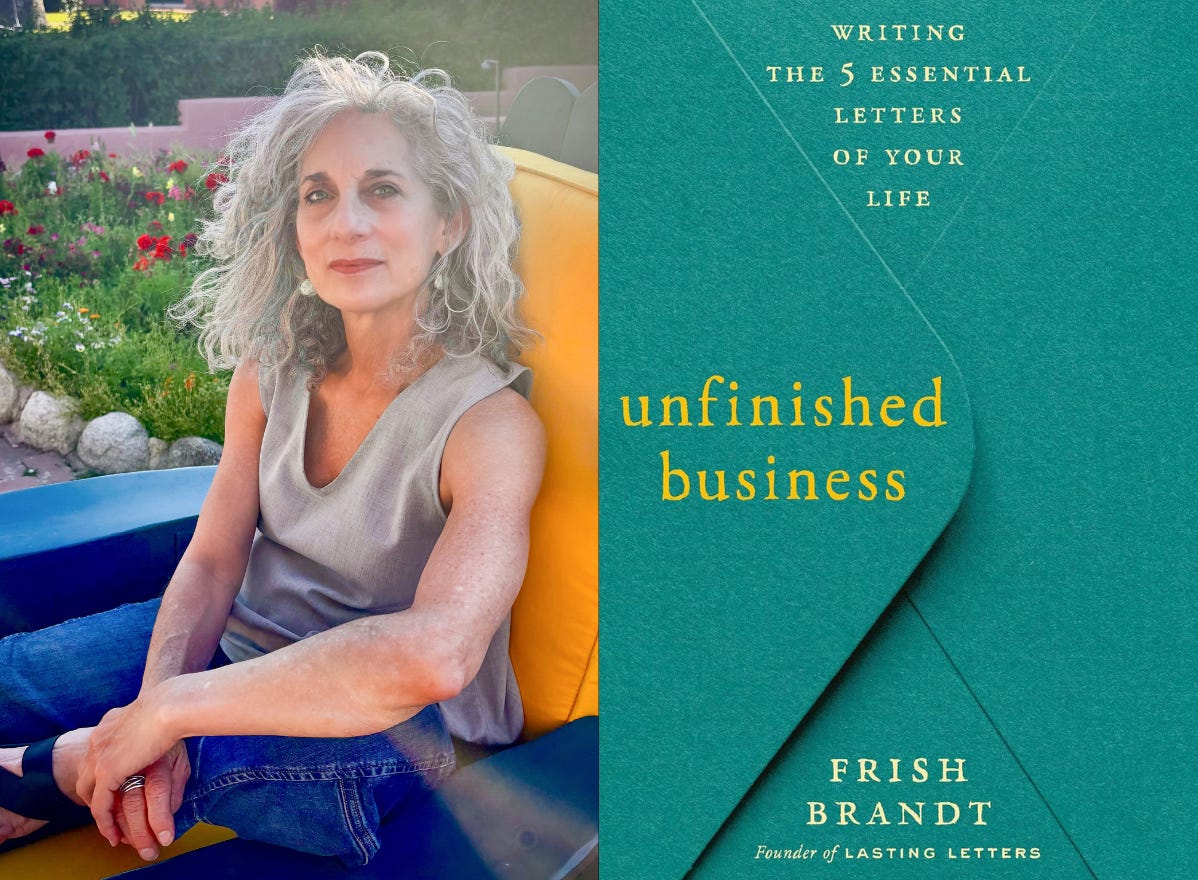
Frish Brandt spent more than four decades working in the arts before beginning a second life in letters. Now a full-time “Letter Midwife,” she teaches essential letter writing at Stanford University’s School of Medicine and to groups around the country, from museums and universities to hospitals and caregiving organizations. Over the past twelve years, she has helped hundreds of people find the words they most needed to say.
Her new book, Unfinished Business, is an invitation to do the same. Centered on five essential letters—thank you, I’m sorry, I miss you, I love you, and goodbye—it combines practical guidance with reflections on grief, forgiveness, connection, and closure. The question behind it is simple and urgent: What is the letter you want to be sure you’ve written while you still can?
21 Questions with Frish Brandt
1. “I couldn’t have written my latest book without…”
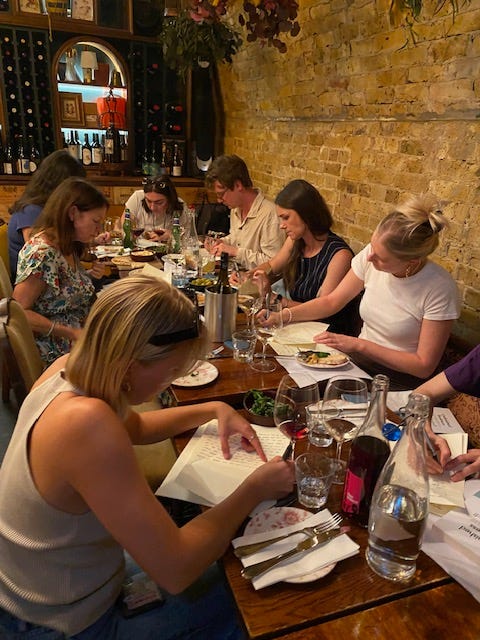
The first three people who understood what a Letter Midwife is; the openheartedness of the hundreds of people whose most meaningful letters I’ve sat with and midwifed over the past twelve years; and countless dinners with friends as I found my way from a life in the arts to a life in letters.
2. What’s the thing most people get wrong about being a writer?
That it’s lonely?
3. What’s the first thing you do after you finish a draft?
Take a walk. Write a letter.
4. Do you read your reviews?
It remains to be seen.
5. What’s the best piece of professional advice you’ve ever received?
When Obama entered the Senate, Chief of Staff Pete Rouse told him to respond to every letter within two days. Obama has cited this as the best political advice he’d received. His deep regard for the power of mail was manifested in the folder of “10 letters from ordinary Americans” included in his nightly briefings, and is evident in his favorite exhibit at the newly opened Obama Center.
That said, the best advice I wish I’d received would be: “Lighten up on the email. Check it twice a day at specific hours. People can wait. After all, you’re not the President of the United States.”
6. Where do you find new ideas, and how do you keep track of them?
New ideas—everywhere. The podcast universe is a mixed blessing; however, for me it provides infinite bounty. I rarely listen to a podcast that doesn’t result in scribbled notes of people to read, research, or reach out to.
In the two weeks before the book’s release, I embarked on an archaeological dig through the flotsam and jetsam of the past five years, which included many of these notes. I found this oddly comforting and confirming. The notes were like breadcrumbs, reminding me of the many people, passages, and ideas that got me here—and some that will take me where I’m next going.
7. What’s something about you that people wouldn’t guess from your bio?
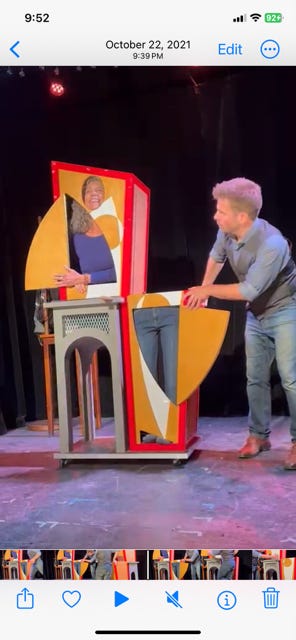
That I LOVE magic. I don’t need to know how it’s done—that would take away from the wonder, and the wonder is what it’s about. In fact, I got cut in half on my first date with my now-husband, Dave.
8. How did you find your agent?
Rachel had heard of my project when she was at the agency where my not-yet-husband’s first book was seeded over ten years ago. By the time my proposal (if you could call it that) was ready to share, she had just started her own agency. When we ran into her one night in a pizza restaurant, she greeted me warmly and referred to my letter project, so I thought I’d take a chance.
I labored—appropriately, since my book is about letter writing—over a brief letter/email to her. She responded positively while adding the response I’d received from all five other agents I’d had occasion to talk to: “This is interesting. It’s not for me, but I’m happy to talk and share some thoughts.”
So we talked, and then we talked a second time about our mutual interest in photography. When we talked the third time, she asked, “How do you feel about the title?” I said, “I’m interested in a title that will reach people.” She shared several other thoughts, then put down her pen and said, “I think we should do this. Do you think we should do this?”
9. What have you stopped doing that made you a better writer, or made the writing life better?
Not writing.
10. What tech tools—including AI—do you use, and which ones do you actively ignore?
I will often utilize “the robot” as a thesaurus. Even if I don’t use any of the alternative words, it’s nice to have a word palette to weigh my choice against. And I use it for certain aspects of research.
11. What’s one thing you pay for that has been worth every penny to your writing career?
A pair of scissors.
12. How many drafts do you typically go through before showing the manuscript to your editor?
I have terrible version-control habits. Writing for me is like molding clay. I respect deadlines, however; what for someone else might be a series of drafts is generally one draft with countless tweaks. Deadlines are lifelines. By the due date, I’ve somehow molded the writing enough that it’s time to get some other hands on it.
13. Describe your ideal workday. How does it compare with your actual one?
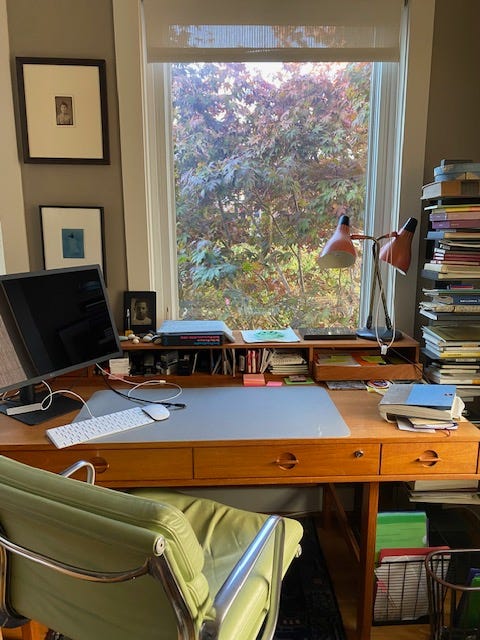
The ideal workday starts with some fitness, followed by a meaningful conversation with a friend over a good cup of coffee, and not checking my email until midafternoon. HA!
The reality: I check my email first thing before fitness (living on the West Coast, I feel responsible to the East Coasters). I check it again and again throughout the day. It’s a termite eating into the “would” work. I’m changing this now.
14. What’s your most common form of procrastination?
Calendaring. Emailing. Baking.
15. What’s the best non-writing skill that’s helped your writing career?
I type the way people type when they pretend they’re typing. Writing takes longer, but the typing part is handy.
16. What’s the strangest or most unexpected response you’ve received from a reader?
It remains to be seen.
17. What’s something you’ve changed your mind about recently?
Getting married.
18. What are you unwilling to do to sell more books?
Karaoke?
19. If you could write one book in a totally different genre, what would it be?
A children’s book about friendship and time, partnered with a favorite illustrator or two.
20. What’s something about the writing life that still surprises you?
How many people are doing it.
21. What is your new book about?
Unfinished Business is an invitation and a guide to writing one’s most meaningful letters—the kind of letter you want to be sure you’ve written while you can, before it’s too late. If that’s a bit abstract, think about someone you’ve loved or admired and about the letter you wish you had from them. Why wait?
You can learn more about Frish’s book here: Unfinished Business: Writing the 5 Essential Letters of Your Life.
More from Author Insider
Author Insider is where writers get the real story of publishing—thoughtful conversations with industry insiders and bestselling authors, clear-eyed analysis of where the market is headed, and practical strategies for building a sustainable writing career. Whether you’re just starting out or several books in, the goal is the same: helping you make smarter decisions about your work.
If you’re new to Author Insider, here are a few reader favorites:
Until next time,
Panio