
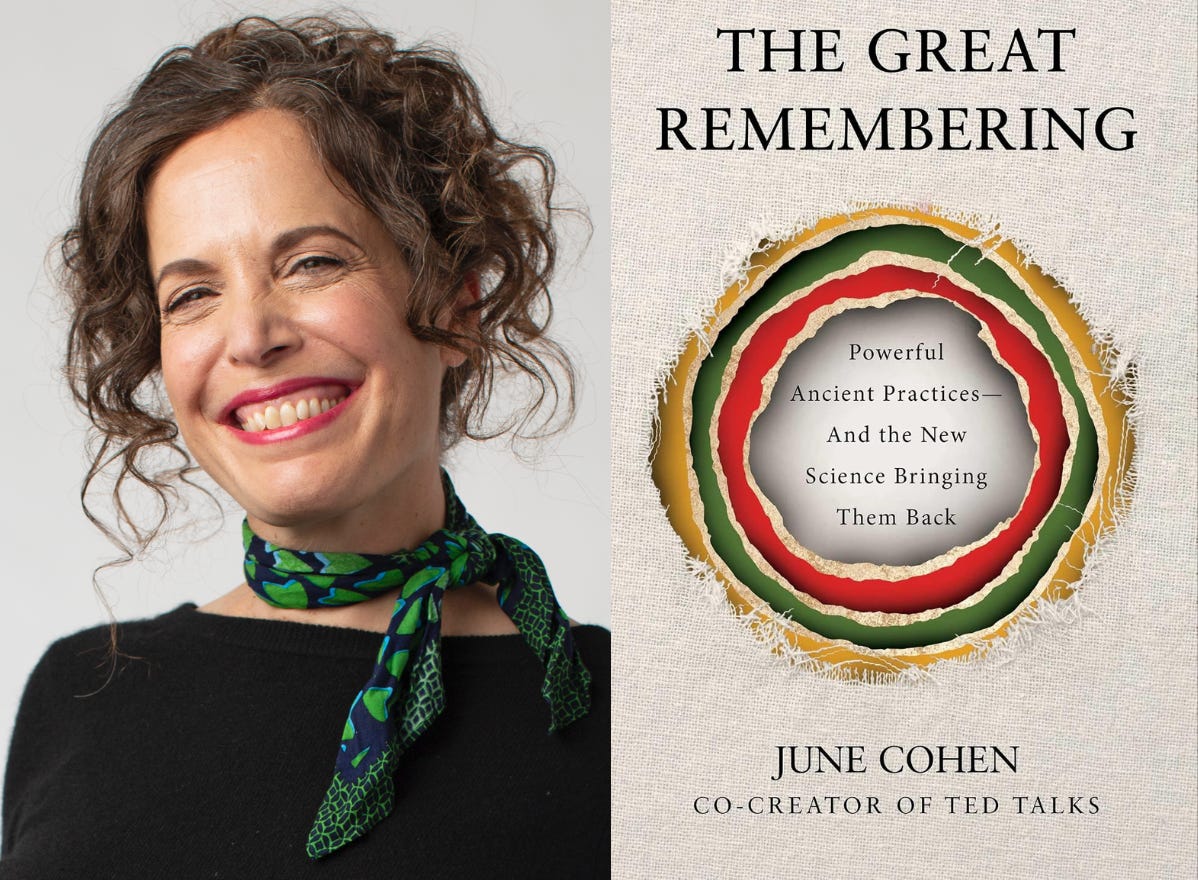
June Cohen is a media and technology pioneer whose career has repeatedly helped define new forms of storytelling. As a college student, she led the development of Proteus, the world’s first multimedia magazine, and later joined the team that launched HotWired, Wired magazine’s pioneering website. She went on to co-create TED Talks, then co-founded the media company WaitWhat, where she created the hit podcasts Masters of Scale and Meditative Story.
Her new book, The Great Remembering, begins with a change of heart. Cohen stopped believing technology alone could solve our biggest problems and started asking a different question: What can the ancients teach us about how to live today? Her answer takes her deep into practices humans have relied on for centuries—from sauna and pilgrimage to communal singing and ritual—and into the emerging science explaining why so many of them still work.
21 Questions with June Cohen
1. “I couldn’t have written my latest book without…”
A technique my husband Deron helped me invent. We call it “Cabin-in-the-Woods Thursday” (“Cabin Thursday” for short). Every Thursday, I would do the equivalent of going to an archetypal ‘cabin in the woods.’ To be clear: I worked on this book every day of the week. But on Thursday, I’d stay entirely focused (whether at home or by checking myself into a hotel) and write late into the night (often all night, like I did in college). I would keep at it until I worked through every wrinkle and turned a draft to my editor, Sara Grace (each draft was a single chapter; I’d typically take 4-5 drafts to finalize each chapter). I need this intensive deadline-driven cycle to help my open-ended brain close down its options, make final decisions, and declare something “finished.”
2. What’s the thing most people get wrong about being a writer?
I think most people vastly underestimate the resilience and courage required to write a book.
3. What’s the first thing you do after you finish a draft?
First: I notice the wave of physical relief move through my body. (I’ve been training myself to notice things like this.) Then: I go to sleep. This is usually somewhere between 3 AM and 7 AM.
4. Do you read your reviews?
Absolutely. And I also had more “beta” readers than my publisher had ever dreamed of. It freaked everyone out, but I had around 30 early readers, and I asked all of them, “Where does it grab you?” “Where does it lose you?” I don’t try to please everyone, but I do try to learn from everyone. Just like entrepreneurs can learn from every “no,” writers can learn from every critique. Sometimes, there’s a gap you can’t close; but very often there’s a kernel of truth telling you how to engage a wider audience without compromising your voice or vision.
5. What’s the best piece of professional advice you’ve ever received?
It’s less the advice and more the modeling of how humans with excellence and integrity carry themselves in the world and care for the humans they work with. In my 20s, I had the incredible good fortune of working for Wired, in San Francisco — specifically for HotWired, the digital side. There were geniuses everywhere in that office — so many extraordinary people I learned from. But I especially learned from two incredible, very different women: our creative director Barbara Kuhr and our president Beth Vanderslice.
They were both unrelenting in their pursuit of excellence and integrity. But that’s only part of what I learned from them. They both remain close friends to this day, and this mutual commitment to friendship and care is the most important thing I learned from both of them. My husband and I visit Barb and her husband almost every year; we all root each other on. Beth and I live in the same city; she’s been to every wedding and every funeral in my family. That’s the kind of mutual bond between teammates I aspire to, always. Neither Beth nor Barb ever gave me this advice in words. But if they had, it might have been: “Never forget to care about the people you work with. Never be afraid to love them.”
6. Where do you find new ideas, and how do you keep track of them?
There are two ways I find new ideas: One is actively seeking them out … movies, books, exhibits, concerts, museums, events, immersive experiences. The other: Making my way to beautiful remote places in nature where ideas can find me.
Keeping track of them? I write things in small notebooks and type them into my iPhone notes. Honestly, I don’t do the best job of cataloging them, but I seem to rediscover them right when I need them.
7. What’s something about you that people wouldn’t guess from your bio?
When I was a tiny kid, I had a deathly fear of Mr. Snuffleupagus on Sesame Street. Today, I collect small carved statues of elephants everywhere I travel. Are those connected? I don’t know! I never thought to connect them until now.
8. How did you find your agent?
I don’t have one.
9. What have you stopped doing that made you a better writer, or made the writing life better?
For this book in particular, I stopped consuming anything that smelled of the outrage news cycle.
10. What tech tools—including AI—do you use, and which ones do you actively ignore?
I use AI extensively—for tech help, formatting transcripts, and minor translation. I also use it for research (though with great caution, as I’ve been badly burned). But the real answer is: After a career of being a relentless early adopter, I’ve become very choiceful. I actively ignore a lot.
11. What’s one thing you pay for that has been worth every penny to your writing career?
My college education
Every Broadway musical I ever attended
My subscription to Britannica
Hot yoga and sauna sessions
12. How many drafts do you typically go through before showing the manuscript to your editor?
For this book, I wrote chapter by chapter, submitting a new draft to my editor, Sara Grace (who is a freaking brilliant collaborator), every week. I need the weekly deadline and feedback to write at my best.
13. Describe your ideal workday. How does it compare with your actual one?
Ideal typical day: Writing and deep creative work all morning; collaborative work with other humans from 12-3; exercise and nature from 3-6. Socializing and dinner after that. My actual day usually has too few people, too little exercise, and too little nature. But I’m working on that.
14. What’s your most common form of procrastination?
Well, I can’t resist saying: Many of the things we call procrastination are actually wisdom systems that help us think better and thrive. For centuries now, we humans have modeled ourselves after machines. Striving to be productive, efficient, logical. But humans are not machines. Our human operating system is fleshy and illogical and emotional … and we’ve kind of forgotten how to operate it. We’ve forgotten how much we need movement and music and nature. We’ve forgotten how much we need each other.
So when I pause my writing to go for a run, or sing along to a song, or call a friend, or even clean a messy corner of the room, I don’t admonish myself for it. I tell my human self, “Good job for remembering you’re not a machine, and giving your human body what it needs to keep thinking and writing.”
15. What’s the best non-writing skill that’s helped your writing career?
Listening. Really listening.
16. What’s the strangest or most unexpected response you’ve received from a reader?
With The Great Remembering, specifically, people very often comment on things they loved in the book that actually aren’t in the book at all. They might say, “Now I remember why I loved boxing” or “Now I remember how important my parent’s coffee ritual was.” I didn’t really write about any of those things. But the book inspires these personal “Aha!” moments. It’s endlessly interesting and surprising to me what people remember when they look at the world through these twin lenses: on one hand, “people have always done this,” and on the other, “here’s why science says it works.”
17. What’s something you’ve changed your mind about recently?
Lots of things. I’ve spent the last three years working on this book and thinking about ‘wisdom systems’ — practices that both accomplish something practical and also holistically (often covertly) support human thriving. One of my unofficial definitions of a ‘wisdom system’ is that it makes someone roll their eyes. Whether you roll your eyes at yoga or golf; potluck dinners or tailgate parties … one person’s eye roll is another person’s wisdom system. Seeing the world through this lens made me rethink a lot. Usually with a smile.
18. What are you unwilling to do to sell more books?
I’m unwilling to release a book that falls short of what I believe to be excellence. In other words: I’m unwilling to shortchange the writing process. Pretty much everyone in my life felt I spent too much time researching, writing, rewriting, adding to, and footnoting this book — when I needed to start marketing it. And don’t get me wrong; I wanted to stop writing and start marketing. But the book wasn’t done yet. Not in my eyes. And I just wasn’t willing to compromise on that. At the end of the day, I’d rather be the person who creates an excellent book, sturdy in its truth, and which perhaps a smaller number of people find and love than one who writes a book that falls short of excellence or integrity but sells like crazy.
19. If you could write one book in a totally different genre, what would it be?
I actually don’t have that aspiration! I wrote or co-wrote two earlier books—and I didn’t love either of them because I didn’t love their genres. The Great Remembering is exactly the kind of book I love to read. So it’s the only kind of book I want to write.
20. What’s something about the writing life that still surprises you?
How hard it is. Everyone knows it’s hard. Everyone says it’s hard. Over my career, I conducted dozens of interviews with people saying it’s hard and commissioned dozens of TED talks and podcast episodes with people saying writing is hard (including Elizabeth Gilbert’s iconic TED talk on creativity and podcast episodes from Susan Orlean and Isabel Allende on writing their master works and how hard it was). But I still didn’t really understand how hard it is. I didn’t know that it can feel like you’re “opening a vein.” I didn’t understand that it can feel like you’re being eaten alive. I’ve led many challenging creative projects in my career; I’ve walked many times through the “creative fog.” But nothing brought me to my knees like writing this book.
21. What is your new book about?
I’ll answer this the way I talk about it in person… My work on The Great Remembering started when I stopped believing that technology could solve the world’s challenges and started asking a different question: What can the ancients teach us about how to live today?
My starting point was this: Today’s existential crises—the mental health crisis, the climate crisis, the crisis of community conflict (that feeling of intractable divisions and anger everywhere), and the coming crisis of AI challenging our way of life—actually aren’t new. They’re real; they require our urgent attention. But they’re not new.
For all of human history, we’ve struggled with the same things: Mental anguish. Tribal conflict. Depletion of natural resources. Even the creation of technologies so powerful they could destroy us. And if these are the challenges we humans reliably create for ourselves, our ancestors must have had solutions for them. The ideas had to be out there. So I set out to discover them.
What I found was hiding in plain sight: there are indeed practices (I call them “wisdom systems”) that humans relied on for thousands of years to manage fear, grief, conflict, and change. Wisdom systems like the sauna, the festival, the epic physical challenge; wisdom systems like pilgrimage, group singing, communal awe, and communal grief. These weren’t just traditions; they were solutions. And modern science — often very thrilling new science — is confirming what humans have always known.
You can learn more about June’s book here: The Great Remembering: Powerful Ancient Practices—and the New Science Bringing Them Back.
More from Author Insider
Author Insider is where writers get the real story of publishing—thoughtful conversations with industry insiders and bestselling authors, clear-eyed analysis of where the market is headed, and practical strategies for building a sustainable writing career. Whether you’re just starting out or several books in, the goal is the same: helping you make smarter decisions about your work.
If you’re new to Author Insider, here are a few reader favorites:
Until next time,
Panio