
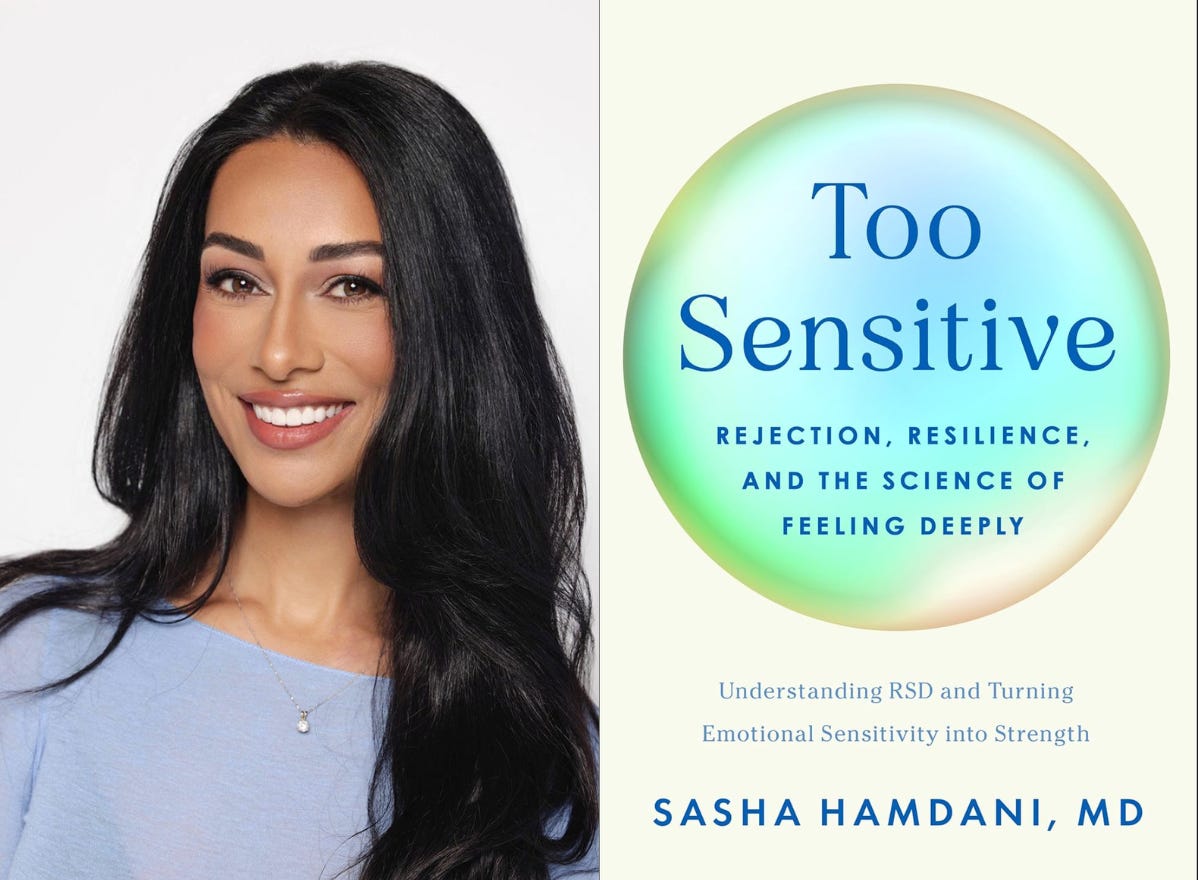
Sasha Hamdani, a psychiatrist specializing in ADHD and emotional regulation, has built an audience of more than two million followers across Instagram and TikTok as @thepsychdoctormd by making mental health accessible and engaging. Which is a refreshing change from the people who go viral for eating 10,000 calories in one sitting, doing The Griddy, or cosplaying (though I kinda have a soft spot for Chewbacca Mom. Who hasn’t wanted to wookie out in a Target parking lot?)
Her new book brings that same smart, accessible, and entertaining approach to a subject that is often misunderstood: sensitivity. Too Sensitive explores the science of emotional sensitivity and rejection-sensitive dysphoria, i.e., why some of us experience rejection, criticism, or even subtle shifts in tone so intensely. Hamdani argues that once we understand what’s happening in our brain (and nervous system), we can learn to respond differently, as well as recognize the strengths that come with feeling deeply. As someone who burst into tears at my fifth birthday party because I couldn’t pin the tail on the donkey, I wholeheartedly endorse this sentiment.
In this edition of 21 Questions, Hamdani talks about being vulnerable on the page, why she works in intense bursts, and the little things that help make writing possible.
21 Questions with Dr. Sasha Hamdani
1. I couldn’t have written my last book without…
My patients. So much of what I write starts with hearing someone describe something they’ve carried for years and realizing, “Wait, THAT HAS A NAME??”
2. What’s the thing most people get wrong about being a writer?
That you need to feel inspired to write. Most of writing is sitting down when you have absolutely nothing profound to say and trusting that eventually something useful will come out.
3. Do you read your reviews?
Yes, which is probably a bad idea for someone who just wrote an entire book about rejection sensitivity.
4. What’s the first thing you do after you finish a draft?
Close my laptop and try not to look at it for a few days. I need enough distance to forget how brilliant or terrible I thought it was while writing it.
5. Kiss, marry, kill: podcasts, newsletters, and speaking gigs.
Kiss speaking gigs, marry podcasts, kill newsletters. I love my newsletter, but every week it somehow feels like the deadline arrives three days earlier than it should.
6. What’s a writing habit you’re embarrassingly superstitious about?
I need the right environment. Always have my big fuzzy cardigan (outside temperature does not matter), a crispy Coke Zero to drink, everything arranged correctly in terms of where my laptop is in relation to my snacks (which vary but are usually either nuts or something else crunchy). Apparently my brain thinks writing requires a small ceremony.
7. What’s something you wish you’d started doing five years ago?
Long-form writing. Social media taught me how to communicate an idea quickly, but writing books taught me how much I love having room to actually explore one.
8. Where do you find new ideas, and how do you keep track of them?
Mostly conversations, patients, comments, and things I notice in my own life. I keep a completely chaotic Notes app that makes sense to absolutely no one except me.
9. What’s the best piece of professional advice you’ve ever received?
Don’t wait until you feel ready. Most of the best things in my career happened because I said yes before I had completely figured out how I was going to do them.
10. And the worst?
Stay in your lane. Almost everything interesting I’ve done professionally has happened because I didn’t.
11. Whose career do you most admire and why?
I’ve always admired Atul Gawande’s career. He’s a physician who has managed to be a clinician, writer, researcher, and public thinker, and he uses storytelling to make complicated questions about medicine and human behavior feel deeply personal.
12. What’s on your nightstand right now?
An embarrassing number of half-read physical books, my Kindle, water, red light mask, and a picture of a treasure map that my son drew.
13. How did you find your agent?
THIS IS MY FAVORITE STORY. My neighbor is an incredible author (Robert Miner!) and when he moved in I told him how I was discouraged from writing another book. He told me his agent asked about me and set up a meeting between us. I met her once and knew that I needed her to be my agent because that would ensure that I would get a chance to be her friend. She’s the coolest.
14. What’s a writing rule you’ve happily broken?
That you have to write every day. I absolutely do not. I tend to write intensely in bursts, which is probably the most ADHD way possible to write a book.
15. What’s the best non-writing skill that’s helped your writing career?
Being a psychiatrist (is that a skill?). My entire job is listening closely, finding patterns, and taking something complicated and making it understandable. That’s basically writing.
16. How many drafts before you show your editor?
I show my editor my first draft because I have zero filter and I’m usually really excited. That being said, it usually takes upwards of 15 rewrites for it to be usable.
17. Can you describe your ideal workday?
A quiet morning, nowhere to be, seeing a few patients (with enough time to chat!), gym with my husband, a few uninterrupted hours to write or to create educational content online, and then school pick up!
18. How does that compare to your actual workday?
My day never looks like that. I don’t even know what a quiet morning looks like. Especially over Summer.
19. If you could write one book in a totally different genre than you usually do, which would it be?
Fiction. I would love to write a novel where I could explore psychology and grief without having to explain the lesson at the end of every chapter. I just want people to feel their way through.
20. What’s something about the writing life that still surprises you?
How vulnerable it feels. You can spend years writing something privately, and then one day strangers are allowed to have opinions about it (again, it’s my own fault for writing about rejection)
21. What is your new book about?
Too Sensitive is for people who feel things too quickly, too deeply, and for too long. It looks at the neuroscience of emotional sensitivity and rejection-sensitive dysphoria, especially in ADHD, and gives people practical tools to understand their patterns, regulate their emotions, and stop treating sensitivity like a personal failure.
You can learn more about Sasha’s book here: Too Sensitive: Rejection, Resilience, and the Science of Feeling Deeply
More from Author Insider
Author Insider is where writers get the real story of publishing—thoughtful conversations with industry insiders and bestselling authors, clear-eyed analysis of where the market is headed, and practical strategies for building a sustainable writing career. Whether you’re just starting out or several books in, the goal is the same: helping you make smarter decisions about your work.
If you’re new to Author Insider, here are a few reader favorites:
Until next time,
Panio
Author Insider is a reader-supported publication. To receive new posts and support my work, consider becoming a free or paid subscriber.