
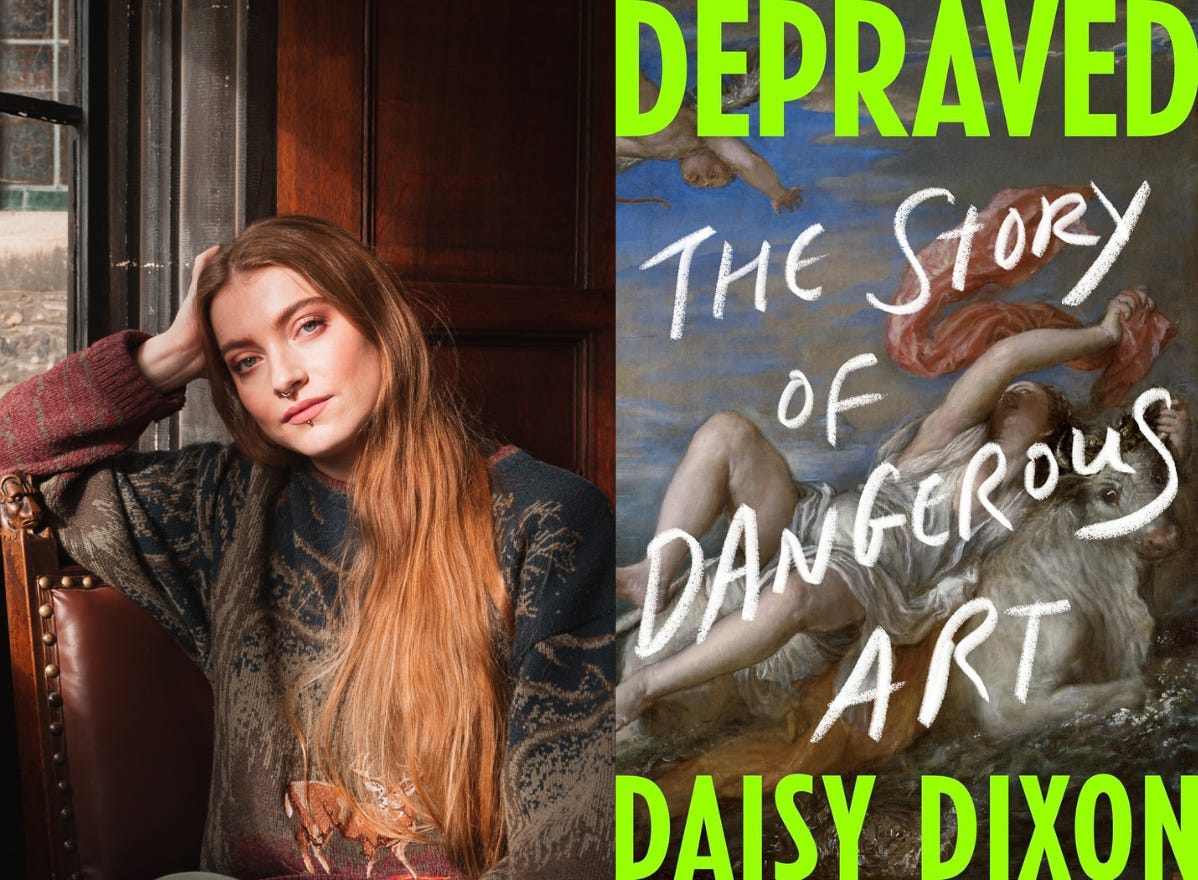
Daisy Dixon approaches art from two sides. She’s a philosopher at Cardiff University who studies the moral and political questions raised by art, and she’s also a practicing artist herself. Much of her academic work has focused on the uncomfortable territory where aesthetics collides with ethics: oppressive monuments, deceptive art, immoral artists, and the ways creative work can reinforce injustice.
Her new book, Depraved: The Story of Dangerous Art, takes those questions far beyond the seminar room. Moving from prehistoric figurines and Renaissance painting to heavy metal and videogames, Dixon asks what makes art dangerous, who gets to decide when it crosses a moral line, and what we should do about it when it does. Her answer is deliberately complicated: art can cause real harm, but censorship carries dangers of its own.
21 Questions with Daisy Dixon
1. I couldn’t have written my last book without…
Quieting that negative voice in my head telling me I can’t do it. It can get rather loud sometimes, and it’s so important to hold on to your convictions and believe in what you have to say.
2. What’s the thing most people get wrong about being a writer?
I’m new to the game book-wise, but I guess one thing I was mistaken about is thinking that our ideas in our books are going to translate smoothly to social media. Philosophy is something done slowly and meticulously, and I naively thought social media would be an easy platform for it… It is not.
3. What’s your most common form of procrastination?
Social media will be the death of me. The number of times I absent-mindedly reach for my phone is incredible. I think I need to get one of those locked boxes that only releases your phone after a certain period of time. I also often just blankly look out the window of my university office.
4. Do you read your reviews?
I’m afraid so. Coming from academia, we get excited just to be cited and engaged with, so I’m used to reading other philosophers’ responses to my work, and I enjoy the criticism! Writing for the general public though has been a lot trickier, and sometimes reviewers have misrepresented what I say, or disagree with my stance in a very dismissive way. I’ve definitely had to grow an even thicker skin this year!
5. What’s the first thing you do after you finish a draft?
I read it several times and it’s an emotional rollercoaster. The first time I think I’m a genius. The second time I hate myself and want to burn it all to the ground. I then leave it a few days and ideally get to a more reasonable headspace with it.
6. Kiss, marry, kill: podcasts, newsletters, and speaking gigs.
Hmm, let’s go Kiss podcasts, Marry speaking gigs, and Kill newsletters (though nothing against newsletters!)
7. What’s something you wish you’d started doing five years ago?
I wish I’d started learning creative writing earlier, to express non-fiction via more storytelling. I’ve been trained to create analytic philosophical arguments, with a search for validity and that rare quality: soundness. But writing for the general public has really challenged me to find my voice more and weave philosophy together with real-life emotion and stories.
8. Where do you find new ideas, and how do you keep track of them?
Like many, my ideas often find me everywhere in the world apart from my actual office. I’ll often be on a train, in class with my students, at the gym, or in the shower. So, I’m constantly reaching for my iPhone Notes App to keep track. Music also helps a lot too—I find certain genres really help me articulate overlooked philosophical concepts.
9. What’s the best piece of professional advice you’ve ever received?
Some of the best advice I received specifically for book writing was from Professor Dan Hicks who chaired my first ever book event. He told me that the book tour is when you learn what your book is really about. And he was spot on.
10. And the worst?
Some academics in the past have been rather negative about academics writing for the general public, judging that it doesn’t carry high esteem in the university. Times have now changed, and I think bringing academic disciplines to the public and inspiring interest and enacting change beyond the ivory tower is a hugely important endeavour for the humanities.
“The book tour is when you learn what your book is really about.”
11. Whose career do you most admire and why?
Can I cheat and choose two? There are so many I admire! To pick just two here: Dr Amia Srinivasan and Dr Kate Lister. Both are academics, though Dr Lister has now left university lecturing and is now a full-time public historian. Both have trodden the line between academia and trade writing so beautifully. To maintain rigour but in an entertaining, illuminating way is something I always strive to do.
12. What’s on your nightstand right now?
Books: Dan Jones’s Lion Hearts, Cat Bohannon’s Eve, and Luke Pepera’s Motherland – I have a bad habit of dipping and diving between several books at a time. I also have a booklight (approaching 40 means getting ever-closer to needing glasses), some hand cream, and a scented pillow spray.
13. How did you find your agent?
I was discovered in the depths of what was then known as Twitter during the pandemic. The medieval historian Dan Jones started chatting to me about writing for the public—I was very keen, so he put me in touch with an agent, Georgina Capel, and amazingly, she took me on (cheers George and Dan!).
14. What tech tools (AI included) do you actually use—and which ones do you actively ignore?
I never use AI for writing itself, mainly because I want to learn the hard way. I do sometimes use Google’s Gemini for quick access to facts, but it once got something wrong about Hitler’s artistic influences (I already knew the correct answer) so that spooked me a bit.
15. What’s the best non-writing skill that’s helped your writing career?
Presenting. I started teaching and giving talks during my Masters and PhD, and while it was terrifying, it was the best way to learn in the deep end. I now don’t get nervous about public speaking and really enjoy it.
16. How many drafts before you show your editor?
It really depends on what’s happening in my day job at the university. If I’ve basically zero time because I’m in the middle of a teaching semester, my editor might get only a second draft. If I have more time, it might be the tenth.
17. Can you describe your ideal workday?
Every perfect workday surely must begin with a good night’s sleep. I’m a bad sleeper, so I’ve always been envious of people who get their forty winks. So, waking refreshed at 7 am. Walk to the office in the sunshine. No emails land in my inbox. No one knocks on my door. Start reading and writing from 9 am until lunchtime, with a few breaks. Watch Netflix over a homemade sandwich. Read and write some more until 5 pm. Then walk to the gym and lift some heavy weights. Head home, make dinner and have a massive glass of wine. As you can tell, when I’m in the creative zone, I become a recluse.
18. How does that compare to your actual workday?
My actual workday starts with me being tired and groggy. Walk to the office in the rain and get wet feet (I live in Wales). I want to start reading and writing philosophy immediately but I get distracted by my email inbox which is constantly pinging. Students and staff knock on my door all day. I often give lectures and seminars, which I do enjoy but they can be rather draining and disruptive to a research day. I then head to the gym and that does still always cheer me up. Then I try to avoid the wine every day because I’m trying to be healthier…
19. If you could write one book in a totally different genre than you usually do, which would it be?
A memoir. I’d still like to one day!
20. What is your new book about?
It’s a philosophical history of immoral art, beginning in the stone age all the way through to the art of today. I explore how art can be immoral and the ways it’s been dangerous to society over the centuries. I move from paleolithic figurines to Renaissance paintings, heavy metal music to video games, exploring the nature of obscenity, the problem of immoral artists, how art might cause us to descend into depravity, how it can oppress whole social groups, and the unethical production process itself. I then caution against censorship, and recommend a distinctive form of iconoclasm to solve the problem of immoral art.
21. Anything you’d like to ask or crowdsource from fellow authors in the Author Insider community?
I think advice on how to avoid perfectionism but while striving to always be better. Maybe that’s too big an ask!
You can learn more about Daisy’s book here: Depraved: The Story of Dangerous Art
Author Insider is where writers get the real story of publishing—thoughtful conversations with industry insiders and bestselling authors, clear-eyed analysis of where the market is headed, and practical strategies for building a sustainable writing career. Whether you’re just starting out or several books in, the goal is the same: helping you make smarter decisions about your work.
If you’re new to Author Insider, here are a few reader favorites:
Until next time,
Panio
Author Insider is a reader-supported publication. Please consider becoming a free or paid subscriber.