
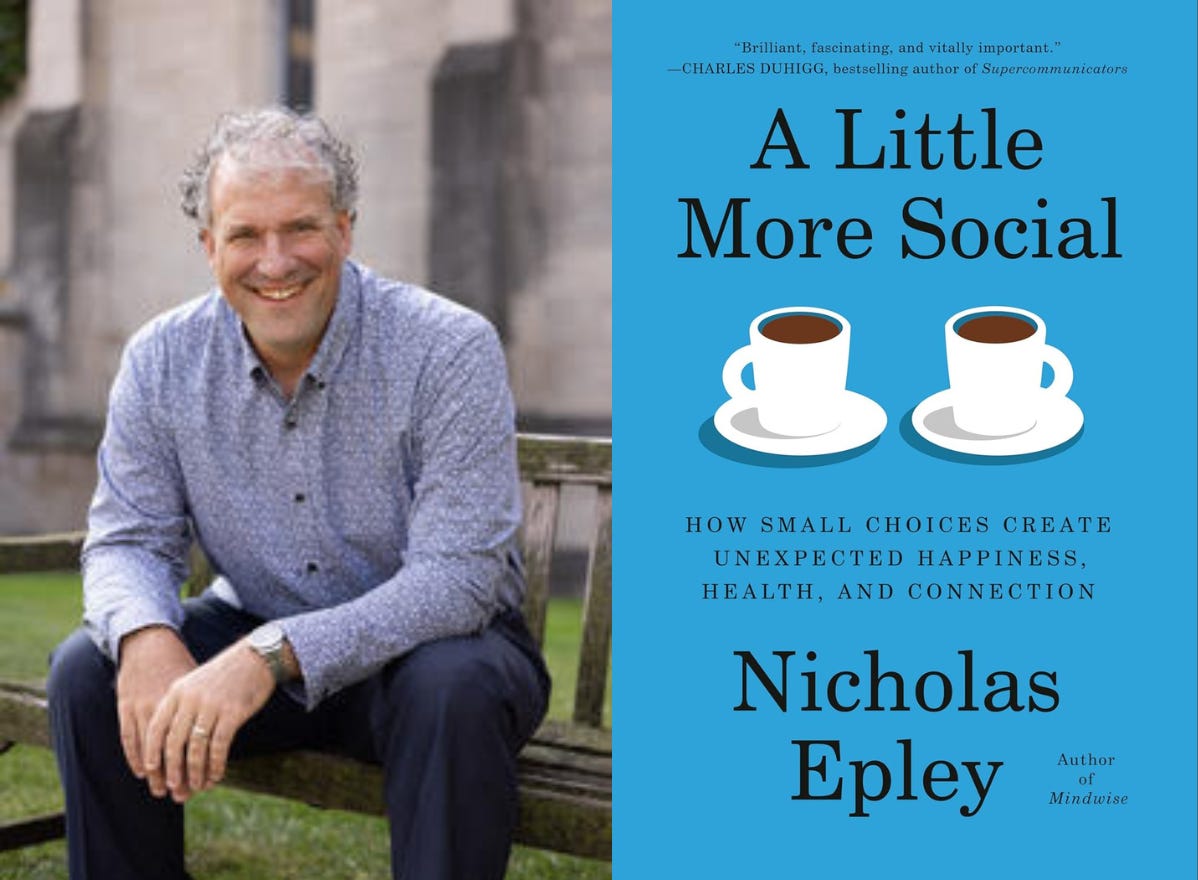
Nicholas Epley has spent the last two decades studying one of the stranger contradictions of modern life: human beings are deeply social creatures, yet we often avoid the very interactions that make us happier. A professor of behavioral science at the University of Chicago and the author of Mindwise, Epley’s work explores how we misunderstand one another, and what happens when we choose to connect anyway.
His new book, A Little More Social, examines why we so often hesitate to reach out, even when the benefits of connection are well established. Drawing on years of behavioral research, he makes the case that connecting with other people is far easier, and much more rewarding, than we expect.
In this edition of 21 Questions, Epley reflects on writing, collaboration, and why conversation remains one of the most generative forces in his work.
21 Questions with Nicholas Epley
1. I couldn’t have written my last book without…
Five-pound bags of Dark Voyage blend from Door County Coffee (in Carlsville, Wisconsin). Some might say it’s a problem for me.
2. What’s the thing most people get wrong about being a writer?
How fast, and how perfectly, the words pour out of you. Readers see the one final draft, not the hundreds that came before it. That makes it seem easier to do than it actually is. It’s a little bit like watching the Olympics and thinking you could probably nail the quad jump.
3. What’s your most common form of procrastination?
Reading the news. Not helpful!
4. Do you read your reviews?
For my scientific papers, absolutely. I have to respond to them when I submit a revision. For my books, I try hard not to. I read the first review that came out after I wrote Mindwise in 2014, and it was so painful that I decided I shouldn’t read others.
Even if a book review is positive overall, there will always be some things a reader didn’t like, or things you think the reader might have misunderstood. Unlike reviewers of scientific papers, you can’t respond to the book reviewer. Instead, I just ended up crafting responses in my mind, taking up valuable space in my brain that I didn’t have to spare.
5. Kiss, marry, kill: podcasts, newsletters, and speaking gigs.
Kiss podcasts. I’ve enjoyed almost every one I’ve done. No two conversations are the same.
Marry speaking gigs. After many years of practice, I really enjoy public speaking. It’s as close as I’ll ever get to my dream job of being the lead singer for Metallica (Lars, when James retires, call me!) Plus, I often conduct experiments with the audience in my talks. Having fun and collecting data; what could be better?
Kill newsletters. Too much unedited and unfiltered information. I get too many emails already.
6. What’s something you wish you’d started doing five years ago?
Training for the Ironman Triathlon.
7. Where do you find new ideas, and how do you keep track of them?
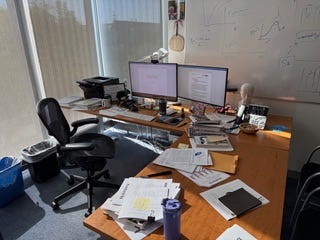
Behavioral science is the scientific study of everyday life, so ideas can pop up almost anywhere. However, the most common place is in conversation with collaborators in my office. Talking is endlessly generative. I keep track by writing ideas in a document on my phone or in notebooks I take to presentations. As my colleague, Linda Ginzel, likes to say: “If you don’t write an idea down, it didn’t exist.”
8. What’s the best piece of professional advice you’ve ever received?
“Being a professor is the world’s greatest job because it allows you to do so many different things, and you should try everything once.” Dan Wegner, a wonderful social psychologist, told me that in my first year as a professor. He was absolutely right. I’ve tried a lot of interesting things in my job, and even done a few things twice.
9. And the worst?
“That experiment’s not worth doing.” I was once told this by a senior faculty colleague about an experiment that ended up being one of the most impactful I’ve ever conducted.
When you’re trying to be creative, your initial ideas will almost always strike other people as wrong. As a scientist, I almost always seek advice from friends and colleagues when starting a project. However, I don’t always follow their advice. You also have to trust your instincts when you’re passionate about an idea.
10. What’s on your nightstand right now?
Run by Ann Patchett. I met Ann—often referred to as Saint Ann in the literary world— at TED in Vancouver recently. My wife and I had so much fun talking with her. Ann spoke in a session with me about social connections and gave me recommendations for books I should read, as she is famous for doing. Ann said she rarely recommends her own books, but thought she had written one that I would really enjoy. It’s her novel, Run, and I’m enjoying it now.
11. How did you find your agent?
I asked friends and colleagues who had written books in the same genre, and they all uniformly loved their agent. That’s who I went with.
12. What’s a writing rule you’ve happily broken?
If grammatical rules were laws, I’d be in jail. My editor will confirm this.
13. What tech tools (AI included) do you actually use—and which ones do you actively ignore?
I write today using the same tools I have for my whole career: a computer, attached to the internet, with a spell checker. I don’t use AI for anything. It’s not that I haven’t dreamed that I could take some crap I’ve written and ask AI to polish it into a diamond. In fact, I’ve even tried it. I just found that what came out was nearly just as bad as what I put into it. Plus, when it comes to writing, using AI feels dishonest. When I read something someone has written, I am expecting it has come out of their own heads, in their own words, just as I expect from the students in my classes.
14. What’s the best non-writing skill that’s helped your writing career?
Public speaking. A great writer once told me that “Good writing is good speaking.” I’ve taken this to heart. I always read my writing out loud to make sure that it sounds right. It’s also good practice for narrating your audiobook!
15. How many drafts before you show your editor?
My approach to writing book chapters is to start every day at the beginning of the chapter and then edit my way through it until I get to the point where I left off the day before. This means that I’m revising every day. It’s sometimes taken me months to get to the end of a chapter draft. But, once I’m finally at the end, I usually think it’s ready to be read because I’ve been editing it every day. I’m not sure how to count that.
16. Can you describe your ideal workday?
Wake up without an alarm clock around 7 AM. Hug my wife for a while before going to pour a cup of coffee already brewed from the kitchen, because I remembered to schedule it the evening before. Breakfast would be two eggs and toast that I’ll eat with my kids before walking to my office at our little summer cabin in Wisconsin to write all morning. Lunch would then be with a colleague I love to talk about ideas with, followed by meetings with a few collaborators to talk about research projects, and then ending the day with another hour or so of writing before heading to dinner. In the evening, I’ll put the kids to bed and then spend some time reading or watching something funny with my wife. We’ll be in bed by 9 PM.
17. How does that compare to your actual workday?
Only moderately comparable. Our youngest daughter has me up at 5:30 AM every day, which is sweet, but I won’t mind when she learns to sleep in a little longer! I almost never remember to set the coffee schedule, and I’m usually in Chicago rather than out in the woods of Wisconsin.
But, I usually do get my morning to write, and I routinely have meetings with wonderful collaborators in the afternoon. Administrative meetings, scientific manuscript reviews, and university obligations also break up my days. These are important, but not always great fun. However, I can’t complain. I have an unusual degree of flexibility to set my schedule every day. If it’s not my ideal, it’s mostly my fault.
18. If you could write one book in a totally different genre than you usually do, which would it be?
A novel, because my wife loves to read them, and because it’s so completely different from what I write now.
19. What’s something about the writing life that still surprises you?
How little I feel like I know what I’m doing, despite writing scientific papers for three decades now. Every time I sit down to a blank page to start writing something new, I feel like I have to remind myself how to do it by either reading something I’ve already written or by reading someone whose writing I love.
20. What is your new book about?
Why we’re not social enough for our own good, and how to do better.
For the last 20 years, my colleagues and I have been trying to understand why highly social creatures like us often choose to avoid social interactions that research has shown make us happier and healthier. We’ve found at least one answer: We can be overly pessimistic about how others will respond when you reach out to connect with them. No research I’ve ever been involved with has changed how I live my own life more than this. I hope that learning about our research can do the same for many readers.
21. Anything you’d like to ask or crowdsource from fellow authors in the Author Insider community?
Just curious: how many of you have told your spouses or friends that the book you just finished will be the last one you ever write, only to come back and do it again not all that long after?
Maybe it’s just me?
If you enjoyed Nicholas’s Q&A, you can learn more about her new book here: A Little More Social.
More from Author Insider
Author Insider is where writers get the real story of publishing—thoughtful conversations with industry insiders and bestselling authors, clear-eyed analysis of where the market is headed, and practical strategies for building a sustainable writing career. Whether you’re just starting out or several books in, the goal is the same: helping you make smarter decisions about your work.
If you’re new to Author Insider, here are a few reader favorites:
Until next time,
Panio Gianopoulos
Author Insider is a reader-supported publication. To receive new posts and support my work, please consider becoming a free or paid subscriber.
While writing the book, I vowed that I would not write another book more times than I'd care to count. Now that the book is done and almost out, here I am, already planning the next.