
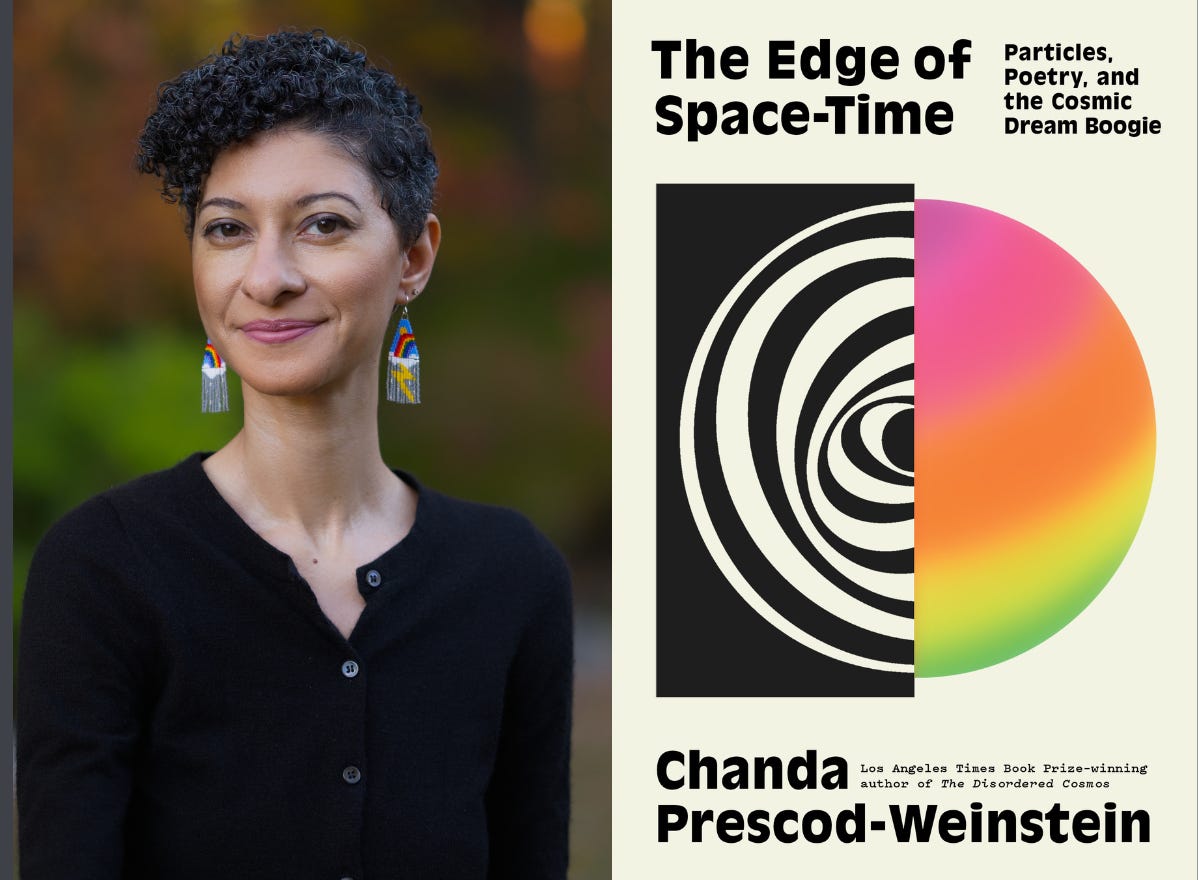
What does it mean to stand at the edge of the universe—and try to describe it? For Chanda Prescod-Weinstein, the answer lies somewhere between physics, poetry, and lived experience.
A theoretical physicist and writer, Prescod-Weinstein studies dark matter and the early universe while also exploring how science intersects with culture and power. Her first book, The Disordered Cosmos: A Journey into Dark Matter, Spacetime, and Dreams Deferred, won the Los Angeles Times Book Prize in Science and Technology. Her new book, The Edge of Space-Time: Particles, Poetry, and the Cosmic Dream Boogie (April 7, 2026), takes readers to the boundaries of the universe, and asks what those boundaries reveal about ourselves.
In this edition of 21 Questions, Chanda talks about libraries, cat memes, and the unpredictable path to becoming a writer.
21 Questions with Chanda Prescod-Weinstein
1. I couldn’t have written my last book without…
Libraries. I accessed so many papers and books I needed thanks to libraries.
2. What’s the thing most people get wrong about being a writer?
We are not born good. We work hard to be good at what we do.
3. What’s your most common form of procrastination?
Looking for cat memes to share with one of my group chats.
4. Do you read your reviews?
Only the published ones.
5. What’s the first thing you do after you finish a draft?
Put it away and watch comfort TV.
6. What’s a writing habit you’re embarrassingly superstitious about?
I thought I didn’t have an answer to this question, but my spouse immediately said, “You’re obsessed with word count.”
7. What’s something you wish you’d started doing five years ago?
It would have been helpful to learn how to let myself write out of order, instead of expecting it to always come to me linearly.
8. Where do you find new ideas, and how do you keep track of them?
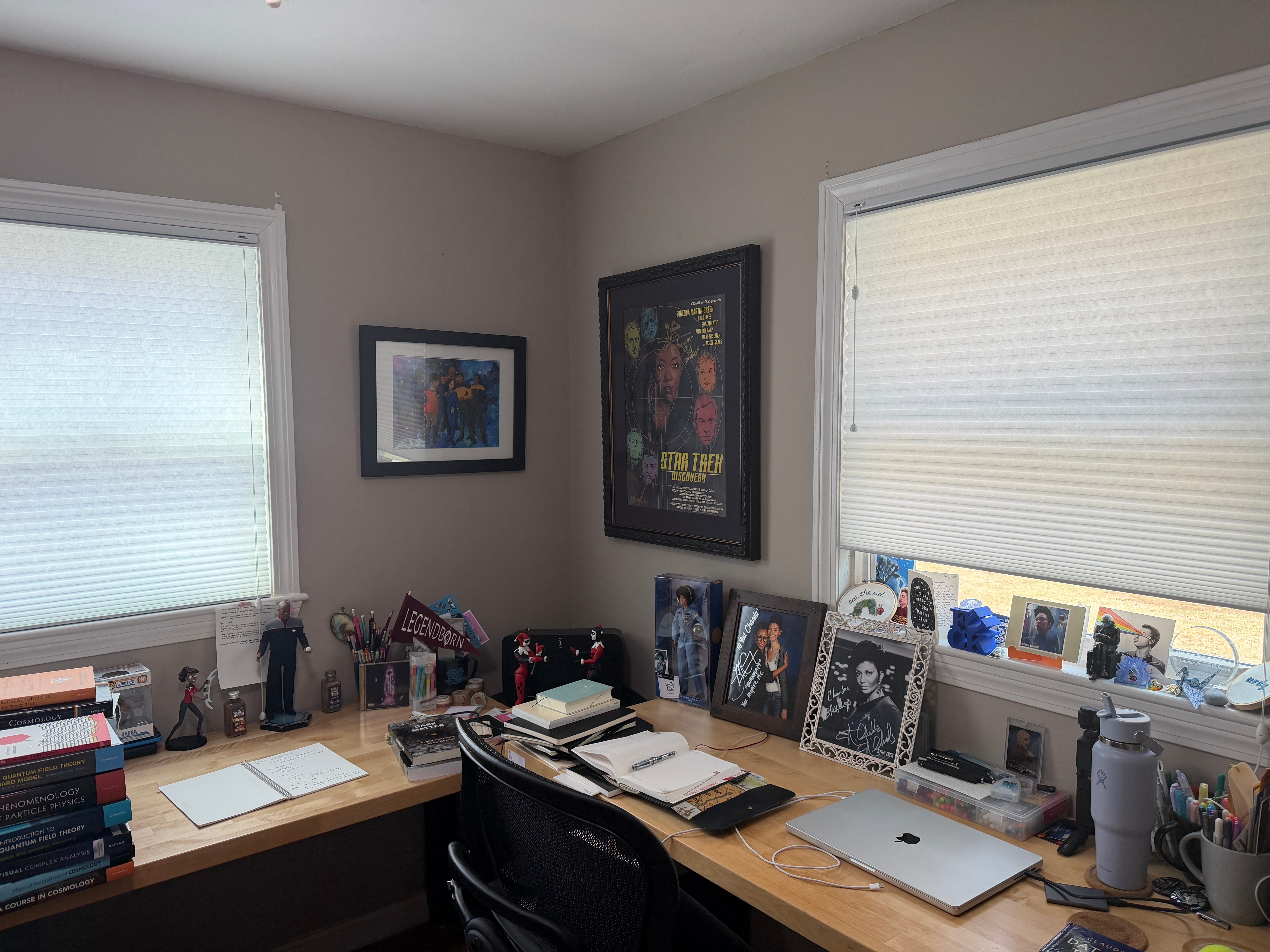
Everywhere. I keep a notebook where I write down important quotes. I put sticky notes on books I want to use, with a comment about what was important in the book.
9. What’s the best piece of professional advice you’ve ever received?
Ask questions when you need to.
10. And the worst?
To give up because I would never succeed. That turned out to be very wrong.
11. Whose career do you most admire and why?
I really admire astrophysicist and author Priya Natarajan. She has had an extraordinary intellectual range within astronomy and has broadly been a force for good in the discipline. On top of that, she’s also a writer with broad interests.
12. What’s on your nightstand right now?
Stephanie Wambugu’s first novel, Lonely Crowds, and Toni Morrison’s classic novel, Sula.
13. How did you find your agent?
Jessica Papin found me, and I cannot put into words how happy I am that she did.
14. What’s a writing rule you’ve happily broken?
Preposition at the end of the sentence. It’s fine, really.
15. What tech tools (AI included) do you actually use—and which ones do you actively ignore?
I am virtual lifemates with Zotero, the reference software. I am a GenAI virgin and proud of it.
16. What’s the best non-writing skill that’s helped your writing career?
Being able to get on stage and talk to large and small audiences has served me well. I’m so glad I went to a public performing arts school for seven years.
17. How many drafts before you show your editor?
Usually my editor sees the first one.
18. Can you describe your ideal workday?
One where I don’t have to deal with any university bureaucracy.
19. How does that compare to your actual workday?
A lot of writing emails and feeling annoyed by wasteful bureaucracy, interspersed with thinking about ideas I actually care about. Right now I’m picking out a textbook for the graduate quantum field theory class I’m teaching next year.
20. What’s something about the writing life that still surprises you?
No two books are alike, and the way I grow and change as a writer is completely unpredictable.
21. What is your new book about?
The Edge of Space-Time: Particles, Poetry, and the Dream Boogie is about how living at the edge of what we know is part of who we are as a species. I write about the power of physics and metaphor to shape our minds and our relationship to the cosmos, and I emphasize the spiritual importance of doing particle physics and cosmology. It’s also for anyone who has ever wondered, “What the fuck is quantum field theory?”
Bonus Q: Anything you’d like to ask or crowdsource from fellow authors in the Author Insider community?
I’m interested to know how they think about what it means to write with integrity.
More from Author Insider
Author Insider is where writers get the real story of publishing—thoughtful conversations with bestselling authors and industry insiders, clear-eyed analysis of where the market is headed, and practical strategies for building a sustainable writing career. Whether you’re just starting out or several books in, the goal is the same: helping you make smarter decisions about your work.
If you’re new to Author Insider, here are a few reader favorites:
Until next time,
Panio Gianopoulos
Editorial Director, Author Insider & The Next Big Idea Club