
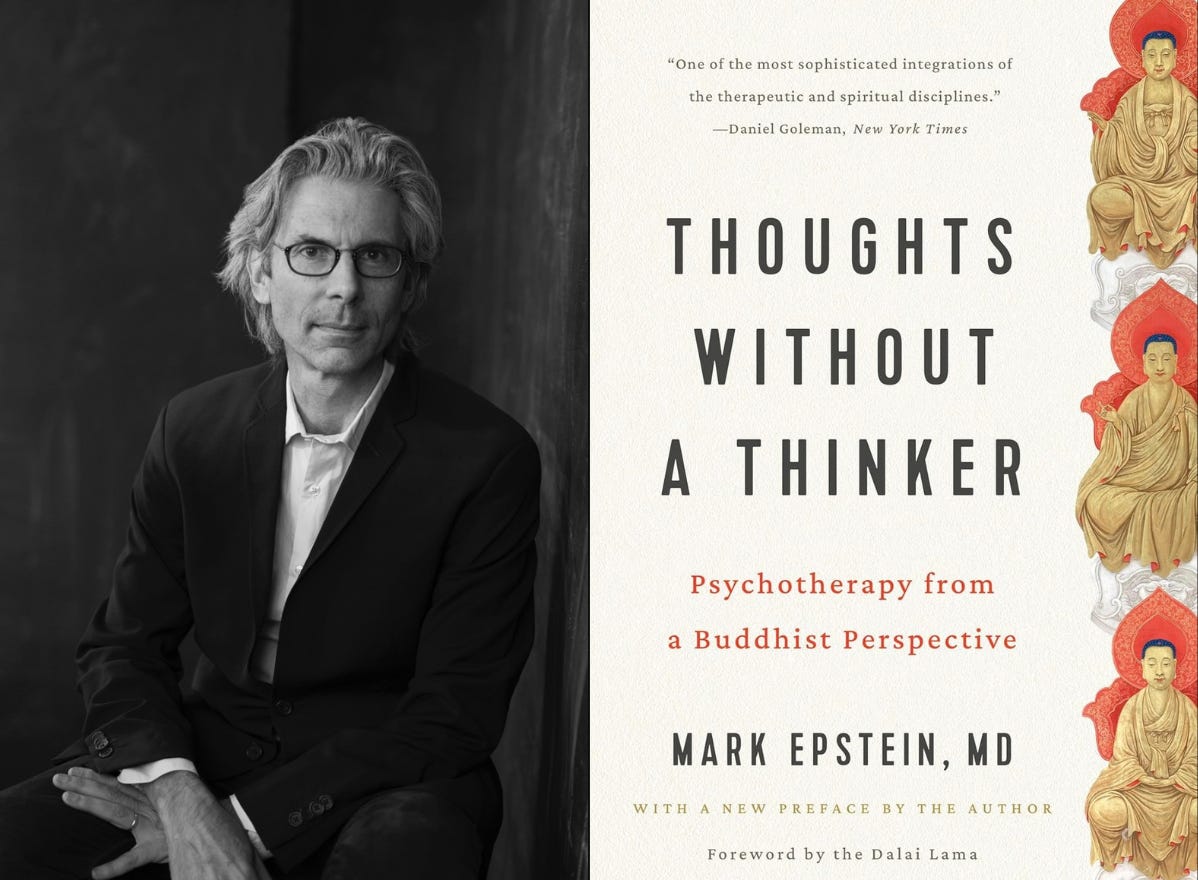
When Mark Epstein published Thoughts Without a Thinker 31 years ago, Buddhism and Western psychotherapy were still an unusual pairing. A psychiatrist and longtime student of vipassana meditation, Epstein set out to translate Buddhist ideas about the self, suffering, and insight into the psychological language of his own profession.
That book became the beginning of a remarkable writing life. Epstein has since written eight books exploring the intersection of Buddhism and psychotherapy, including Going to Pieces Without Falling Apart, The Trauma of Everyday Life, and The Zen of Therapy. Thoughts Without a Thinker itself became a modern classic, arriving well before mindfulness entered the therapeutic mainstream.
Now, with a new edition and a new preface, Epstein has returned to the book that launched his writing career, and to the ideas that have occupied him ever since.
21 Questions with Mark Epstein
1. I couldn’t have written my last book without…
My friend Jonathan Cott sending me every book about Zen poetry that he knew about. Those poems began to make sense to me as I read them over and over in the context of writing about my individual psychotherapy sessions in The Zen of Therapy. I was trying to find a kernel of truth in the midst of a quotidian therapy hour and the poems led me there.
2. What’s the thing most people get wrong about being a writer?
That it requires inspiration.
3. What’s your most common form of procrastination?
I very rarely procrastinate. I’m the kind of person who likes to get the thing that’s hanging over me over with so I don’t have to be anxious about it.
4. Do you read your reviews?
If I know about them, I always read them. But I never read the Amazon customer reviews. Or more accurately, I once read one that was unfavorable and it took a long time to get it out of my head. I haven’t read any since.
5. What’s the first thing you do after you finish a draft?
I email it to myself so it won’t get lost.
6. Kiss, marry, kill: podcasts, newsletters, and speaking gigs.
Podcasts have begun to be, or to seem, repetitive, especially when the interviewer has a list of previously configured questions. Newsletters I know nothing about. Speaking gigs are often welcome, except for ones on Zoom.
7. What’s something you wish you’d started doing five years ago?
Going to the opera.
8. Where do you find new ideas, and how do you keep track of them?
New ideas tend to come out of everyday conversations or happenstance. When I’m writing, I’m always trolling for good little tidbits, things people say in passing. On occasion, when on a silent retreat, a new thought or new idea will just happen. Almost as if it comes out of nowhere. I have a little notebook that I keep for such things. Once, for instance, the title Advice Not Given, appeared in my mind while I was on retreat. It was a good title and then I had to write the book that went with it.
9. What’s the best piece of professional advice you’ve ever received?
Never do a psychotherapy session on a full bladder.
10. And the worst?
That the therapist should be a blank screen.
11. Whose career do you most admire and why?
Bob Dylan. I mean, how could you not admire that career? The guy doesn’t quit and he’s brilliant and dedicated. He gives so much.
12. What’s on your nightstand right now?
Robert A.F. Thurman: Life and Teachings of Tsong Khapa; Wolfgang Koeppen, Pigeons on the Grass; Sam Roberts, Are They Dead Yet?; Adam Phillips, The Life You Want; Ian Baruma, Stay Alive; Rachel Cusk, Life of M; Rachel Aviv, You Won’t Get Free of It; Graham Greene, The Heart of the Matter; Gisele Pelicot, A Hymn to Life; Harold Bloom, The Man Who Read Everything
13. How did you find your agent?
She is my sister’s husband’s sister. I had no idea what she did, but when we first met I was talking about writing my first book and she said, “I’m an agent.” She’s been my agent for more than 30 years now.
14. What’s a writing rule you’ve happily broken?
I never thought of myself as a writer, I thought I was a psychiatrist. So when I started writing, I didn’t know there were writing rules. I guess writing without being a writer is breaking some sort of rule!
15. What tech tools (AI included) do you actually use—and which ones do you actively ignore?
I write on a computer, that’s about it. I wrote all my books before AI was a thing.
16. What’s the best non-writing skill that’s helped your writing career?
When I found an editor who I felt understood where I was coming from and what I was trying to say (the late Ann Godoff), I always listened to her and took her very generous advice.
17. How many drafts before you show your editor?
The way I write, for any given chapter, I always start at the top and tinker with it when I first sit down and read it through until I get to the place that is not yet written. So, technically, a given chapter or essay or piece is a single draft, but it’s been worked over a lot in the process of its development. When there’s nothing left to fix, I will send it off or put it away.
18. Can you describe your ideal workday?
I have done all my writing one day a week. The rest of the days I am seeing or talking to patients. So that day is special. I usually sit down first thing and work for about four hours. Then I’ll take a break to eat or exercise or something, then, if I have the energy, I’ll sit down again for a couple of more hours.
19. How does that compare to your actual workday?
In my regular day I will generally speak with seven or eight people for an hour at a time. My writing day is the inverse of my actual workday.
20. What’s something about the writing life that still surprises you?
That I don’t miss it.
21. What is your new book about?
My newest book is a reissue of a book I wrote 31 years ago called Thoughts Without a Thinker: Psychotherapy from a Buddhist Perspective. It was my attempt to translate Buddhist thought into the psychological language of our time. It has a new preface, which is actually the latest thing I have written, that attempts to describe why the book is still relevant. The preface, and the book, is more about what Buddhists call ‘insight’ than it is about mindfulness or meditation. What can Buddhism really teach us about ourselves? Are its insights the same or different as Freud’s?
You can learn more about Mark’s book here: Thoughts Without a Thinker: Psychotherapy from a Buddhist Perspective
Author Insider is where writers get the real story of publishing—thoughtful conversations with industry insiders and bestselling authors, clear-eyed analysis of where the market is headed, and practical strategies for building a sustainable writing career. Whether you’re just starting out or several books in, the goal is the same: helping you make smarter decisions about your work.
If you’re new to Author Insider, here are a few reader favorites:
Until next time,
Panio
Author Insider is a reader-supported publication. To support my work, consider becoming a free or paid subscriber.