
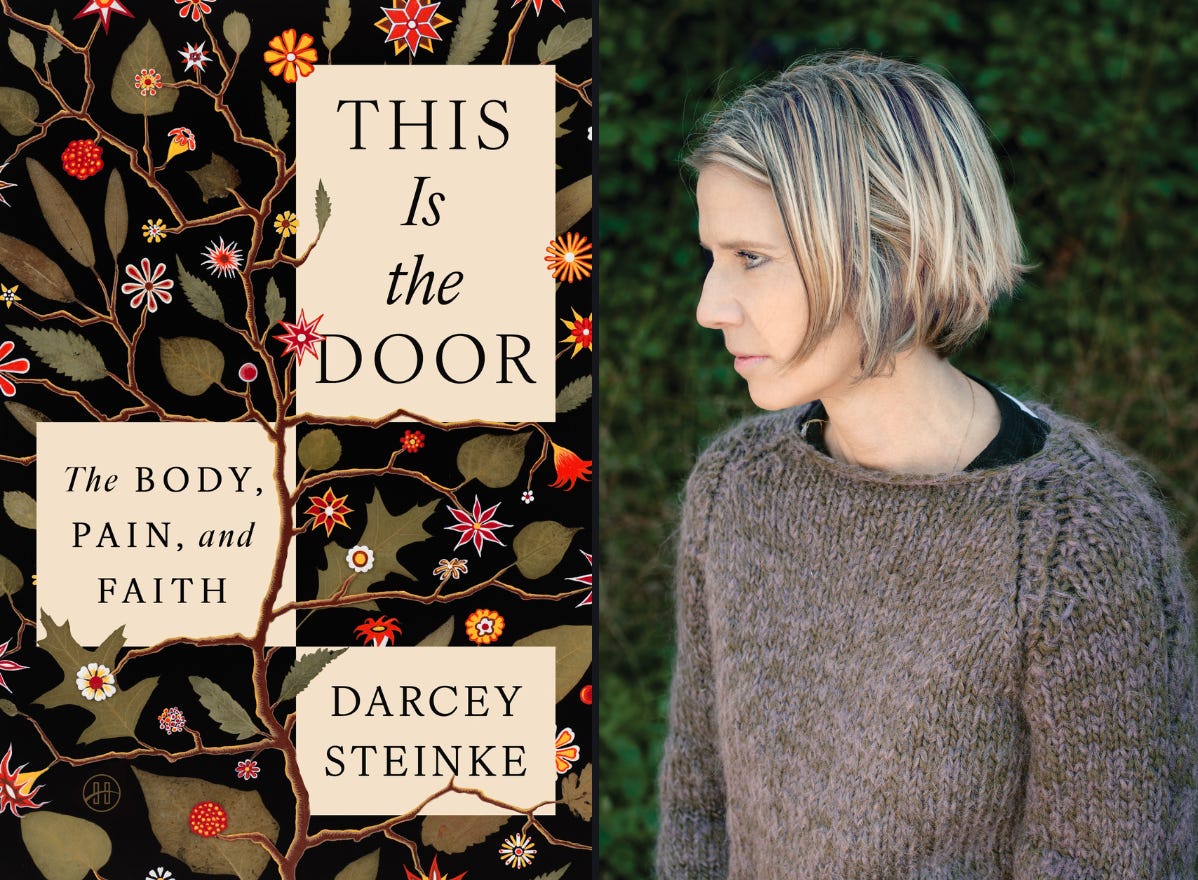
Darcey Steinke has spent much of her career writing about the body—its desires, its mysteries, and its limits. Across several novels and works of nonfiction, including her acclaimed memoir Flash Count Diary, she has explored the complicated terrain of being human.
Her new book, This Is the Door: The Body, Pain, and Faith, turns to one of the most universal experiences of all: pain. Blending personal story with history, philosophy, religion, and art, Steinke examines how humans try to understand—and live with—suffering.
In this edition of 21 Questions, Steinke reflects on the writing life and the experiences that become books.
21 Questions with Darcy Steinke
1. I couldn’t have written my last book without…
Having injured my back. That’s the odd thing for me about being a writer; the painful and difficult things that happen to me are often the very subjects I need to explore. My suffering interests me in a way my day-to-day life does not. They are also the experiences that bring me into a greater humanity and connect me with others.
2. What’s the thing most people get wrong about being a writer?
It’s such a strange vocation writing, as it’s both arduous—there is lots of rewriting and worry—but it’s also wondrous, allowing me to communicate what my own embodied experience is to others. It can be lonely; I am alone in my office many hours of every day, but when I go out, I am often overtaken by the beauty and complexity of the world.
3. Hemingway wrote standing up; Edith Wharton, lying down. What are your quirks?
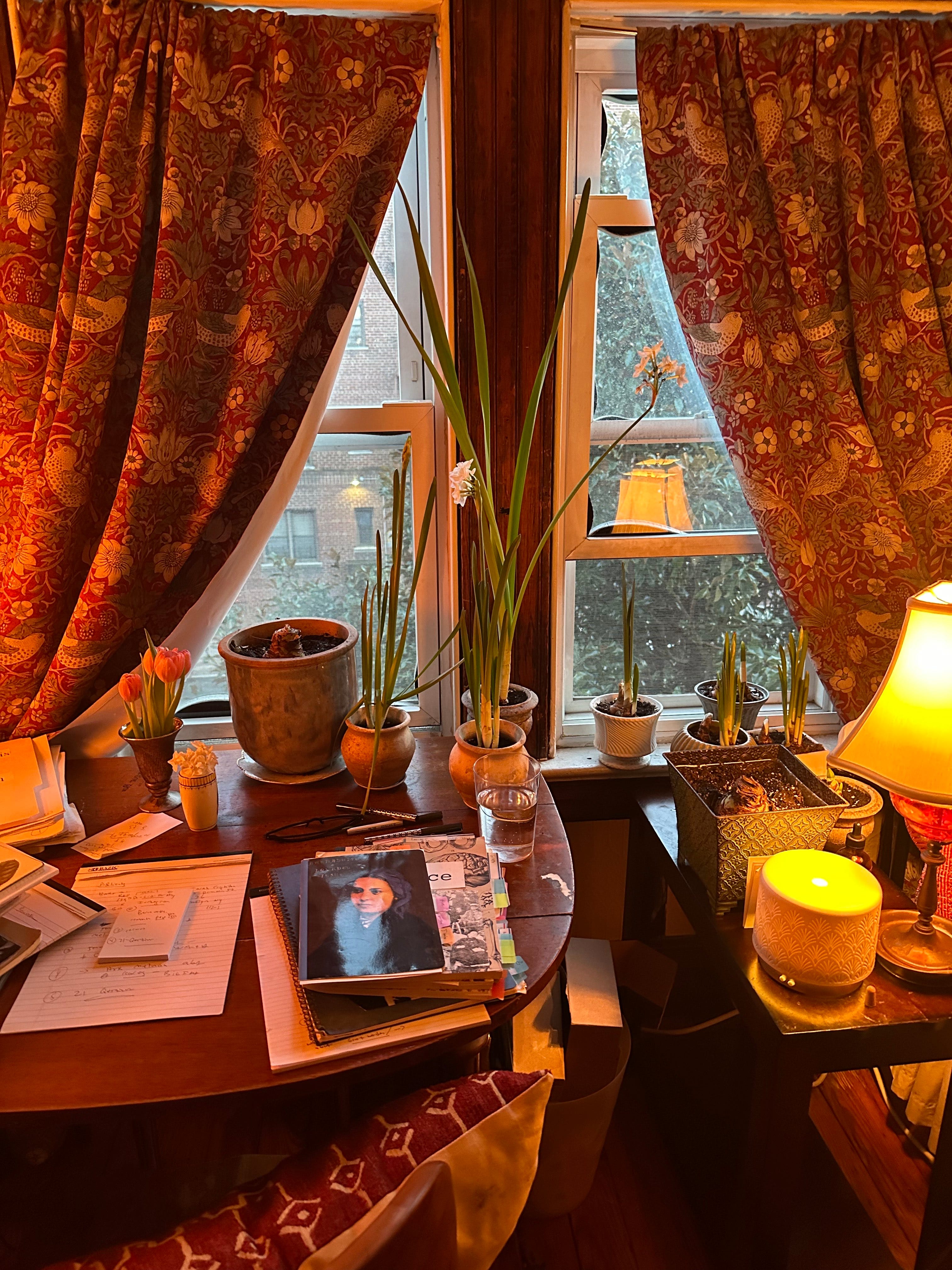
I have a standing desk and a regular desk. Also, a place to lie down and read in my office. If I am going to work for 4-6 hours, I need a variety of places to do it. I like to have things growing on my desks; that helps me remember that ideas and page numbers can grow as well. Right now, I am watching a half dozen green shoots move up from narcissus bulbs.
4. Do you read your reviews?
I do. They can be painful and I have to remember that a review is just one person’s opinion. I feel if you read and believe your good reviews you also have to be open to complaints in your bad ones. One of the qualities I like the best about myself is an ability to take in criticism and try to work with it to make my writing better. We write alone but we can’t bring the work out into the world without help from editors, and also reviewers.
5. Is there a book you wish you’d written?
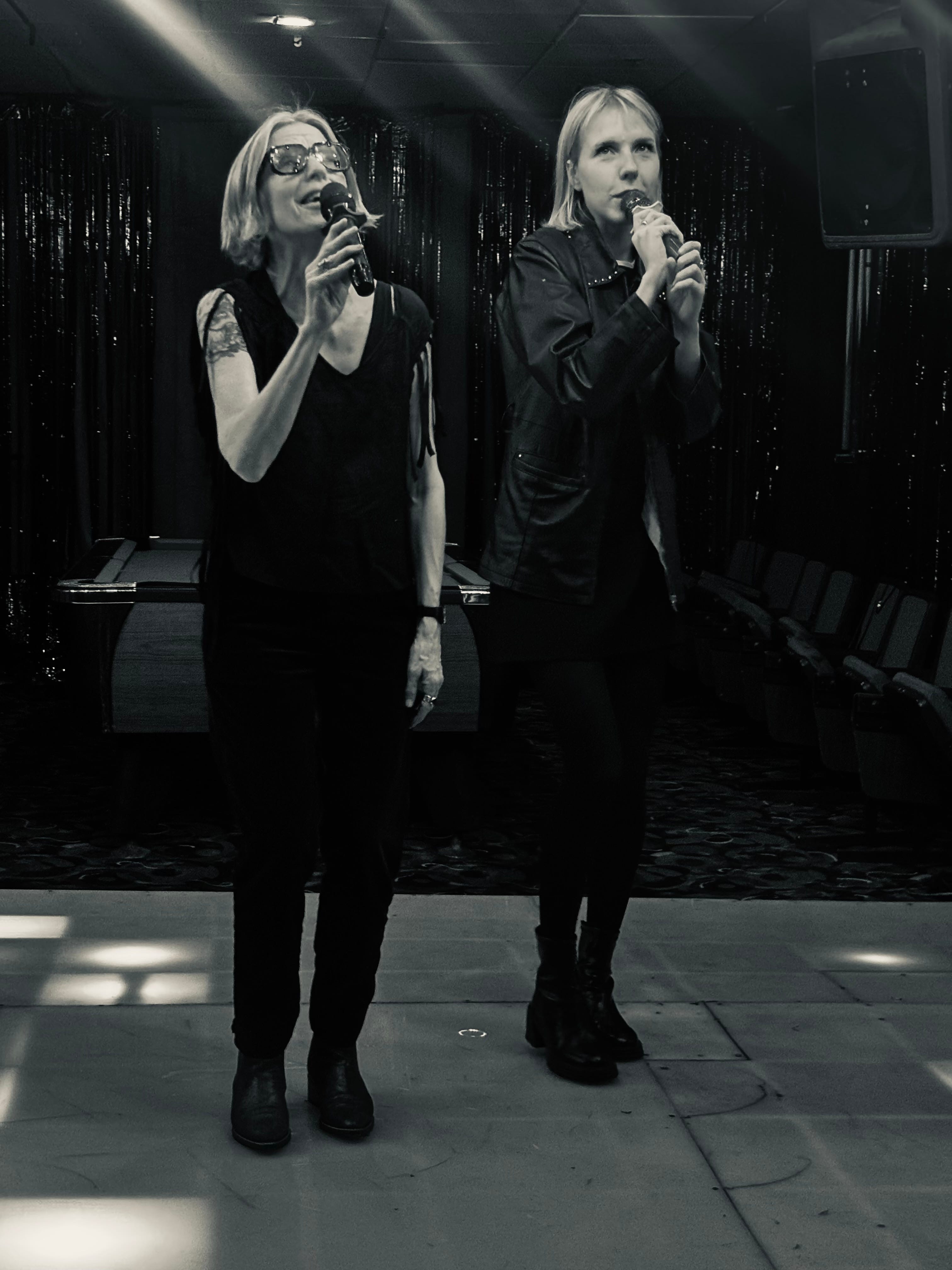
Oh my gosh! So many. Just a few are The Vegetarian by Han Kang, Member of the Wedding by Carson McCullers, Sleepless Nights by Elizabeth Hardwick, The Second Sex by Simone de Beauvoir
6. How has AI changed your writing process?
I guess it can make things easier to look up, but as far as the actual writing, not at all. I don’t think AI will ever be able to understand human sorrow, the brokenness of being human, of grief and love. So, I am not really worried. I mean, no machine can write a Darcey Steinke book!
7. How do you keep track of new ideas?
I have a zillion journals. In recent years, my books have come out of my journals. My last book, Flash Count Diary, came directly out of the diary I kept of my hot flashes when I was going through menopause. At the moment I have a journal called One Thing From Nature, and I write one observation about the natural world every day in its pages. I have another, in which I keep track of a house that is being torn down on my block, and yet another to record my feelings, and another (!!!) to keep track of ideas for new projects. I glue pictures to the front of all my journals and give them names.
8. What’s the best piece of professional advice you’ve ever received?
To remain curious and open. To not shut down things that threatened you but be interested in them. Also, that it’s not just about your own books but about the literary community at large. It’s important to buy books, go to readings, read drafts of friends’ books, and talk about books you love.
9. And the worst?
I had a teacher who modeled narcissism in the writer’s life, and I think that is dangerous. Writing can seem like a singular, selfish pursuit, but it’s actually a very generous one; it gestures out to connect with others.
10. What is the one piece of advice you would give to recent graduates that want to make a living as a writer?
Keep your expenses low and be careful with money. I guess I believe that if you are called to write, you will do it no matter what the obstacles are, but I have seen former students have to take jobs to pay bills that leave little time for writing and thinking. Also, surround yourself with people who understand your need to write and are readers themselves.
11. Whose career do you most admire and why?
I admire Simone de Beauvoir a huge amount. How she worked out her own ideas so bravely, how she wrote both fiction and philosophy, and understood both modes could get her ideas out. Her elegance, her style, her curiosity, her fierceness.
12. What’s on your nightstand right now?
The Little Communist who Never Smiled by the French writer Lola Lafon, Girls Play Dead by Jen Percy, Under the Glacier by Halldor Laxness, The Empusium by Olga Tokarczuk, The Wise Child by Olga Ravn, Loved and Missed by Susie Boyt.
13. Foreign rights, audio rights, film rights: which have been the most valuable to you?
My books have been translated into many languages and that means a lot to me. As a little girl, it was my dream to be a writer, but also one who could be read around the world. To think of a reader in, say, South Korea, opening one of my books and sharing in my world, thrills me.
13. What’s the best non-writing skill that’s helped your writing career?
Wonder and curiosity. Trying to see the depth in every situation, even if it’s just going to the grocery store. A writer’s work is to witness, sometimes that means highly emotional and charged situations, but also just ordinary ones, a walk in the park, watching a mother interact with her baby, the way snow falls against a street light.
15. Coffee, tea, or something stronger?
I start my workday with a cup of coffee. I just have one, but it’s a key part of the morning ritual. A few days a week in the late afternoon, I might have a hazy IPA while I read.
16. What’s one marketing tip you’d give a new author?
Try to be authentic to who you are and what your book is about. Before the book comes out, try to write some short essays that might accompany the pub date. Send your book to other writers who might be interested in your book and could help you spread the word. Social media is great, but in-person stuff is important too: do readings, workshops, stop by bookstores to sign your books.
17. How many drafts before you show your editor?
30 to 50. I am never really done. I work endlessly. I show it to people, get comments, rewrite. I let it sit for a month, then look with fresh eyes. I pay attention to any little nagging feeling that a passage is not quite right.
18. Can you describe your ideal workday?
After a good sleep, I wake between 6 am and 8 am, get coffee, and meditate. I try to be at my desk soon after. Some days I answer emails first, but that is not ideal. Work a bit in my journal to warm up. Then go over my notes from the day before, read through what I have written, and start. I like to work between 3 and 6 hours, depending on where I am with a project. Then I either, in the summer, go swim in the sea at Brighton Beach, or I take a yoga class. Come home and read till dinner.
19. How does that compare to your actual workday?
I teach graduate students at NYU and Columbia, and so some days I read their work and comment on it. Some days I have to go to the dentist or get groceries. Some days I am sick or upset. Even if these things are part of my day, I always try to work even a little, at least an hour.
20. What do you wish you’d known when you were starting out?
I have loved my writing life, even with its ups and downs; it’s a way to be in the world that has a lot of freedom in it. It’s not a race, it’s a slow unfurling of your ideas and stories. I think at the beginning of my career I rushed.
21. What is your new book about?
This is the Door: The Body, Pain, and Faith is about my own struggle with back pain, about what people did in the past to relieve their pain, about how artists, writers, musicians and saints worked with their pain to create new worlds. It’s also about my minister father’s death, how in his long illness, he lost his faith but also gained human connection and a more lucid grip on reality. It’s about trying to live in flawed but wondrous bodies, incarnate for such a short time on this earth.
·More from Author Insider
Author Insider is where writers get the real story of publishing—thoughtful conversations with bestselling authors and industry insiders, clear-eyed analysis of where the market is headed, and practical strategies for building a sustainable writing career. Whether you’re just starting out or several books in, the goal is the same: helping you make smarter decisions about your work.
If you’re new to Author Insider, here are a few reader favorites:
Until next time,
Panio Gianopoulos

Editorial Director, Author Insider & The Next Big Idea Club