
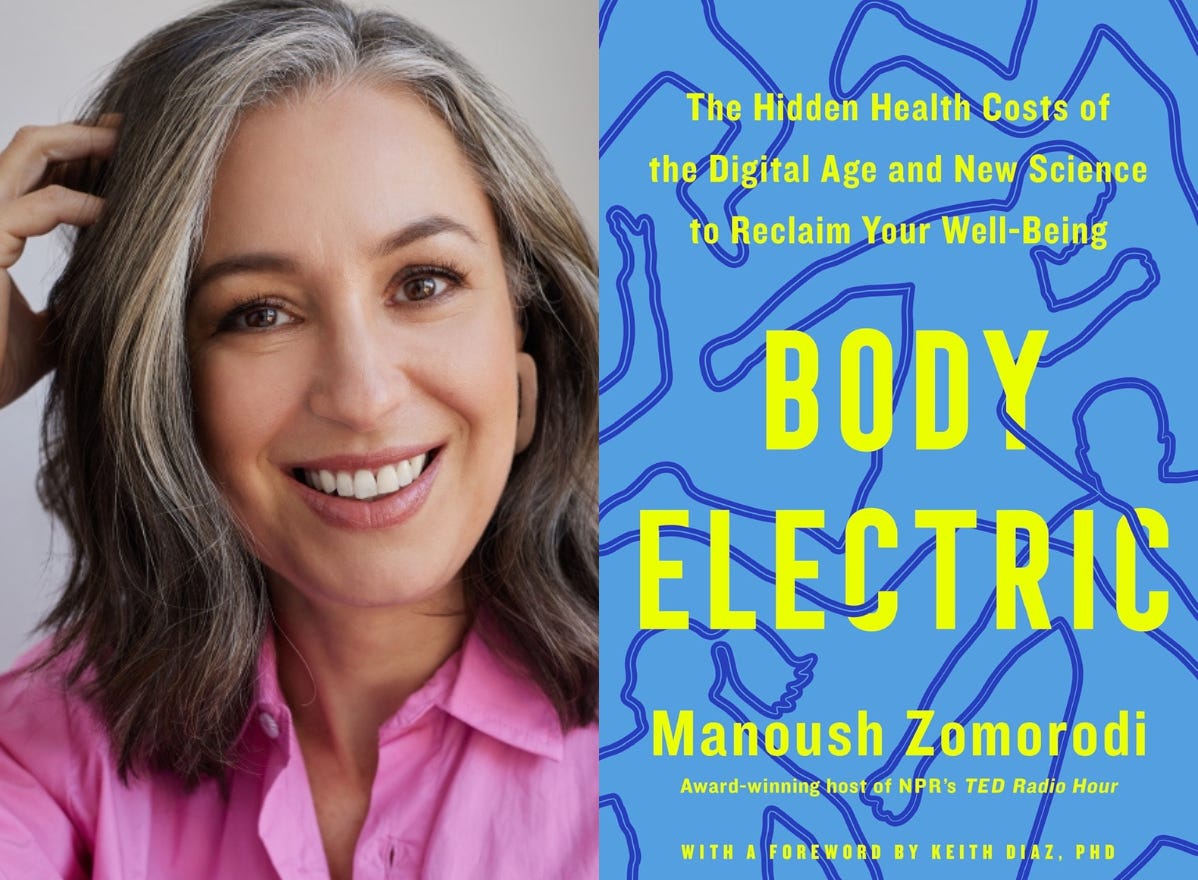
Manoush Zomorodi didn’t set out to write a book about posture, walking, or movement breaks. But after years spent reporting on technology and behavior, and after noticing how exhausted she was, she began asking a deceptively simple question: “Why do I feel so damned tired all the time?”
The host of NPR’s TED Radio Hour and creator of the Body Electric project, Zomorodi combines personal experimentation with reporting and scientific research in her new book, Body Electric, an investigation into the physical costs of modern work and digital life.
In this edition of 21 Questions, Zomorodi reflects on writing, movement, and the challenge of staying human in a world of increasingly digital routines.
21 Questions with Manoush Zomorodi
1. I couldn’t have written my last book without…
A Columbia University researcher named Keith Diaz and the 20,000 people who volunteered to be part of our Body Electric study.
I had a question (why did I feel so damn tired all the time?), Keith gave me the scientific understandings and solutions, and our participants showed that regular people could integrate movement breaks into their days, live better with their tech, and prove that we don’t need to throw away our phones to live healthier lives.
2. What’s your most common form of procrastination?
Going for a walk. After doing this project, the good news is that my body craves regular movement. The bad news is that I’d rather walk and think than come back to sit at a keyboard and get it all down on the page.
3. Do you read your reviews?
Yes. As a friend in college once said to make me feel better about some unkind gossip going around: “Honey, at least they’re talking about you.”
4. What’s the first thing you do after you finish a draft?
Go for a walk. Are you sensing a pattern here? I’m trying to walk the talk: Taking movement breaks helps me shake off anxiety that my writing sucks and I’ll never be able to string together another sentence.
5. Kiss, marry, kill: podcasts, newsletters, and speaking gigs.
I’ve been podcasting since 2013, so that’s a committed relationship.
Newsletters and I have had an on-off-on relationship over the past decade. Right now we’re very much ON.
Speaking gigs… hmm. I would never get rid of them, but they require a lot of my energy. I try to only say yes if I feel like I can “kill it,” not in a murderous but in a triumphant way.
6. What’s something you wish you’d started doing five years ago?
Working on my posture with strength training.
7. Where do you find new ideas, and how do you keep track of them?
They find me on walks. My notes app is full of them.
8. What’s the best (or worst) piece of professional advice you’ve ever received?
It’s the same answer. My boss at the BBC back in the ‘90s told me the key to professional success was bringing senior management solutions, rather than problems. On the plus side, this pushed me to become a nimble and proactive news producer who rose through the ranks at a young age. But it also meant that I took on problems in my mid-twenties that I wasn’t trained to deal with (like a correspondent’s mental health struggles). Decades later, I look back and see that this advice was a bit manipulative of a young woman who really wanted to please.
9. Whose career do you most admire and why?
Gretchen Rubin. She loves the entrepreneurship part of being an author and has turned her writing successes into a stable solo business. She diligently does what it takes to get her work out there and is always looking around the next corner to see how she can serve her readers.
10. What’s on your nightstand right now?
CBD cream for sore neck muscles, the Kripalu catalog, and every book about how AI is changing our lives that’s on the market or about to be, including Noam Scheiber’s Mutiny, Jill Lepore’s The Rise and Fall of the Artificial State, and Cory Doctorow’s The Reverse Centaur’s Guide to Life After AI.
11. How did you find your agent?
I got connected to Daniel Greenberg through a friend of a friend. He was so no-nonsense on our first call that I knew he was for me.
12. What’s a writing rule you’ve happily broken?
Write every day. Sometimes I just don’t have it in me.
13. What tech tools (AI included) do you actually use—and which ones do you actively ignore?
Google Docs and Google Scholar are the core of every writing session. I’m constantly going back to transcripts of interviews, random notes, and finding new research that I’m cross-referencing with other studies.
For the last year, I’ve been playing around with ChatGPT and Claude, mostly to help me workshop a single paragraph that I’m struggling with. I’ll ask them to rewrite it for clarity, and inevitably, they do a shitty job, which forces me to articulate why the rewrite is shitty, which then helps me understand what connective tissue was missing in the first place.
I tried Grammarly. I thought it flattened my voice completely. Delete.
14. What’s the best non-writing skill that’s helped your writing career?
Being curious about people and asking them a lot of questions before I knew it was something called journalism.
15. How many drafts before you show your editor?
Two to four. The first version is always so, so crappy.
16. Can you describe your ideal workday?
Walk the dog (silently at first, then listening to NPR news after I get my first coffee), write for an hour, walk while taking a call with my producer, write for another hour, take a walk listening to podcasts with someone I’m going to interview the next day (I like to get a sense of how they talk and their energy), come back and prepare for the interview, update my calendar/to do list/Notion boards so I know what I need to tackle the next day.
17. How does that compare to your actual workday?
HAHAHAHA. Way more Slack and Zoom meetings than I would like. A dog who doesn’t want to walk and I end up carrying half the time.
18. If you could write one book in a totally different genre than you usually do, which would it be?
A graphic novel! In fact, I was (at first) convinced Body Electric was a graphic novel, and I ended up studying all sorts of great graphic novelists (my faves are Alison Bechtel and Maryam Satrapi), but I realized I had no idea what I was doing and it was better to stick with what I know: Talking directly to the reader.
19. What’s something about the writing life that still surprises you?
How much physical energy it takes. Sitting, typing, and struggling with ideas takes a toll on my body that shows up in tight shoulders, dry eyes, and sluggishness. Every day, I have to wrestle back my equilibrium with enough stretching, walking, and being out in nature.
20. What is your new book about?
I’m going to defer to how Oliver Burkeman described Body Electric, because I think he really sums it up beautifully:
“A wonderfully inspiring and intensely practical exploration of how technology took us out of our bodies, and how we can learn to inhabit them again, thereby transforming only our physical health, but our creativity, productivity, relationships, and the state of our souls.”
21. Anything you’d like to ask or crowdsource from fellow authors in the Author Insider community?
How do you pace yourself during book launch month and beyond?
If you enjoyed Manoush’s Q&A, you can learn more about her new book, Body Electric, here.
More from Author Insider
Author Insider is where writers get the real story of publishing—thoughtful conversations with bestselling authors and industry insiders, clear-eyed analysis of where the market is headed, and practical strategies for building a sustainable writing career. Whether you’re just starting out or several books in, the goal is the same: helping you make smarter decisions about your work.
If you’re new to Author Insider, here are a few reader favorites:
Until next time,
Panio Gianopoulos
Editorial Director, Author Insider & The Next Big Idea Club
Author Insider is a reader-supported publication. To receive new posts and support my work, please consider becoming a free or paid subscriber.